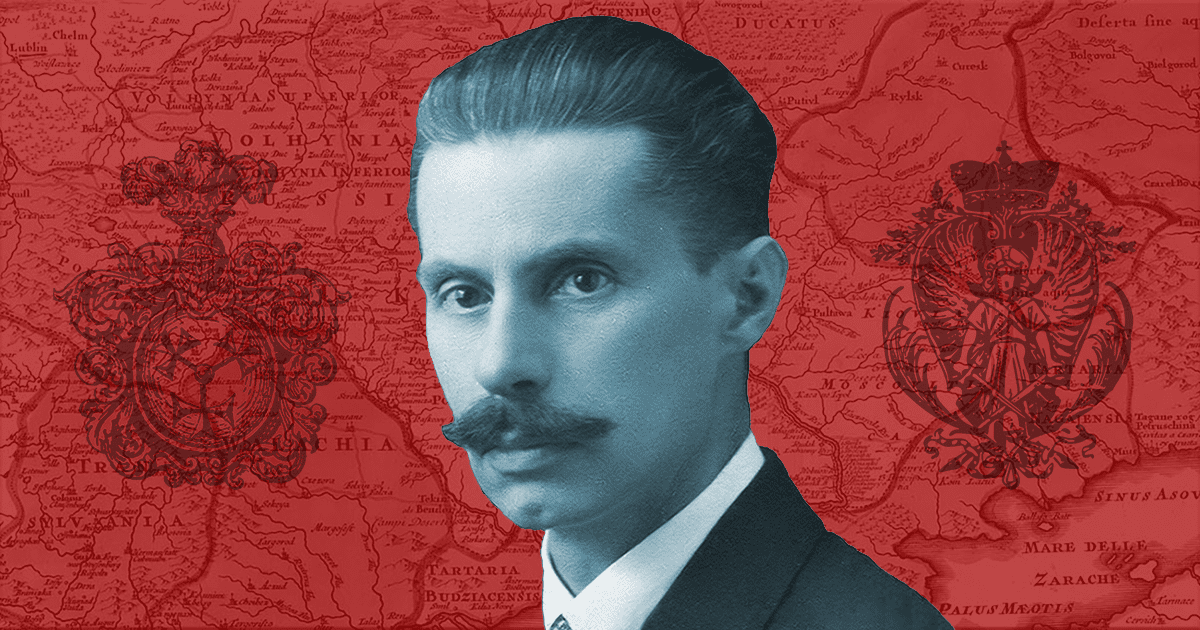
Vyacheslav Lypynsky, a prominent Ukrainian thinker, historian, sociologist, diplomat, philosopher, publicist, and politician, holds a special place in the history of Ukrainian social and political thought. He became one of the leading theorists of Ukrainian conservatism and the founder of the statehood school of national historiography.
Lypynskyi was born in 1882 in Volyn, Ukraine, to a Polish landowning nobleman. He was educated at the First Classical Gymnasium in Kyiv, and later studied at the Jagiellonian University in Krakow, where he majored in agronomy, history, and philosophy. He continued his studies at the Geneva Graduate School of Political Science.
His name is associated with the development of the conservative-monarchist trend in Ukrainian political thought, which was especially widespread in the interwar period among Ukrainian emigrants in Western Ukraine, Europe, Canada, the United States, and Latin America.
In 1917, Lypynsky became one of the founders and ideologues of the Ukrainian Democratic-Agricultural Party (UDHP). During the reign of Pavlo Skoropadskyi, his political concept gained wide support among Ukrainian conservative circles. In 1918, he was appointed ambassador of the Ukrainian state to Austria-Hungary, but after the fall of the Hetmanate and the restoration of the UPR, he refused to cooperate with the social democratic leadership and left the diplomatic service.
In the following years, Lypynsky worked actively in exile. Together with his associates, he founded the Ukrainian Union of Farmers-Statesmen (USKhD) in Vienna, which aimed to restore the Hetmanate and build an independent Ukrainian state. His scientific work was aimed at developing a conservative ideology based on the idea of a monarchical system.
The scholar paid special attention to legitimizing the Skoropadsky dynasty as contenders for the Ukrainian throne and justifying their policy in 1918. However, in 1930, as a result of a conflict with the hetman, Lypynsky dissolved the Ukrainian Universalist Congress and, together with Viacheslav Kuchabsky and other like-minded people, founded the Brotherhood of Ukrainian Classical Monarchists. He died in 1931 in Austria.
Intellectual influences and scientific research
Lypynsky’s worldview was shaped by the leading European social theories of the nineteenth and early twentieth centuries. He was largely influenced by the ideas of Georg Hegel, Ludwig Humplowitz, Gustav Le Bon, Gustav Ratzenhofer, Friedrich Ratzel, Franz Oppenheimer, and Polish conservative historians whom he met while studying in Krakow, one of the centers of European conservatism.
The ideas of Mykola Mikhnovsky, a theorist of Ukrainian nationalism, played an important role in shaping Lypynsky’s national consciousness. This influence was reflected in his independent stance and the founding of the stateist school of Ukrainian historiography, which still dominates the field. He also studied the elite theories of Gaetano Mosca, Wilfredo Pareto, and Robert Michels, which influenced his concept of classocracy and his idea of a national aristocracy.
Researchers emphasize that his writings combine features of positivism, neo-romantic irrationalism, vitalism, elements of social mechanics by Emile Durkheim, rationalism by Max Weber, and the ideas of French sociologist Georges Sorel. It was from Sorel that Lypynsky borrowed ideas about the role of social myths, intellectuals, and democracy. His intellectual search was not only academic but also synthetic, combining scientific, cultural, political, and ideological dimensions.
Farmers’ ideology and classocracy
Among Lypynsky’s key ideas was the justification of the special role of the Ukrainian peasantry as the nation’s nucleus. He believed that the future state should be built on the farming class, because the agrarian ideology was organic and close to the Ukrainian people, who had lived in agricultural culture for centuries. This ideology, in his opinion, could ensure the stability of economic development and the preservation of national identity.
The central concept of his political theory was “classocracy,” a form of government that provided for a balance between power and freedom. The state was to be headed by a hereditary monarch, the hetman. Lypynsky contrasted classocracy with democracy and ochlocracy, believing that only it could guarantee freedom and order. He did not deny either personal or political freedoms, but believed that they should exist within a stable government.
Classocracy envisaged the division of society into productive classes, among which a special place belonged to farmers. The leading role in the state was to be played by the “national aristocracy”-an elite based not on hereditary privileges but on moral authority, loyalty to national and religious values, and the ability to organize society. As an example of classocracy, Lipinski often cited England, where, in his opinion, this system was most fully manifested.
Significance for Ukrainian political thought
Vyacheslav Lypynsky’s political concept was distinguished by its originality, intellectual depth, and innovation. He developed a model of government that combined monarchical power with the preservation of civil liberties, national culture, and the moral foundations of society. His doctrine became one of the cornerstones of Ukrainian conservatism and had a significant impact on social and political thought both in Ukraine and in the emigration community.
Author: Valeriy Maydanyuk