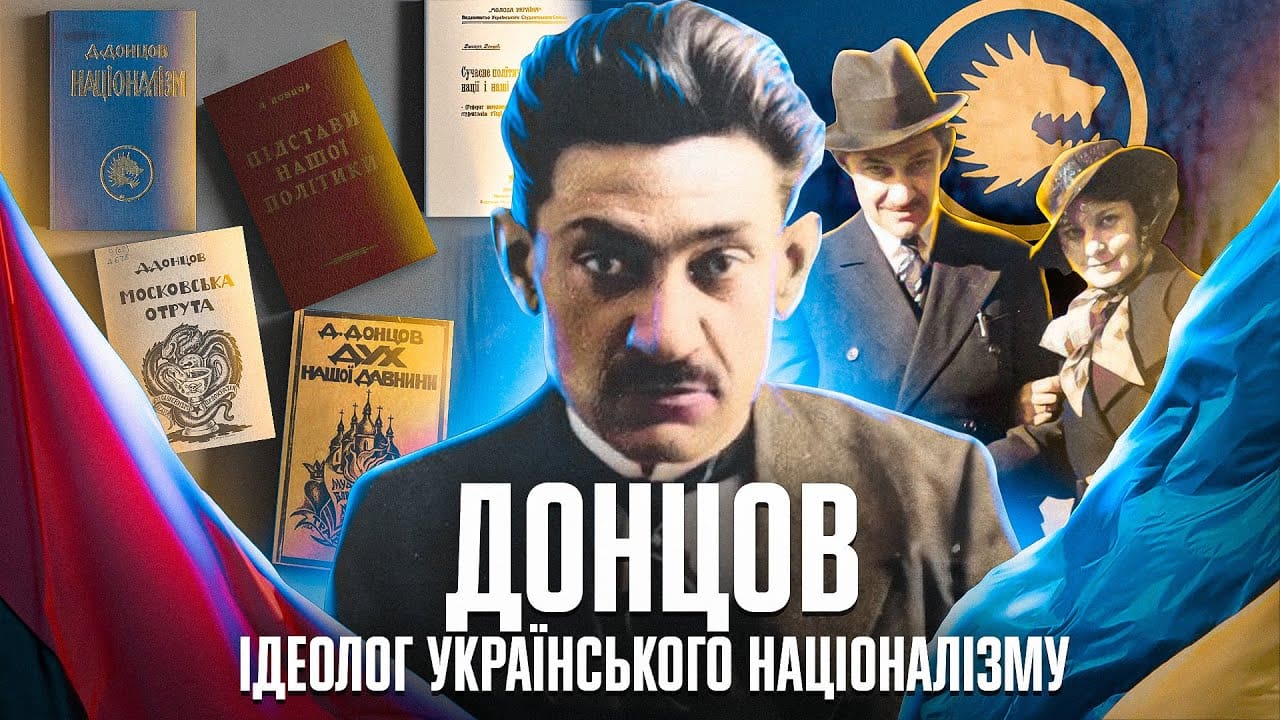
To the reader of this short article, I offer my thoughts on Drahomanov and Dontsov, their teachings, the followers of these teachings, and most importantly, what doctrine the Ukrainian people should take as their compass today, when the threat of extinction and Moscow slavery hangs over them once again.
If we briefly describe the “science” of of Dontsov and Drahomanov, or rather their polarized worldviews, the basis of Dontsov’s worldview and “science” Dontsov’s worldview and “science” is the will, and Drahomanov’s is the mind. Dontsov is the ardent desire of a spiritual man, while Drahomanov is a cooled-down rationalism.
It would seem that today, reason, intelligence, and calculation are the most important worldview foundations of any person. The foundations that significantly improve the quality of human life and cognition. The foundations that bring different nations to a common denominator, making wars impossible, because the logic is common to all – this is Drahomanov’s worldview. Indeed, it is pointless to deny the contribution of intelligence and analysis to the development of human life. But it is one thing to use intellect in schools, academies, in the study of the structure and structure of any matter, and this list can go on for a long time. But it is another thing to transfer the laws of logic, analysis and calculation as the basis for the birth, formation and survival of a nation, which is exactly what Drahomanov did, giving rise to a whole galaxy of his followers who led the Ukrainian nation to slavery and destruction, both physically and spiritually.
Looking back, we see that history is not made by analysts and rationalists who calculate probabilities, pragmatic benefits, or simply engage in passive philosophical observation, but by people who have a great and unquenchable “want” – I want freedom, I want empire, I want power, etc. And if this “I want” is strong enough and comes from the deepest and brightest corners of the human soul, then it breaks through the thickness of the “most objective impossibilities” that the logical mind tells us about.
I will not describe these examples in detail, but will simply list them: the formation of monarchies and empires (the Macedonian Empire, the Ottoman Empire, Napoleon’s French Empire, the Moscow Empire-USSR, etc.); the destruction of the ancient monarchies that once dominated Europe and which had all the power of national movements, etc. The creation of all these empires out of “nothing” is possible only thanks to the irrational “want” that the Macedonians, Ottomans, Napoleon, Ivan the Terrible, Peter the Great, Lenin, and Stalin had.
The destruction of these empires and the seemingly “unchanging” order that they created was also the result of an irrational, volitional “want.” Their creation and destruction is impossible from the point of view of “laboratory” analysis, but from the point of view of the willful “I want”-it is absolutely possible. That is why Dontsov lays the foundation for the national worldview in the will-the creative and ardent desire to create and fight, rather than passive observation and analysis, which says that your deepest spiritual aspirations are “impossible” to satisfy, so you have to adapt and not demand the “impossible”-this was the main slogan of Drahomanov and his “apostles.” From their worldview emerged the state ideal, as Dontsov so aptly puts it, of a “cheerful and happy slave nation under the wings of a conquering nation.”
From this “science” follows – quite logically – the idea of a federation and changing the evil nature of Muscovites by “magic science,” logic, common sense, humanism, etc. And the “leaders” of the Ukrainian nation poisoned by this “science” in the twentieth century tried to realize these ideals in a poor way, but the leaders of the Muscovites and Poles-unlike ours-were guided by a real life-historical “science”-the willful “I want,” so they won and we lost. We can see that Drahomanov’s worldview and his ideas failed.
But to whom does the Ukrainian nation owe its state and freedom today? To those who wanted national freedom, but did not prove its relevance or possibility. Not to Hrushevsky, Vynnychenko, Efremov, or Drahomanov, but to Shevchenko, Lesia Ukrainka, OUN members, UPI members, numerous dissidents, and writers who realized Dontsov’s ideals-who put the Ukrainian willful “I want” above all else, without dampening or weakening it with any mental sanctions.
I emphasize that logic, rationalism, analysis, and observation are not harmful things in a worldview. However, when it comes to the nation and its life, the basis of the national worldview should be the will. Dontsov’s reason and analysis are guided by the will and “want,” while Drahomanov’s is the opposite: reason guides the will and “want,” giving it sanction or justification.
Therefore, to summarize, it is obvious that Dontsov’s strong-willed worldview should be a compass for us in this struggle for national life, as it is crystallized from the ideals of Shevchenko, Lesya Ukrainka, and other writers, from the Ukrainian unrestrained “I want,” from the historical experience of mankind. And it is this worldview that raised the UPA-UN generation, which is a spiritual and ideological model for our army today in the struggle for its existence, formation and development as a nation.
Author: Maksym Pominchuk