Консервативна Платформа
  • News
    • Analytics
    • Worldview
    • Anti-imperial front
    • Weapons
    • Geopolitics
  • publication
  • Position.
  • Events.
Thursday, August 27, 2026
  • English
    • Ukrainian
Консервативна Платформа
  • News
    • Analytics
    • Worldview
    • Anti-imperial front
    • Weapons
    • Geopolitics
  • publication
  • Position.
  • Events.
Консервативна Платформа
  • News
    • Analytics
    • Worldview
    • Anti-imperial front
    • Weapons
    • Geopolitics
  • publication
  • Position.
  • Events.
Copyright 2021 - All Right Reserved
Analytics

Elite vs. Ukrainians

від Майданюк Валерій November 30, 2024

There is not a single successful country or society where the common good was achieved without a moral and responsible elite. The sooner Ukrainians realize this, the sooner we will begin to build an effective state.

One of the characteristic features of conservatism and, ultimately, of Christian democracy is the emphasis on the decisive role of the elite in society. But elitism here should not be perceived as the domination of the greedy rich over the working people, as it is often presented in leftist distortions of this rational and sober thought. Take a simple meeting of a class, a student group, a condominium, or a work team, and everywhere and always any activity aimed at the common good will be impossible without an initiative minority, without leadership. On the scale of a community or a state, this will be the political elite, with whom Ukrainians have not always been lucky, but we are not the only ones. But without the leadership role of the elite, which rules under the people’s mandate, neither the state nor the nation can develop.

For Ukrainians, this is a huge problem, because the problem of the quality of the Ukrainian elite is one of the most acute, although its roots lie in the real prevailing values of the Ukrainian people, who have been living by specific life guidelines since the 1990s. If personal enrichment at any cost or violation of the law is a cause for praise and is not condemned by the environment or even society, then it is not surprising that each new wave of elite will be the same as the previous one.

But in our country, there are already centers with fundamentally different values, on the basis of which a new Ukrainian elite can be elected to power. But for this to happen, it is necessary that the voters who will give the government a mandate choose candidates who promise fair rules for everyone, instead of those who gave a ball of buckwheat and brought a KAMAZ truckload of gravel to a village street.

One of the deepest problems of Ukrainian state-building is that a significant part of Ukrainians perceive the elite as a priori something alien and anti-national, believing that the “deep people” will solve all problems themselves. Although this opinion can only be held by those who have never done anything of social importance, this idea has already led to severe social disasters.

In December 1918, the socialist-oriented leaders of the Ukrainian People’s Republic approved the so-called “labor principle,” according to which local power was to be vested in councils of workers, peasants, and labor intellectuals. The bourgeoisie was deprived of voting rights, effectively excluding the elites from the process of state-building. Given the catastrophic level of literacy among peasants, workers, and soldiers of the time, the threat of populism was even greater than the Moscow-Bolshevik invasion.

As a result, the very next month, the Directory lost the capital of Ukraine and was unable to organize the army, defense, overcome atamanism and introduce discipline, etc. And then the Bolsheviks came and introduced repression, famines, and further Russification. 100 years ago, Ukrainians disliked their elites so much that they were forced to grovel before others who were much worse.

For conservatives, the elite is the engine that sets the vector of development due to its education, experience in managing people, and moral qualities based on responsibility to society. Ukrainian historian Roman Lekhniuk notes that the way out of Ukraine’s current situation is not to reject elites as such, but to create conditions under which a qualitatively new elite with social elevators that function not according to paternalistic ties but according to the criterion of efficiency for society can be formed.

Ukrainians should remember that their own state is difficult to gain, but very easy to lose. Especially considering our neighbors. But your own state, even if imperfect, is always better than someone else’s. At least because Ukrainians can always force their government to take into account the opinion of the people.

Author: Valeriy Maydanyuk
November 30, 2024
FacebookTwitterLinkedinWhatsappTelegramViberEmail
Internal front

“Hands off the GUR and Budanov” – Ukraine’s first chief of military intelligence reacts harshly to attempts to change the agency

від Юрій Гончаренко November 30, 2024

Lieutenant General Oleksandr Skipalskyi, the first Chief of the Defence Intelligence of Ukraine (1992-1997), warned against attempts to change the leadership of the DIU, calling it a planned influence of the Russian agent network. According to him, the agent network of the aggressor country still has the ability to influence the state structures of Ukraine.

He said this in an interview with OBOZ.UA.

“Which structure do you think is the most annoying for Russia? Most of all, military intelligence. The agent network is working, and after 5-10 broadcasts, there is someone who believes in the rightness of the message and starts making statements that it is necessary to change the structure of the DIU and deal a devastating blow to the military intelligence system,” – explained the lieutenant general.

According to Skipalsky, the current head of the DIU, Kyrylo Budanov, is envied because of his young age and achievements. “They say, how come Budanov is being honored, while I, also a general, am not,” – he said.

“I have seen the first wave of media coverage of Kirill Budanov. In my opinion, this is a person who is in the right place. It is such a young combat general who should lead such an important structure as the Defence Intelligence of Ukraine in times of war,” – emphasized Skipalsky.

The first head of the DIU also reminded that Ukrainian military intelligence is based on the principles of American and European intelligence services and does not imply totalitarian influence.

“As a person who contributed to laying the foundations on which the Ukrainian military intelligence successfully fulfills its tasks, I have the moral right to say: hands off the GUR and Kyrylo Budanov,” – emphasized Skipalsky.

Earlier, President Volodymyr Zelenskyy made a “correct statement,” according to Skipalsky, that Budanov “is on the spot and working today.”

“And I think it should be so,” – summarized the first head of Ukraine’s military intelligence.

November 30, 2024
FacebookTwitterLinkedinWhatsappTelegramViberEmail
Ukraine

Survey: Ukrainians trust the GUR the most among all special services

від Юрій Гончаренко November 27, 2024

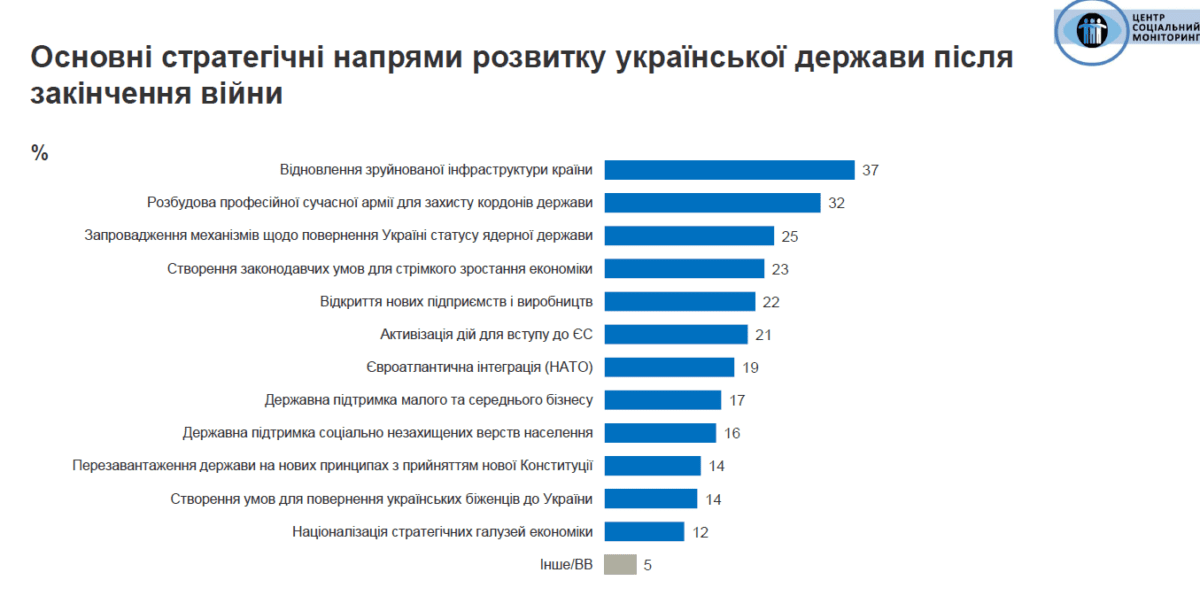
According to a sociological survey conducted by the Social Monitoring Center on November 15-21, the Main Intelligence Directorate enjoys the highest level of trust among Ukraine’s special services.

According to the survey, 61% of respondents trust the PID, 52% trust the SBU, and 37% trust the police. The Armed Forces of Ukraine (90%) and volunteers (80%) have the highest levels of trust.

The performance of the head of the DIU, Kyrylo Budanov, is approved by 65% of respondents.

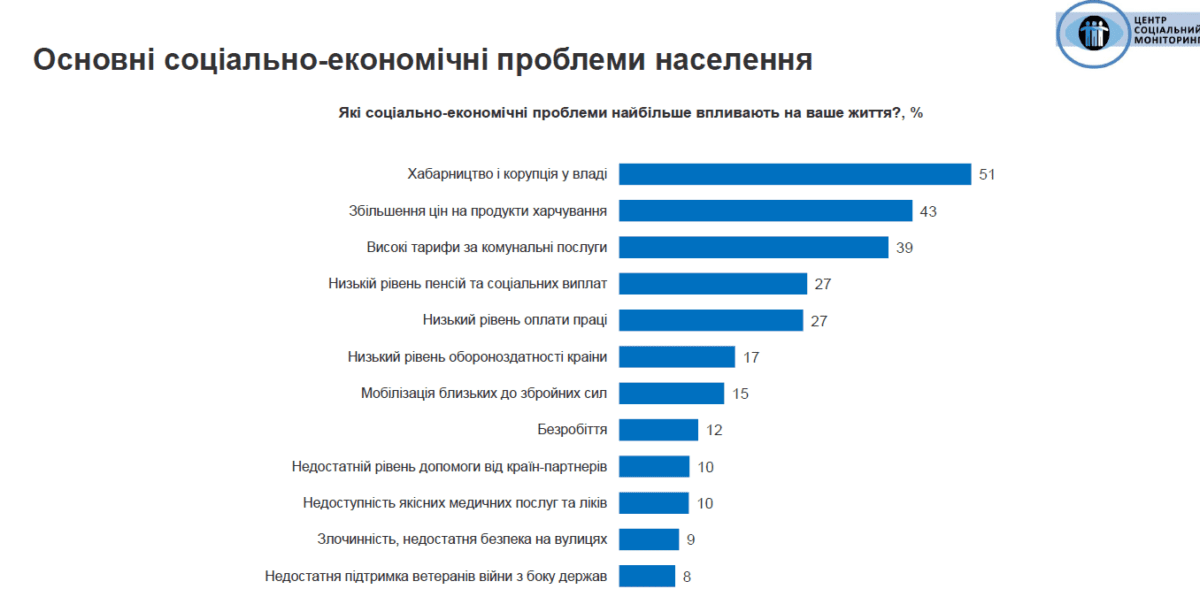
The study also revealed key issues of concern to Ukrainians:

  • Corruption in the government (51%)
  • increase in food prices (43%)
  • High utility tariffs (39%)

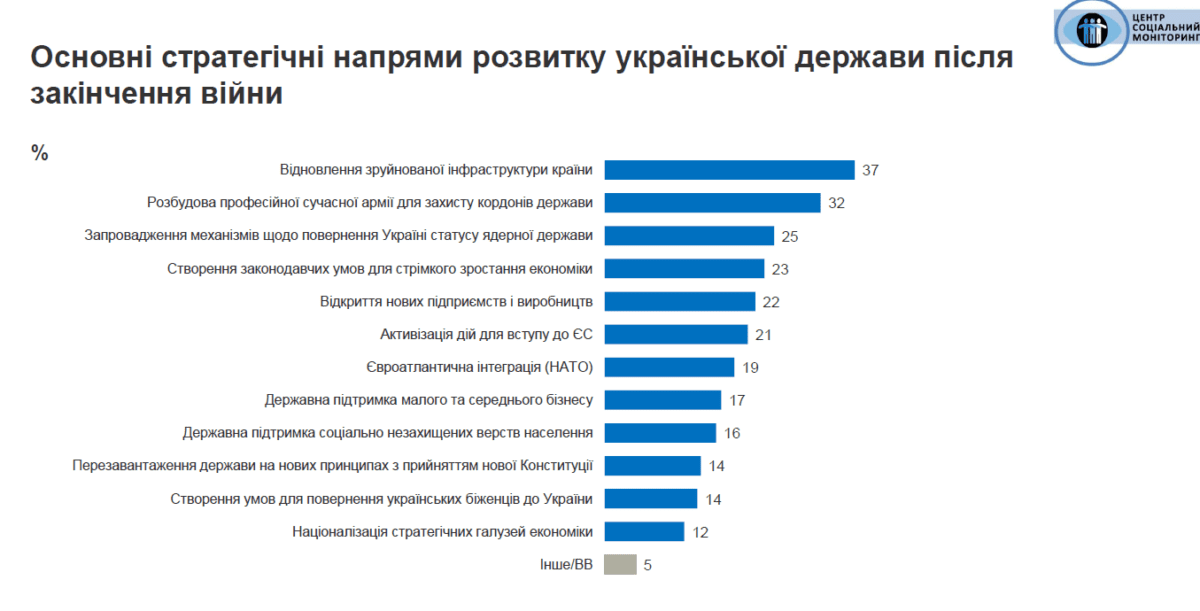
After the war, citizens prioritize the restoration of infrastructure, the development of a modern army, and the return of Ukraine’s nuclear status.

The survey was conducted by the Center for Social Monitoring at the request of American Political Services, LLC. The sample consisted of 1200 respondents interviewed by telephone. The statistical error is 1.8-2.9%.

November 27, 2024
FacebookTwitterLinkedinWhatsappTelegramViberEmail
Analytics

Conservatives and change

від Майданюк Валерій November 24, 2024

One of the popular myths about conservatism spread by opponents of this rational ideology is that conservatives are against change and would like to bring everything back hundreds of years, or even better, to the mammoth era.

The fallacy of this opinion is that conservatism has never denied change, but only insisted on its rational and reasonable nature. For conservatism, changing something unnecessarily, for the sake of change, or even worse, imitating change and inventing “innovations” that make no sense, is worse than not changing at all.

In our history, Ukrainian conservative forces have been perhaps the greatest advocates of change. And Ukraine’s being under the rule of other states turned the struggle to preserve Ukrainian national traditions and identity into a real revolutionary and sometimes radical struggle, in which conservatives were far ahead of liberals or socialists.

The conservatives in Galicia fought for electoral reform in Austria-Hungary and the introduction of universal suffrage, rather than defending the outdated noble-elite system. The Hetmanate of Pavlo Skoropadskyi became a real driver of reforms during its 7.5 months, while the socialist Central Rada managed to issue only 4 station wagons in a year.

During the era of independence, the conservative People’s Movement was a force that fought for change, while it was the communists who wanted to preserve the colonial position of the Ukrainian language, culture, and national status in relation to Erephia. Initiatives to raise the status of the Ukrainian language in the 1990s, conservative in their content, were called “radical,” “extremist,” and whatever else you want to call them. The fact is that if conservatives were in favor of no changes, they would have to demand that the Russian language and the Communist Party remain dominant in Ukraine, as they were before. However, it was the Ukrainian national-democratic conservatives who promoted revolutionary state-building processes at the dawn of independence.

Conservatism advocates change when it is important and indispensable, not just to change things for the sake of change. In Ukraine, as a result of the prevailing bureaucratic and populist procedures, a system was formed whereby every new leader or minister, upon taking office, tried to “change” something to make it visible that they were doing something. Usually, this was limited to changing the names, signs, and “caps” of documents, although it also consumed a lot of Ukrainian taxpayers’ money and man-hours of government agencies that could have been used to better serve the needs of the population.

Thus, the Presidential Administration of Ukraine became the Presidential Secretariat, and today it is called the Presidential Office, but the essence of its powers has not changed at all, despite the name change. The question is: why change it and spend people’s money on these changes? After all, as the “icon” of conservatism Margaret Thatcher said: “The state has no money of its own, only taxpayers’ money.”

Conservatism advocates changes that are truly important for society and rejects the pseudo-change-making that is used by those who seek to change only their financial situation, often at someone else’s expense.

Author: Valeriy Maydanyuk

November 24, 2024
FacebookTwitterLinkedinWhatsappTelegramViberEmail
Important

GUR: Russia was preparing genocide of Ukrainians even before the full-scale invasion

від Юрій Гончаренко November 23, 2024

DIU Chief tells about execution lists and mobile crematoria prepared by occupants

The military and political leadership of Russia deliberately prepared the genocide of the Ukrainian people before the full-scale invasion. The preparations included the creation of execution lists, mobile crematoria, and the planning of mass graves.

This was announced by the Chief of the Defence Intelligence of Ukraine Lieutenant General Kyrylo Budanov during his speech at the forum “Genocidal Practices of the Russian Federation in Ukraine: from the Holodomor to the Russian-Ukrainian War”.

According to the head of military intelligence, the execution lists were to include teachers of the Ukrainian language, literature, history, ATO veterans, journalists, scholars, writers, priests of the OCU and other pro-Ukrainian denominations, public and political figures, heads of state authorities and self-government bodies.

“The genocide of Ukrainians is not only the state policy of the Russian Federation, but also a mandatory public belief, handed down from above,”Kyrylo Budanov emphasized.

The Chief of the Defence Intelligence of Ukraine recalled that back in July 2021, Russian dictator Putin published an article in which he once again denied the right of the Ukrainian nation to exist. After that, “Russian propaganda, the highest state authorities, high-ranking officials and the entire state machine, having received such a blessing from their leader, have repeatedly called for the destruction of Ukrainians.”

“We have seen horrific mass crimes against Ukrainian citizens, the facts of which have become known to the whole world. The atrocities committed by the Russian armed forces in Borodyanka, Bucha, Gostomel, Izyum, Mariupol and many other Ukrainian cities and towns showed that these identical and synchronized actions were based on clear doctrinal provisions of the Russian genocidal policy of the authorities and military leadership,”summarized Kyrylo Budanov.

The forum “Genocidal Practices of the Russian Federation in Ukraine: From the Holodomor to the Russian-Ukrainian War” was held on November 22. The forum was attended by Holodomor researchers, historians, members of the public, and foreign guests.

November 23, 2024
FacebookTwitterLinkedinWhatsappTelegramViberEmail
Analytics

Conservatism as a reaction to the guillotine

від Майданюк Валерій November 23, 2024

Conservatism emerged as a reaction to the French Revolution, which began under the slogans of liberty, equality, and fraternity and ended in revolutionary terror and the guillotine.

At first, everyone liked the republican-democratic ideas, and even Joseph de Mestre (1754-1821), one of the most gifted thinkers of his time, was a supporter of liberal ideas before the Jacobin dictatorship and only later switched to conservatism. When the revolutionaries began to look for enemies everywhere, and at the peak of the revolutionary struggle executed up to 60 people a day, it became clear to many that good intentions had gone a little wrong.

It is believed that during the French Revolution, 15,000 people were executed on guillotines in public. The French revolutionary army, going on a campaign against the rebels, carried with them camping guillotines. Scientists of the time believed that a severed head lived for another 5 to 10 seconds. Therefore, the executioner would take the severed head and show it to an ecstatic crowd so that the executed person could see how the public was laughing at him.

No one could feel safe and be sure that they would not be caught for any offenses before the revolution. One of the most prominent intellectuals, the Marquis de Condorcet, was arrested for ordering a six-egg omelette in a cafe while traveling under an assumed name, which seemed suspicious to the owner of the establishment, who called the “people’s police.” It is not surprising that in such circumstances many people realized the falsity of such “democracy” and began to rethink the need to preserve rather than destroy. This is how conservatism began to take shape as a reaction to the guillotine and the destruction of revolutionary terror.

Of course, some conservative figures advocated the preservation of the monarchy and noble privileges, some hid behind the “divine order,” but others quite rightly pointed out that neither the old discredited and unjust orders nor the new “democratic-guillotine” ones, which had little in common with true democracy and declared human rights, were acceptable.

Conservatism as a worldview ideological system was based on political principles that were opposite to the understanding of democracy at the time. Western European and American conservatism (J. Adams, O. Branson, B. Disraeli, A. de Tocqueville) was then characterized by a critical attitude to democracy and liberal values, emphasizing its shortcomings, in particular, the incompetence of the people in governing the state and the mercantilism of democratic demagogue leaders, the dangers of fraud and corruption in the electoral process. The conservatism of that time emphasized the priority of the collective, society, and the state, adhering to the concept of the imperfection of human nature, the incompetence of ordinary citizens, and the harmfulness of excessive individual freedom.

But times have changed, and conservatism has not only become, but today remains, perhaps the only defender of true, authentic democracy: freedom of speech, equality of citizens regardless of privilege, and equal political representation.

The current results of the U.S. presidential election were also a reaction to the destruction of traditional values by ideas of pseudo-equality, privileging certain groups, or “new-speak,” to use George Orwell’s apt words. Guillotines are not yet used, but the number of people punished and “kenneled” in violation of the Constitution for leftist “thought crimes,” for “wrong” thoughts and statements, and for posts on social media has also become significant.

When a minority imposes its incomprehensible will on society, when someone else’s values are imposed, when they pretend to be victims, but in fact the majority are victims, then conservatism emerges as a reaction to destruction and the instinct for self-preservation of society.

Author: Valeriy Maydanyuk

November 23, 2024
FacebookTwitterLinkedinWhatsappTelegramViberEmail
Events.

Elections in time of war: challenges and possible solutions

від Юрій Гончаренко November 22, 2024

On the need to prepare a legislative framework for holding elections after and even during the war was discussed Yuriy Goncharenko, Head of the Research and Analytical Group at InfoLight.UA, spoke about the need to prepare the legislation for elections after the war and even afterwards in the Ukrainian Experts Talks podcast .

Discussions about the possibility of holding elections under martial law are becoming increasingly relevant. In the context of Russian aggression, the issue of holding elections in Ukraine faces unprecedented challenges. Especially given the recent political events – the President’s speech in the Verkhovna Rada, which many experts perceived as pre-election, and the announced social payments, which have signs of populist steps. Society needs honest answers about the government’s plans and the country’s future.

“We have to find a balance between preserving democratic principles and taking into account the realities of wartime. If we don’t start working on the relevant legislation now, in the future we may find ourselves in a situation where elections will be necessary, but the legal framework for this is absent or imperfect ,” Yuriy Goncharenko said in a conversation with the podcast hosts.

In the context of Russian aggression, the issue of holding elections in Ukraine is becoming particularly acute and relevant. Especially given the recent political developments – the President’s speech in the Verkhovna Rada, which many experts perceived as a pre-election speech, and the announced social payments, which have signs of populist steps. Society needs honest answers about the government’s plans and the country’s future.

Ukraine must be prepared for a long war that could last for years. According to the expert, our goal is not just a temporary cessation of hostilities, but the complete elimination of the threat from Russia forever. This ambitious task requires not only military resilience, but also the preservation of the state’s democratic institutions, including the electoral system.

The development of new electoral legislation is not just a possibility, but a necessity. The issue of the lack of a legal framework for holding elections in the post-war period is particularly acute. For example, if martial law ends in February 2025, the state will be forced to immediately announce regular elections. However, with the existing regulatory framework, they cannot be organized in the first 6-9 months after the end of hostilities.

Among the main challenges of holding elections in a time of war, Honcharenko highlights ensuring the physical security of voters and election commissioners, organizing voting for military personnel on the job, creating mechanisms for voting for internally displaced persons and refugees, and countering disinformation and cyberattacks.

The expert believes that the best solution is to introduce a mixed voting system that combines traditional polling stations with elements of electronic voting. At the same time, it is important to audit the existing electoral infrastructure and adapt it to the conditions of martial law.

When drafting the relevant legislation, international experience should be taken into account, in particular Israel’s practice of organizing voting for military personnel and the experience of the Balkan countries in ensuring the participation of refugees in elections. According to the expert, it will take at least 3-5 months of intensive work to prepare a full-fledged legislative and technical framework.

Preparing for the possible holding of elections in a time of war is a complex but necessary process that demonstrates to the world our unwavering commitment to democratic values even in the most difficult conditions, emphasized Honcharenko. In the context of rising political tensions and populist initiatives, it is especially important to maintain transparency of the process and public confidence in democratic institutions. Ukraine must continue the struggle until complete victory, while preserving its democratic essence.

November 22, 2024
FacebookTwitterLinkedinWhatsappTelegramViberEmail
Analytics

The principle of imperfection

від Майданюк Валерій November 18, 2024

Conservatism is perhaps the only ideology that does not idealize a person, does not try to make him or her an ideal citizen, and does not force society to be perfect.

Conservatives are guided by the principle of the imperfection of human nature, realize that every person has some flaws, passions and sins, and treat this with understanding, not looking for perfection. For conservatives, the phrase “even the sun has spots” is not just about the celestial body. The Communists tried to force people to be selfless, to work selflessly in Komsomol units for rations and to dream of the success of socialism. And when they failed, the USSR was plagued by corruption, fraudsters, speculators, crime, and sycophancy. And then communist idealists tried to re-educate people through repression, famines, and gulags.

Contemporary left-liberals and leftist movements fight against what they themselves consider latent or overt manifestations of intolerance, censor hate speech, fight for the correct use of feminine terms, and hate those who cannot understand the importance of their ideas. And yet studies show that in no country in the world has 100% of the population become tolerant, equal, and inclusive. Even in Denmark and Sweden, countries that are considered to be the flagships of feminism, gender experts say that women’s rights are only 80-90% protected. For some reason, in this reality, there is not a single society that has reached the level of tolerance ideals sought by left-liberal activists.

Neither fascists, nor environmentalists, nor communists, nor liberals have yet succeeded in forcing people to stop being selfish creatures, to get rid of their stereotypes and desires, and to start serving the ideals of the perfect society they have constructed. Strange, isn’t it?

Such lofty ideas, imbued with the public good, but for some reason they are still unattainable.

The United States is still fighting racism, Sweden is still fighting patriarchy, and the Netherlands is still fighting homophobia, and the struggle is still ongoing, with no end in sight. It seems that the activists of the above ideologies themselves do not believe that their ideas can be implemented 100%, but no one will say so out loud. And if a person remains imperfect, then no ideal social order can be created.

Conservatives are the only ones who do not rape human nature and do not demand that citizens be inclusive, diverse, tolerant, selfless, or conform to the purity of a race. According to conservatives, humanity will never become the way adherents of social utopias see it. And forcing people to follow the utopia means killing millions of “different” people who do not meet the standards of utopianism. Lenin and Stalin exterminated kulaks, the bourgeoisie, and “enemies of the people,” while in modern Iran they are trying to force women to hide under veils, and in Cuba communism has been completed to the point of total blackout and no one is allowed to leave the “island of freedom.”

Conservatives are convinced that it is best not to pursue any perfect utopia, but to build a relatively orderly, just and as free a society as possible, in which poverty, inequality and injustice will not disappear, but their manifestations will be minimized by fair state and social regulation.

Of course, there will always be dissatisfied minorities: for example, quadroberts may be unhappy with the parliamentary representation quota, and others may complain about the lack of respect for their identity. But the basic provisions of the Declaration of Human Rights and Freedoms are a sufficient framework for human and social development.

By implementing sensible reforms, society can preserve and improve an imperfect but tolerable order. Instead, those who promised the perfection of man and society turned their countries into ruins and hell. Conservatism does not force people to be perfect and does not kill anyone for it.

Author: Valeriy Maydanyuk

November 18, 2024
FacebookTwitterLinkedinWhatsappTelegramViberEmail
Analytics

Trump’s team: who will work with Ukraine?

від Майданюк Валерій November 16, 2024

Donald Trump is forming his cabinet and selecting members of the team that will lead the US domestic and foreign policy tomorrow. Therefore, it is particularly important for us to know who in the team of the new owner of the White House will deal with issues related to Ukraine.

The electoral advantage of the Republicans in Congress, the Senate and the White House allows Trump to gain full power and freedom to make decisions and appoint his preferred candidates. Trump chose Florida Republican Senator Mark Rubio as his candidate for Secretary of State, who has previously supported assistance to Ukraine and even criticized his fellow party members for doubting the continuation of assistance to our country. The new Secretary of State still has to be confirmed by Congress in January 2025, but given the Republican advantage in the U.S. Senate, his nomination should be voted on without any complications.

But in recent years, Rubio has expressed skeptical rhetoric about the nature of the Russian-Ukrainian war, and in April he did not support a bill to allocate $61 billion to support Ukraine. At the same time, Rubio has been ambiguous about how to end the war, calling Ukraine’s struggle for independence against the Russian occupiers a “stalemate war.”

“I think that Ukrainians have been incredibly brave and strong when they have stood up to Russia. But, at the end of the day, what we are funding here is a stalemate war, and it has to be brought to an end. I think there should be common sense here. You don’t have to be a fan of Vladimir Putin to want the war to end,” Rubio said.

Trump chose Michael Walz as his National Security Advisor, who has taken a tough stance on China and Russia. Last year, when Walz visited Kyiv, he criticized Biden for the slow pace of deliveries and tweeted that Ukraine should have had weapons before the war, not the second year after it began. Walz is considered to be a hawkish candidate who demands to counteract Russia and China, pointing out their aggressive intentions towards the West and the United States as the leader of the democratic world. With such candidates, US foreign policy has a chance to become more decisive and stronger.

Trump may appoint Brian Hook, a career diplomat who is called a “hawk” and a critic of Iran, as a special representative for negotiations to “end the Russian-Ukrainian war.” Brian Hook, 56, a lawyer by training, worked in the Republican administrations of George W. Bush and Donald Trump. He was responsible for the Iranian direction: he was the head of the interagency sanctions coordination group, supported the withdrawal from the Iranian nuclear deal and the operation to eliminate Iranian General Qassem Soleimani. Currently, the powers of the US special representative are not clearly defined, but the press claims that the main task of such a potential appointment is to fulfill Trump’s promise to end the war quickly.

At the same time, a problematic aspect of Trump’s personnel policy was the initiative to appoint Tulsi Gabbard, a politician and former US Army reserve officer who repeated Russian propaganda, as Director of National Intelligence. In 2022, she left the Democratic Party, calling it an “elite cabal of warmongers,” and joined the Republicans a month before the presidential election.

Tulsi Gabbard is known for her position against providing military assistance to our country. Moreover, in 2022, the Center for Countering Disinformation at the National Security and Defense Council claimed that Tulsi Gabbard was working for a foreign audience for the Kremlin’s money. For example, she claimed that “the United States is guilty of military aggression” against Russia, “provoked” the aggressor for many years, and “the ruling elite of Washington wants to kill as many Russians as possible with the help of Ukrainians.”

On the air of the American Fox News channel, which supports Trump, Tulsi Gabbard spread Russian propaganda theses about weapons of mass destruction in Ukrainian biolabs. In 2018, Gabbard accused Poland and Ukraine of anti-Semitism, glorification of Nazism, and Holocaust denial. However, the Association of Jewish Communities (AJC) rejected these accusations and called Gabbard’s words “anti-Ukrainian defamation” used by the Russians.

Hubbard even met secretly with Syrian dictator Bashar al-Assad, whom she called a “fact-finding mission” and refused to call Assad a war criminal. The appointment of such an intelligence candidate is a serious problem for a successful confrontation with the Russian aggressor, unless Trump changes his choice or Gabbard changes her position.

The new potential team of Donald Trump’s administration, which still needs to be confirmed in the Capitol, is made up of candidates who do not agree on the vision of US foreign policy. Some of Trump’s nominees take a completely correct, conservative and pro-Western position, some want the war to end as soon as possible, and some have been found to be spreading Russian propaganda, unless this can be attributed to populist rhetoric for the sake of ratings. But no matter who works in the US State Department, the decisive influence on the course of our struggle for independence depends on the Armed Forces, the crisis management abilities of the current Ukrainian government, and the resilience of the Ukrainian nation.

Author: Valeriy Maydanyuk

November 16, 2024
FacebookTwitterLinkedinWhatsappTelegramViberEmail
Analytics

Will the German Christian Democrats return to power?

від Майданюк Валерій November 15, 2024

The recent governmental crisis in Germany could return power to the Christian Democrats, who remain the most popular party in the country.

Germany’s de facto three-party ruling coalition of the Social Democrats, the Greens and the Free Democrats has ceased to exist after Chancellor Olaf Scholz announced that he would dismiss the “Free Democrat” Finance Minister Christian Lindner due to persistent disagreements over spending and economic reforms. The “traffic light” coalition, which was named after the main colors of the parties – red (Social Democrats), green (obviously) and yellow (Free Democrats) – is ceasing to exist.

The disagreement in the coalition arose from the position of the Free Democrats’ Finance Minister Lindner, who insisted that the government stick to austerity and tax cuts, while the Social Democrats wanted to maintain social spending and support German industry with economic incentives. Lindner demanded liberal economic reforms, tax cuts, and curtailment of climate policy to stimulate economic growth, but such provisions contradicted the policies of the Greens and the SPD. Chancellor Scholz was dissatisfied with this approach of the finance minister and criticized his “frugality” in helping Ukraine, but Lindner refused to “break his oath.”

The dismissal of the finance minister removes the Free Democratic Party from the government coalition and forces Chancellor Scholz to call a vote of confidence in parliament, which is scheduled for January 15. If the incumbent chancellor loses this vote – and the rival parties and the Free Democrats are unlikely to support the government’s policies – early elections will be held as early as March 2025.

There is also a possibility that within 21 days the parliamentary parties will form a new majority, the government coalition will attract another party to the partnership, and the MPs will approve a new chancellor.

Given that the Free Democrats currently have a rating of about 4%, which does not allow them to enter the Bundestag, the parliamentary future of the German liberals remains in doubt.

Early elections are likely to bring to power a new government led by the CDU/CSU, which is currently leading in opinion polls by a wide margin. In recent years, the German Christian Democrats have moved to a more center-right position on migration and have also advocated for more military aid to Ukraine.

Author: Valeriy Maydanyuk

November 15, 2024
FacebookTwitterLinkedinWhatsappTelegramViberEmail
Новіші
Старіші

ВАЖЛИВЕ

Who forms the “hawkish” wing of the US...

January 22, 2026

Stepan Tomashivsky is a conservative who warned of...

December 28, 2025

A Pole who believed in Ukraine earlier than...

December 26, 2025

Being yourself and not pretending: how conservatism is...

December 10, 2025

MAGA as a new ideology of American conservatism

December 7, 2025

UKRAINIAN EXPERTS TALKS’S PODCAST

Новини

  • The Conservative Platform has gathered the best scholars to launch a systematic work on debunking Russian myths

    December 1, 2025
  • Budanov has a sober view of geopolitics and leads an effective team – blogger

    July 3, 2025
  • CDU/CSU leader pays support visit to Kyiv

    December 9, 2024
  • With the help of Russia, the Taliban wants to build an air defense of Afghanistan

    September 11, 2024
  • Americans to deploy Typhon missiles capable of reaching Russia on Japanese islands – media

    September 10, 2024
Назад Вперед

Спротив.News

«
Prev
1
/
213
Next
»
loading
play
Мінуснули три мости за раз! Сили оборони ламають логістику окупантів на ТОТ!
play
Крим переходить у режим ізоляції? Окупанти скасовують масові заходи до 1 вересня!
play
«Гордість, Єдність, Мрія»? Як РФ перетворює День молоді на ТОТ на шоу пропаганди
«
Prev
1
/
213
Next
»
loading

Реалізується ГО Фонд сприяння демократії за підтримки Фонду Ганнса Зайделя в Україні

Copyright © 2017 Фонд сприяння демократії Наші Політика конфіденційності,  Умови використання сайту
Facebook Youtube Telegram Spotify Instagram Linkedin
Консервативна Платформа
  • News
    • Analytics
    • Worldview
    • Anti-imperial front
    • Weapons
    • Geopolitics
  • publication
  • Position.
  • Events.

Shopping Cart

Close

No products in the cart.

Close
  • Українська (Ukrainian)
  • English