Консервативна Платформа
  • News
    • Analytics
    • Worldview
    • Anti-imperial front
    • Weapons
    • Geopolitics
  • publication
  • Position.
  • Events.
Friday, August 28, 2026
  • English
    • Ukrainian
Консервативна Платформа
  • News
    • Analytics
    • Worldview
    • Anti-imperial front
    • Weapons
    • Geopolitics
  • publication
  • Position.
  • Events.
Консервативна Платформа
  • News
    • Analytics
    • Worldview
    • Anti-imperial front
    • Weapons
    • Geopolitics
  • publication
  • Position.
  • Events.
Copyright 2021 - All Right Reserved
in Russia

Russia sends young Africans to the front to die in the war against Ukraine

від Савицький Олексій June 10, 2024

Russians are sending young Africans to the frontline in Ukraine, threatening to deport them from Russia if they don’t, Bloomberg reports, citing European officials.

The Kremlin has forced thousands of migrants and foreign students to fight alongside Russian troops in Ukraine, joining the ranks of the offensive forces in Kharkiv region, according to European officials.

According to sources, the Russian authorities have already forced thousands of Africans to travel to Ukraine. Increasingly, they are threatened with not renewing their visas unless they agree to join the army. The journalists note that Russian special services have also detained Africans who were in Russia on work visas, and they were forced to choose between being deported or signing a contract with the Defense Ministry.

The newspaper reports that according to Ukrainian intelligence, Russia is conducting a global campaign to recruit foreign mercenaries in at least 21 countries, including several in Africa. The recruitment campaigns offer potential contractors large bonuses and salaries. Recruiters also targeted migrants and students who had previously sought work in Russia. In some cases, they were lured with promises of good jobs and then forced to undergo training and go to the front.

A senior Ukrainian official said that the number of foreign fighters among the prisoners has increased. According to him, Africans and Nepalese are particularly common.

Earlier this year, the Kathmandu government said it was aware of about 400 young Nepali men who had been recruited by Russia, but many more had likely registered without the government’s knowledge. India’s decision to stop recruiting Nepalese Gurkhas into its army, ending a 200-year tradition, may have prompted Nepalis to seek work in Russia and other countries.

According to Evgeny Primakov, head of Rossotrudnichestvo, 35-37 thousand African students are currently studying in Russia.

“Every year we attract about 6,500 students from Africa to study in Russia for free,” he said at the St. Petersburg International Economic Forum.


June 10, 2024
FacebookTwitterLinkedinWhatsappTelegramViberEmail
Analytics

Social policy: Christian Democrats for the people

від Майданюк Валерій June 9, 2024

According to the former French socialist prime minister Guy Mollet, the Christian democratic movement as a political force “should not exist at all” because of the significant heterogeneity of its social composition: a combination of both employers and workers. However, it is precisely this diversity that is the secret of success and one of the strongest points of Christian democracy, which retains the ability to gain support from all social groups.

When elections to the Bundestag were held in Germany in December 1990 for the first time since the country’s reunification, the CDU/CSU bloc won the support of the electorate, which in sociological terms corresponded to the demographics of all social groups and classes. Such cross-class Christian democracy persists in other countries, including Latin America.

Such values of Christian democracy as responsibility, which implies the priority of the common good, subsidiarity, which implies that the state authorities should not interfere in the affairs of local communities without asking for such assistance, and solidarity based on the principle of “One for all, all for one” are the basis of Christian democratic social policy.

It is complemented by respect for work and its results, social justice, and a social market economy. The latter is an invention of Christian democrats. According to its principles, economic policy should be regulated by the state, not just by the laws of the market. The state should support not only large corporations, but also the middle class and small owners. The redistribution of social resources should be aimed at supporting the most socially vulnerable groups in society. The state should stimulate the disappearance of poverty.

Christian democrats build their social policy on the basis of a welfare state, morality, and respect for human rights, which is perceived as a being created in the likeness of God.

The most important tasks of Christian democratic socio-economic social policy include:

– protecting citizens from poverty and creating conditions for a decent life for all;

– creating groups of solidarity and mutual assistance, as one person cannot cope with social challenges alone;

– maintaining social balance, social peace and support for justice.

The left likes to maintain the myth that they have a monopoly on protecting the rights of workers and the working class, but a significant role in this belonged to Christian trade unions and the Church, which worked quietly to improve the situation of employees, avoiding propaganda of class hatred.

Social policy in Germany, the Netherlands, Italy, Austria, and other countries where Christian Democrats have been in power demonstrates the creation of high-quality living conditions for human and social development and well-being.

Author: Valeriy Maydanyuk

June 9, 2024
FacebookTwitterLinkedinWhatsappTelegramViberEmail
in Russia

Ukrainian hacker attack could bankrupt one of Moscow’s largest Internet providers

від Юрій Гончаренко June 6, 2024

One of the leading Internet providers in Moscow and the Moscow region, Rialcom, is under threat of bankruptcy due to a large-scale hacker attack by Ukrainian intelligence. This was reported by RBC-Ukraine with reference to representatives of the BO Team hacker group.

At the beginning of the week, the Ukrainian cyber group BO Team, in cooperation with the Main Intelligence Directorate of the Ministry of Defense of Ukraine, carried out a large-scale attack on the servers of Russian government agencies and large companies that support Russian aggression.

The attack blocked access to the electronic services of such important structures as the State Services, Ministry of Defense, Ministry of Finance, Ministry of Internal Affairs, Ministry of Justice, Ministry of Industry and Energy, as well as the website and services of the Federal Tax Service.

Hackers report that some of the consequences of the attack for Russian institutions will be irreparable. In particular, this applies to Rialcom, which suffered significant damage: 10,200 switches were disabled, customer databases were destroyed, and the company’s website was disabled.

As a result, Internet and communication services were suspended for several days for 3,452 legal entities and tens of thousands of individuals. The restoration of personal accounts and payment services lasted until June 3-4. The company’s customers, including large businesses and government agencies, experienced significant inconvenience.

In addition, personal data of users, including confidential logins, passwords, and browsing history, was leaked to the network. The FSB data was also leaked.

Rialcom’s customers complain about the massive distribution of unwanted content. One of the company’s executives, Alexander Belov, assures consumers that the customer base is safe.

According to preliminary estimates, Rialcom’s losses exceeded 178 million rubles (almost $2 million). Taking into account customers’ claims for damages, the final losses may exceed RUB 200 million (over USD 2.2 million).

The company has acknowledged the problem and assures on social media that it will soon resume operations and compensate for the downtime, but these measures could lead to its bankruptcy.

It is worth noting that since the beginning of the invasion of Ukraine, many hackers have been actively attacking Russian services. Recently, RBC-Ukraine’s sources reported cyberattacks by the Main Intelligence Directorate of Ukraine on the electronic services of various Russian ministries.

“Roskomnadzor, in turn, stated that the disruptions were caused by an accident on the backbone communication network.

June 6, 2024
FacebookTwitterLinkedinWhatsappTelegramViberEmail
Internal front

Russian agent and her daughter who praised Putin detained in Dnipro

від Савицький Олексій June 5, 2024

In Dnipro, the Security Service detained an agent of the Main Directorate of the General Staff of the Russian Armed Forces (known as Gru) and her daughter, an ideological racist from Kyiv region.

Both defendants praised Putin and glorified the occupation groups of the aggressor country fighting against Ukraine.

The main task of the mother, the informant of the game, was to adjust enemy fire on the locations of the Defense Forces in Dnipropetrovs’k region. In order to identify potential targets, the suspect traveled around the area, where she covertly recorded the temporary bases of Ukrainian troops.

First of all, its curators were interested in the places of the largest concentration of personnel and heavy weapons of the Armed Forces of Ukraine.

She planned to use a messenger to send the information to her Russian military intelligence supervisor to prepare air strikes in the region.

The Security Service disrupted the transfer of intelligence to the aggressor and took comprehensive measures to secure the positions of the Armed Forces.

At the final stage of the special operation, SBU officers detained the Russian agent in her own home.

According to the investigation, the detained resident of Dnipro was recruited in 2023 by a staff member of the group. The SBU has already identified him.

At the same time, the detainee’s daughter, who lives in Kyiv region, regularly justified the aggressive war against Ukraine, in particular enemy missile attacks on the civilian infrastructure of our country.

SBU investigators have served both offenders suspicion notices under Part 1, 3 Art. 436-2 of the Criminal Code of Ukraine (justification, recognition of the lawfulness, denial of Russian armed aggression against Ukraine, glorification of its participants).

The criminal actions of the Russian agent are additionally qualified under Part 2 of Art. 111 of the Criminal Code of Ukraine (high treason committed under martial law). She was chosen as a measure of restraint in the form of detention without the right to be released on bail.

The offender faces life imprisonment with confiscation of property.

June 5, 2024
FacebookTwitterLinkedinWhatsappTelegramViberEmail
Analytics

Anti-aristocracy. The emergence of the first Christian parties

від Майданюк Валерій June 3, 2024

For a person of the late nineteenth and early twentieth centuries, Christian parties with their almost complete infrastructure-their own professional associations, a network of charitable and philanthropic organizations, their own press, and close relations with priests at the parish level-became a kind of substitute for the “lost world” of traditional societies.

Nineteenth-century Europe was changing radically. Industrialization and urbanization were destroying the world of traditional societies. The way of life of a person in the pre-industrial era was radically different from today. All life and social activities were concentrated in relatively small groups, where tradition and religion played an important role.

In traditional societies, paternalistic ties between individuals and their communities, guilds, church parishes, and large landowners created informal institutions of social stability. The connection with these institutions was a guarantee of a stable existence for a person and his or her children. Freedom in these conditions was perceived not as an opportunity but as a threat of separation from social institutions.

The destruction of the traditional world and the weakening of human connection with traditional institutions led to a sense of abandonment, loneliness, and nostalgic longing for the “lost world” for most people.

For most of these people, modern political ideologies were alien or incomprehensible. In fact, the emergence of Christian parties was one of the signs of the crisis of the liberal-conservative paradigm of the nineteenth century. New groups came to politics, not satisfied with the old ideas.

Liberalism, with its appeal to freedom and its call for the rejection of paternalistic institutions, was too radical. The liberal respect for individualism went against Christian conciliarity. Lengthy parliamentary procedures and respect for the law seemed to be just a screen to hide the selfish interests of a few individuals.

Christian parties were separated from socialism by their attitude toward religion-almost all socialist movements became atheistic. The socialists’ call for the creation of a radically new system went against the “existential nostalgia” for the lost traditional world. At the end of the nineteenth century, separate groups of Christian socialists emerged in almost all European countries-from Lisbon and London to St. Petersburg and Bucharest. However, these groups were extremely uninfluential and failed to become the basis of a mass movement.

It seemed that conservatism should be a natural refuge for these people. However, as practice has shown, conservatism was able to absorb these sentiments only in those countries where parliaments played a prominent role. In these countries, conservative parties, trying to broaden their support base, appealed to ordinary citizens and somehow protected their interests. A classic example of this practice is the activities of the Conservative Party of Great Britain.

In most European countries, conservatism crystallized around ruling dynasties and dominant social strata. Conservatism treated the moods of the great masses with aristocratic superiority, perceiving them as plebeian and low. The gradual increase in the rights of parliaments and the expansion of suffrage led to the formation of huge electoral groups that were alien to the liberalism of big capital, “godless cosmopolitan” socialism, and the conservatism of aristocratic circles.

It was on the basis of such sentiments of the great masses that the first Christian parties of the nineteenth century began to emerge.

In Belgium, the Catholic Party was founded in 1869. In 1870, the Anti-Liberal Party was formed in Germany, later renamed the Center Party. In the Netherlands, the Anti-Revolutionary Party was finally formed in 1879. In 1893, the Christian Social Party was founded in Austria.

Appealing to religion proved to be a rather successful practice. Within a short time, Christian parties gained considerable electoral support. The positions of Christian parties were strengthened by the fact that over time, the leaders of these parties began to create Christian trade unions, youth associations, and numerous Christian aid committees. It is the social work of the parties that contributes to the fact that the electorate of Christian parties is the most consolidated and magnetized. Despite their religiosity and spontaneous monarchism, Christian parties’ relations with church institutions and monarchies have not been partnerships.

In the Netherlands, for example, the Anti-Revolutionary Party came into ideological conflict with the liberal leadership of the Calvinist Church and eventually formed their own church structure.

In Austria, a representative of the Christian Social Party won the mayoral elections in Vienna several times, but did not receive a mandate from the emperor, which led to the actual annulment of the municipal elections.

In the newly formed German Empire, Chancellor Otto Bismarck, believing that the inhabitants of the empire should be Germans first and Catholics second, launched the so-called “war for culture” (Kulturkampf). The Kulturkampf was aimed at weakening Catholic communities. However, the Kulturkampf further consolidated the Catholic community in Germany. In particular, the Center Party strengthened its cooperation with Catholic organizations. Of particular importance was the Center’s alliance with parties that were also associated with Catholicism: “The Bavarian People’s Party and the Catholic People’s Party in Baden. The consolidation of Catholic circles in the German Empire actually led to the first political defeat of the “Iron Chancellor.”

The relationship between the church hierarchy and Christian political movements in purely Catholic countries was even more complicated: Italy, Spain, Portugal, and Ireland. Although it seemed that there was an opportunity for the formation of powerful popular Christian movements, this did not happen in the nineteenth century. This phenomenon can be explained by the official position of the Catholic Church. For a long time, the Roman throne condemned the participation of Catholics in politics, parliamentary elections, and democracy in general. These phenomena were considered destructive and anti-canonical, and the right to power was recognized only for the “God-given sovereign.”

For example, in Italy, the Roman Curia officially opposed the participation of Catholics in elections until 1913. The activities of many societies that tried to reconcile the interests of the church and political forces also did not find support from the clergy.

It was only during the reign of Pope Leo XIII (1878-1903) that the Catholic Church began to gradually change its attitude toward politics. In his encyclicals, Leo XIII called on Catholics to engage in active social work to eliminate social distortions and to create Catholic relief committees. The encyclicals of Leo XIII “Rerum Novarum” and “Graves de Communi Re” formed the so-called “social doctrine of the Catholic Church”. Catholics began to actively form relief committees, trade unions, rural banks, cooperatives, youth organizations, and the corporate press. The Catholic Church began to pay considerable attention to the creation of a network of Sunday schools, which was extremely important in the context of limited access to education in the late nineteenth century. Although the papacy continued to oppose the creation of Catholic parties, the participation of Catholics in elections was no longer condemned.

It is precisely because of this position of the Roman Curia that Christian parties began to be created in the most Catholic countries only in the twentieth century. In particular, contrary to the position of church hierarchs, Catholic priest Luigio Sturzo created the Italian People’s Party.

Christian parties were also formed in France, Ireland, Poland, Yugoslavia, Spain, Czechoslovakia, and Portugal, but the late start of their creation and the lack of initiative on the part of their leadership led to the fact that these parties did not develop into powerful organizations. The late creation of Christian parties had the most negative impact on the political development of the Iberian countries. Due to the religious specificity of the political culture, Christian parties could have acted as a stabilizing factor in the political system. However, due to the absence of such parties, both Spain and Portugal have long balanced between radical left and extreme right forces, which led to a long period of political dictatorships.

Author: Konstantin Kanishev

June 3, 2024
FacebookTwitterLinkedinWhatsappTelegramViberEmail
World

Ukrainian special forces and Syrian rebels destroy Russian mercenaries in Syria

від Юрій Гончаренко June 3, 2024

Exclusive videos obtained by Kyiv Post from sources in Ukraine’s Military Intelligence Directorate(GUR) show Ukrainian special forces and Syrian rebels killing Russian mercenaries in Syria. The video is dated March 2024.

The HUR special unit “Chemist” in cooperation with the Syrian opposition attacks Russian mercenaries fighting on the side of the Bashar al-Assad regime in Syria.

Active hostilities continue in the southern part of the country, particularly in the Golan Heights, where Russian troops are currently concentrated.

According to a Kyiv Post source in the HUR, since the beginning of the year, rebels supported by Ukrainian operatives have launched numerous attacks on Russian military facilities represented in the region by the so-called “grouping of the Russian Armed Forces in the Syrian Arab Republic.”

The source, who spoke to the Kyiv Post on condition of anonymity, said that there are constant attacks on enemy checkpoints, strongholds, foot patrols, military convoys and other targets.

These attacks include the use of rocket-propelled grenade launchers and improvised Tarab mortars to attack defensive positions and what appears to be command wire or radio-controlled improvised explosive devices (IEDs), attack vehicles, including a minibus traveling at high speeds on the main road, and enemy foot patrols.

What are Ukrainian special forces doing in Syria?

Russia’s intervention in Syria in 2015, initially aimed at supporting President Assad’s regime during the civil war, led to the permanent deployment of thousands of Russian troops there.Last fall 2022, Moscow redeployed some troops and equipment from Syria to the Ukrainian battlefield, potentially making its troops in Syria more vulnerable to Ukrainian attacks in the region.

At the same time, given their long-standing presence in the region, Russians have set up numerous recruitment centers to deploy Syrian mercenaries in Ukraine.

The recruitment of mercenaries is carried out under the supervision of the “Center for Reconciliation of the Opposing Parties and Control over the Movement of Refugees” from the Russian-occupied Hmeymim air base.

There, mercenaries are issued Russian passports and then mobilized into the ranks of the Russian Armed Forces.

In May 2023, the head of the GRU, Kirill Budanov, promised to “destroy Russian war criminals anywhere in the world, wherever they are.”

In addition to Syria, Ukraine’s GUR special forces continue to hunt down pro-Kremlin mercenaries of the Wagner PMC in Sudan.

June 3, 2024
FacebookTwitterLinkedinWhatsappTelegramViberEmail
Analytics

Conservatism is an ideology without utopias

від Майданюк Валерій June 2, 2024

Most ideologies have their own ideal of a “bright future” – a utopia of a perfect society where progress will reign, there will be no destructive forces, and everyone will live in harmony. Only conservatism does not tell adults seductive fairy tales about an ideal world.

Communism seduced by building a society of equality and prosperity, where there would be no money, no power, and no private property. Left-wing liberalism offers a utopia where there will be no discrimination, numerous differences between people will disappear, and everyone will become gender neutral and tolerant. Libertarians propose to build a world without borders and states, to get rid of taxes and give everything to the market, after which the desired freedom should come. Social democracy, anarchism, feminism, and environmentalism with Greta Thunberg offer their own recipes for an ideal system.

Conservatives do not deceive people with stories that an ideal world can be built. They do not call for killing “enemies of progress and the people” by the millions, as the communists did. They do not call on humanity to abandon energy sources, destroy environmentally harmful technologies, and move to an idyll of gathering and harmony with nature, as eco-fascists propose. They do not call for the prohibition and destruction of “inferior” or “wrong” social groups. In building the future, conservatives advise paying attention to the experience of past generations of human civilization. If no one on any continent has yet succeeded in building an ideal society of equality and justice, then there is no need to force people to strive for it and kill everyone on the way to a utopian ideal. Or at least, we should not rape human nature to fit someone else’s illusory ideals, usually armchair theorists who have no idea about real humanity. The USSR, North Korea, Cambodia, China, Cuba, Venezuela, or modern aggressive movements are clear examples of why utopias are harmful.

But this does not mean that conservatism does not have a single model, if not an ideal, then at least an adequate society whose standards are worth striving for. Such an “ideal” certainly exists in conservatism, though, unlike other ideologies, it is in a more rational and realistic format.

Conservatives advise to build a happy future on the basis of preserving everything good and effective that has proven its usefulness over the decades. Preserving democracy, instead of replacing it with a minority dictatorship; preserving freedom of speech, instead of censorship and silencing those who have their own human rights-guaranteed opinion; preserving public morality and family values, instead of rampant moral relativism; preserving national identity, instead of nations disappearing into the melting pot of modern internationalism. The formula for an ideal conservative future is based on preserving the existing achievements of democracy, civil rights and freedoms, while increasing the economic well-being of the population, strengthening morality, order and stability.

Between the good and the utopian, conservatives choose the good. Conservatives do not believe in the realism of the utopian not because they do not want to build an ideal society, but because they maintain a rational, sober, critical and, most importantly, based on civilizational experience view of society and its development trends. Conservatives simply know that utopias are not possible because human nature remains imperfect, despite the emergence of smartphones and electric cars. Between a good job and an online casino, a conservative chooses a good job. And between populist promises to end the war tomorrow, overcome corruption and join the EU by the evening and thoughtful democratic reforms based on the rule of law, a conservative chooses the latter.

Because a conservative thinks like an adult, does not believe in beautiful promises, and focuses only on real deeds.

Author: Valeriy Maydanyuk

June 2, 2024
FacebookTwitterLinkedinWhatsappTelegramViberEmail
in Russia

Protesters in Moscow protest against forced mobilization of sick and unfit relatives

від Юрій Гончаренко June 1, 2024

Yesterday, a spontaneous protest against forced mobilization took place in Moscow, attended by relatives of sick and unfit for service, reports InfolIght.UA.

The participants of the rally expressed their indignation at the mobilization measures, which affect even those who cannot perform military duty for health reasons. The protesters demanded that such actions be stopped and that their relatives be exempted from mobilization, emphasizing humanity and the right to be treated with dignity.

You can watch the video of the protest here:

June 1, 2024
FacebookTwitterLinkedinWhatsappTelegramViberEmail
Events

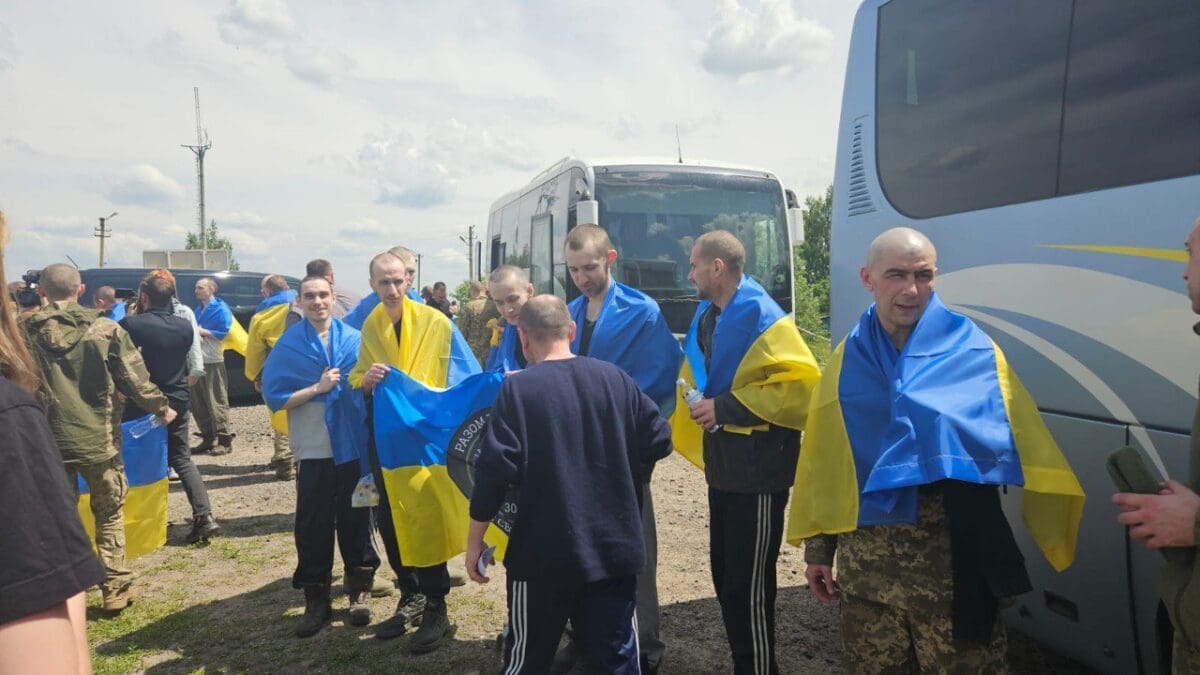
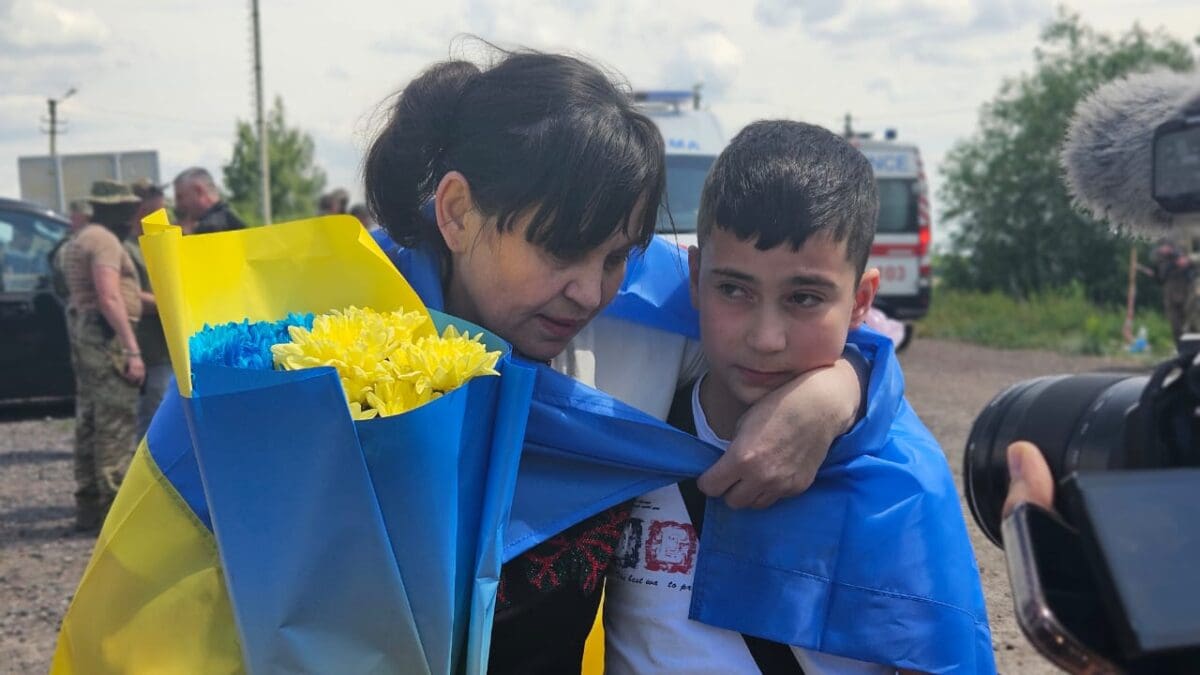
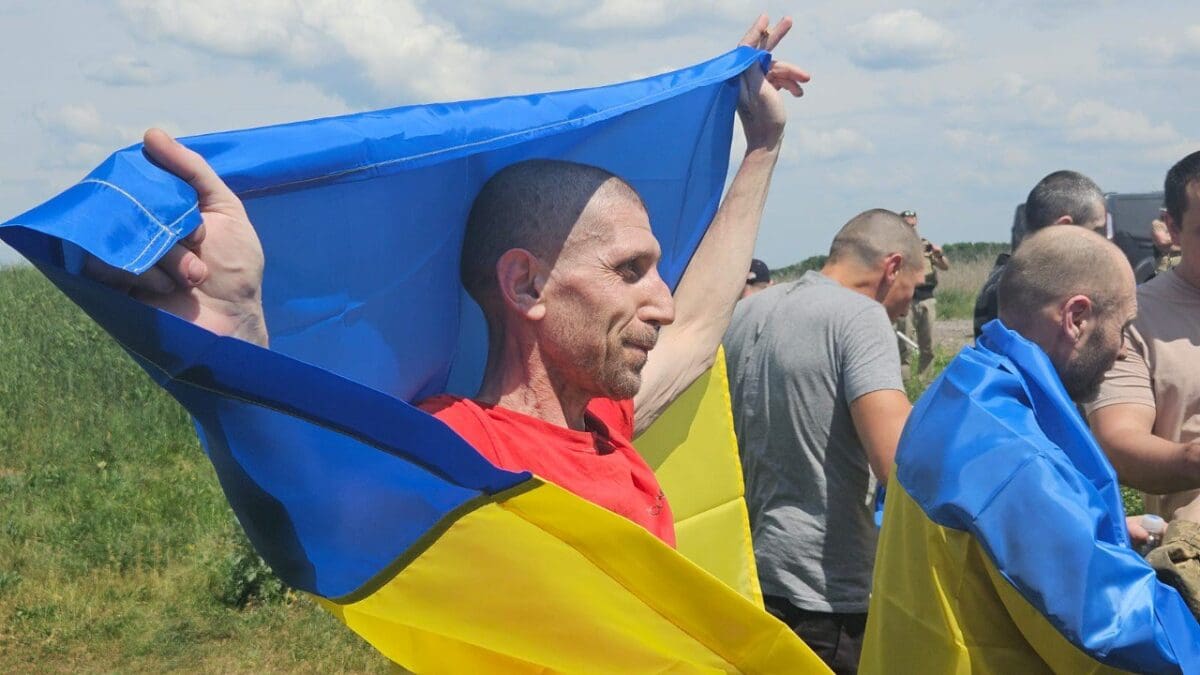
After a long break, another exchange of prisoners took place: 75 Ukrainian defenders and civilians were released from enemy captivity

від Юрій Гончаренко May 31, 2024

Thanks to the efforts of the of the Coordination Center for the Treatment of Prisoners of Waron behalf of the President of Ukraine, the long-awaited exchange of prisoners of war took place for the first time since February this year.

Today, 75 Ukrainian defenders, as well as Ukrainian civilians, are returning to their families. Among the rescued Defenders are 70 men and five women, six officers and 65 privates and non-commissioned officers. At least a third of the rescued soldiers have been injured, seriously ill or disabled.

This time, 37 members of the Armed Forces of Ukraine were released from captivity, including 13 members of the Navy and two members of the Air Force. Also, 21 National Guardsmen were released from captivity. Seven border guards, six terrorists and four Ukrainian civilians are returning home.

We managed to bring back 19 defenders of Zmiyiny Island, 14 servicemen who guarded the Chernobyl nuclear power plant, and ten defenders of Mariupol. Ukrainians captured in the Kharkiv, Kyiv, Kherson, Donetsk, Luhansk, Zaporizhzhia and Sumy sectors are returning home.

Today’s exchange is the 52nd since the beginning of Russia’s full-scale invasion. As of today, 3210 Ukrainian defenders have been released from the occupiers’ captivity. We would like to express our special gratitude to the United Arab Emirates for their active participation in the implementation of this exchange.

There are still many Ukrainian defenders and civilian Ukrainians in enemy captivity. Despite all the difficulties and opposition from the aggressor state, the Coordination Center continues to make efforts to ensure that all our people return home as soon as possible.

May 31, 2024
FacebookTwitterLinkedinWhatsappTelegramViberEmail
Analytics

The Russian Information Operation Using Tucker Carlson and the Transformation of American Conservatism

від Юрій Гончаренко May 28, 2024

Our team in the project InfoLight.UA project investigated a Russian information operation to spread the “news” that Tucker Carlson’s show was coming to Russian TV. It turned out that the show has been broadcasting since September 2023, and as of May, several dozen episodes have already been released in Russian. In other words, there was no news, no event worth writing about.

In addition, a few hours after our rebuttal, Tucker Carlson’s team issued an explanation, stating that they had “no cooperation with state media.” This was a reaction to the article in the popular American publication Newsweek.

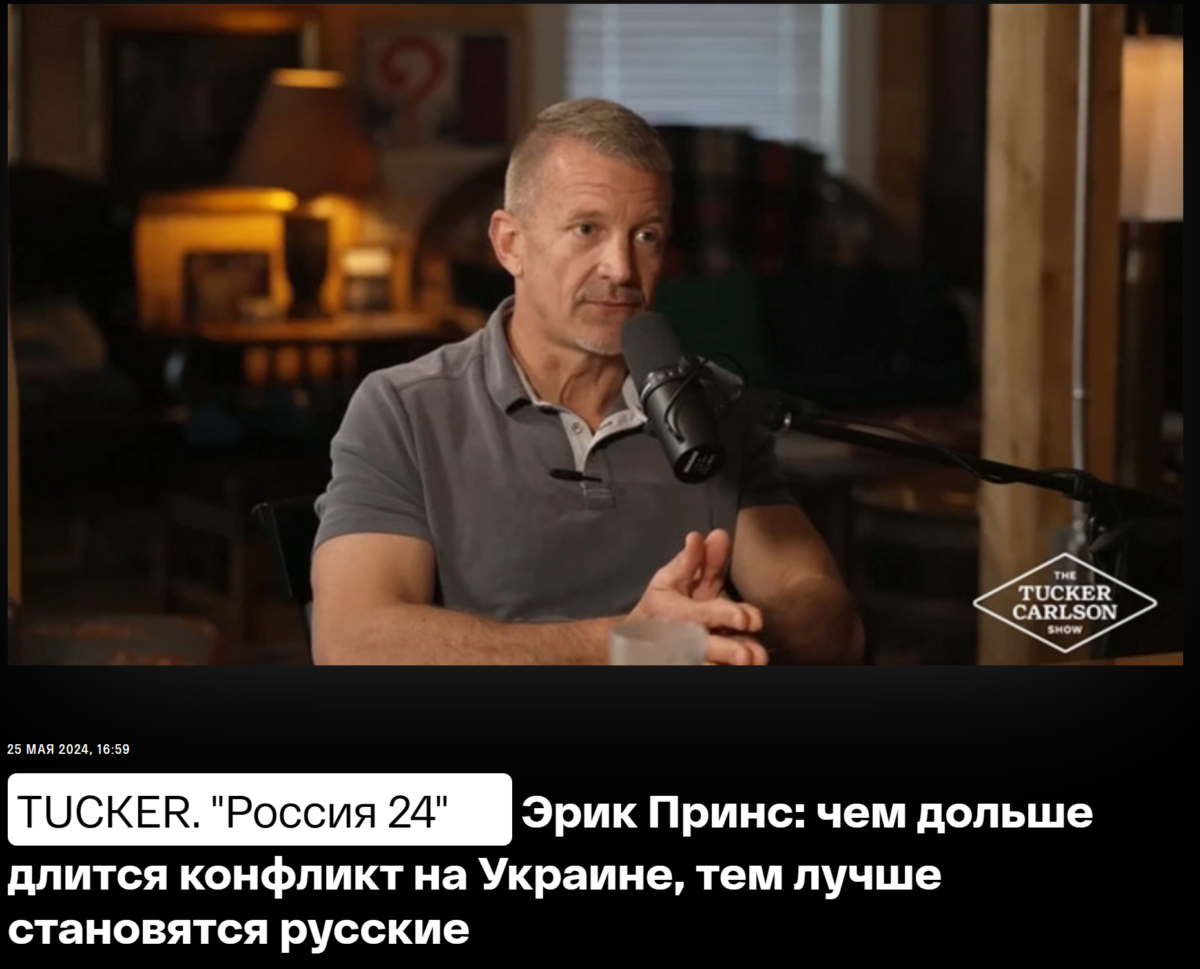
Nevertheless, the show goes on. After the scandal, a new episode was published in which the founder of Blackwater, Eric Prince, claims that Russia had the right to attack Ukraine because “the West was pumping Ukraine with weapons.” However, Tucker Carlson has no complaints about the apparently unlicensed use of his content.

So what was it?

It’s easy to assume that one of the goals of the information campaign, to widely inform about the availability of the Russian-language version of the content produced by Tucker Carlson, has been achieved. First and foremost, in Ukraine, where anyone with a VPN and no knowledge of English can comfortably listen to a rather selective selection of this show. For example, the original video with Eric Prince lasts almost two hours, while the Russian version is 20 minutes long. They contain the narratives Russia needs in a very concentrated way: that it is impossible to defeat Russia, that the war could have been stopped, and even that American weapons are weaker than Russian ones.

However, it was not possible to completely edit the picture Russia wanted. Although the most important thing, one might say the key thing, was removed. And that’s what Russia is all about. Although both Tucker and Prince speak complimentarily enough about Russia and its power, it obviously cannot be their ideal, because

  • Prince criticizes the intrusion into privacy and the proliferation of street cameras, surveillance of people, and promotes a return to cash. And he cites China with its total control as an anti-example. But is there less of this in Russia? Isn’t Moscow covered with so many cameras that no city in the United States can match? What about public services and even online subpoenas? Didn’t Tucker Carlson notice this surveillance while he was in Moscow?
  • Prince names Telegram as one of the secure messengers. And it’s frankly shocking that the founder of the largest private military company and certainly a security expert could not know that this messenger is neither secure nor private. And that its connection with the FSB is known to the whole world.

Is the Republican Party dead?

One of the key theses of this interview is Prince’s statement that the modern Republican Party has been hijacked by corporations and that Trump must destroy it to save it.

So, yes, perhaps a completely new political movement. That’s why Trump is transformative. Because he went beyond the Republican Party, yes, and he did that.

He says.

This is a very important signal. Because it is obvious that under the slogans of conservative ideology, part of this party is planning, in fact, an anarcho-capitalist revolution.. If you believe that Tucker Carlson is close to the real core of the Trumpists, and this is obviously the case, and that Eric Prince is quite influential in it (and how could it be otherwise if he was the one who was instructed in 2016 to establish a secret channel for contacts between Trump and Putin?), then this paints a very clear picture: the Republican Party and American conservatism are under threat of destruction from within.

At the same time, it is not known whether Trump himself really wants this or whether he is being manipulated very successfully by people like Prince. However, we must clearly understand that a rather dangerous trend is taking place in the United States that could bring the country to the brink of open confrontation: on the one hand, the ultra-liberal extremes in the Democratic Party are driving away many moderate democrats. On the other hand, the radicalism, populism, and conspiracy theorizing of the Trumpists and their desire to destroy the Republican Party deprive the most powerful country in the democratic camp and the Euro-Atlantic community of at least some alternative.

And what about Ukraine?

In fact, our place in this story may be key. Not so long ago, Ukrainian Protestant pastors managed to convince Mike Johnson to introduce and push through a bill to help Ukraine. And no matter how much Prince and Carlson convince their viewers that Russia will win this war, even they admit that we are very good at learning, and in terms of engineering, we are now the world’s leaders in weapons.

Of course, we lack the resources and time to scale, test, and produce these developments. But this resource is available in the United States. Moreover, they desperately need it, even based on Prince’s words. And the task of Ukrainians is to reach the American information field, those who can lobby for our military-technical cooperation and convince them that support for Ukraine is the only alternative for the conservative American voter.

Ukraine is not asking for anything for nothing. Although we are giving up the most valuable thing in this battle – the lives of our soldiers – we can and should speak two languages with the United States at the same time: Christian values and benefits.

We are currently the only ones who are restraining the rapid advance of radical Islam of the terrorist variety (because the moderate Islam of the Caucasus is with us), the depraved nepotism of the elite crypto-monarchy, which behaves very much like the times of Caligula in the Roman Empire and communist China, which uses Russia as a battering ram against the United States. Instead, everything that is healthy in Russia has long been fighting alongside the Ukrainian armed forces. And we are certainly not talking about the collective Navalny and other pseudo-position, but about fighters like Denis Kapustin and his RDC. Who could be closer in spirit to the American right than he or the Azovites? Is there anyone like him on the other side of the front line?

On the other hand, we are indeed the greatest technological and military innovators in the world. We adapted all military strategies to extremely limited resources, we survived for six months without American assistance and almost did not lose any territory. We drove one of the largest powerful fleets in the world away from our shores with our own drones. Our own drones are hitting further and further into the enemy’s rear. Our power supply is being cut off, but we still have electricity. Yes, it is extremely difficult for us. But before the war started, Ukraine was ruled by the team of the traitor Yanukovych, who was preparing the country for surrender. And having a lot of agents at all levels, we resisted.

What is this if not a manifestation of Christian courage and devotion to one’s country, nation, blood, and faith? What is this but the birth of new crusaders whose mission is to repeat the feat of their predecessors? Perhaps we should remember that it is Ukrainian vehicles that have white crosses on them! Is it a coincidence that the enemy was the first to choose dark symbols?

This is a battle between good and evil, and we invite a healthy and strong America to revive and stand by our side!

May 28, 2024
FacebookTwitterLinkedinWhatsappTelegramViberEmail
Новіші
Старіші

ВАЖЛИВЕ

Who forms the “hawkish” wing of the US...

January 22, 2026

Stepan Tomashivsky is a conservative who warned of...

December 28, 2025

A Pole who believed in Ukraine earlier than...

December 26, 2025

Being yourself and not pretending: how conservatism is...

December 10, 2025

MAGA as a new ideology of American conservatism

December 7, 2025

UKRAINIAN EXPERTS TALKS’S PODCAST

Новини

  • The Conservative Platform has gathered the best scholars to launch a systematic work on debunking Russian myths

    December 1, 2025
  • Budanov has a sober view of geopolitics and leads an effective team – blogger

    July 3, 2025
  • CDU/CSU leader pays support visit to Kyiv

    December 9, 2024
  • With the help of Russia, the Taliban wants to build an air defense of Afghanistan

    September 11, 2024
  • Americans to deploy Typhon missiles capable of reaching Russia on Japanese islands – media

    September 10, 2024
Назад Вперед

Спротив.News

«
Prev
1
/
213
Next
»
loading
play
Мінуснули три мости за раз! Сили оборони ламають логістику окупантів на ТОТ!
play
Крим переходить у режим ізоляції? Окупанти скасовують масові заходи до 1 вересня!
play
«Гордість, Єдність, Мрія»? Як РФ перетворює День молоді на ТОТ на шоу пропаганди
«
Prev
1
/
213
Next
»
loading

Реалізується ГО Фонд сприяння демократії за підтримки Фонду Ганнса Зайделя в Україні

Copyright © 2017 Фонд сприяння демократії Наші Політика конфіденційності,  Умови використання сайту
Facebook Youtube Telegram Spotify Instagram Linkedin
Консервативна Платформа
  • News
    • Analytics
    • Worldview
    • Anti-imperial front
    • Weapons
    • Geopolitics
  • publication
  • Position.
  • Events.

Shopping Cart

Close

No products in the cart.

Close
  • Українська (Ukrainian)
  • English