Консервативна Платформа
  • News
    • Analytics
    • Worldview
    • Anti-imperial front
    • Weapons
    • Geopolitics
  • publication
  • Position.
  • Events.
Friday, August 28, 2026
  • English
    • Ukrainian
Консервативна Платформа
  • News
    • Analytics
    • Worldview
    • Anti-imperial front
    • Weapons
    • Geopolitics
  • publication
  • Position.
  • Events.
Консервативна Платформа
  • News
    • Analytics
    • Worldview
    • Anti-imperial front
    • Weapons
    • Geopolitics
  • publication
  • Position.
  • Events.
Copyright 2021 - All Right Reserved
Analytics

The role of Christian democracy in the development of the Netherlands

від Майданюк Валерій April 21, 2024

Throughout the twentieth century, the Christian Democrats in the Netherlands were the ruling or one of the defining political forces, and these years were the period of economic development and the construction of the welfare state.

Christian political forces have played a significant role in the struggle for state stability and civil rights in the Netherlands since the nineteenth century. As early as the 1840s, a group of conservative MPs acted in the country’s parliament, opposing the liberal majority from a Christian standpoint.

Significant changes in the Christian political movement occurred with the beginning of the activities of the Calvinist pastor Abraham Kuyper. In 1872, Kuyper founded the conservative Christian newspaper The Standard, which became the mouthpiece of the Anti-Revolutionary Party. Christian politicians saw that in many countries revolutions led only to violence, not to positive social change. Therefore, they relied on improving the lives of citizens through legitimate political methods, considering Holland a country where this could be achieved without bloody carnage.

The newspaper began to participate in civic mobilization campaigns, including ensuring public funding for public schools. It was thanks to Kooper that a unique feature of Dutch political culture was formed – the existence of the so-called pillar system. In an attempt to spread the influence of the Anti-Revolutionary Party, Kooper initiated the creation of a number of public and social institutions: schools, hospitals, trade unions, religious and niche publications. He even created his own Free University. The pillar system dominated Dutch society until the 1960s. Certain manifestations of the pillar system persist in the Netherlands to this day.

A distinctive feature of the political culture of the Netherlands was the emergence of a significant number of influential Christian parties before 1945. Gradually, the Anti-Revolutionary Party became one of the most influential forces in the country. In the elections of 1888 and 1901, the Anti-Revolutionary Party gained the largest number of votes. In these elections, the ARP gained 31.4% and 27.4% respectively. The party, with its Catholic coalition partners, forms the government. Kuiper served as Prime Minister and Minister of the Interior from 1901 to 1905.

But Koyper’s willingness to enter into a governmental alliance with Catholics caused a number of splits in the party. The Free Anti-Revolutionary Party and the Christian Historical Voters’ League, the Christian Historical Party, emerged. Most of these parties gained electoral support and formed governments in coalition alliances.

The liberation of the Netherlands from the Nazis in 1945 revived political life in the country. In the postwar period, all Christian parties in the Netherlands switched to the ideological position of a social market economy. The most powerful Christian parties of the postwar era were:

  • Catholic People’s Party (established in 1946, but formally the successor to the Roman Catholic State Party);
  • Christian Historical Union (emerged as a conservative offshoot of the ARP in 1894);
  • Anti-revolutionary party.

Due to the high level of support, representatives of the Catholic People’s Party were in all postwar governments. In the years 1940-1960, Christian democratic parties garnered between 30 and 50% of the vote, but due to disagreements, they entered into government coalitions with socialists or liberals.
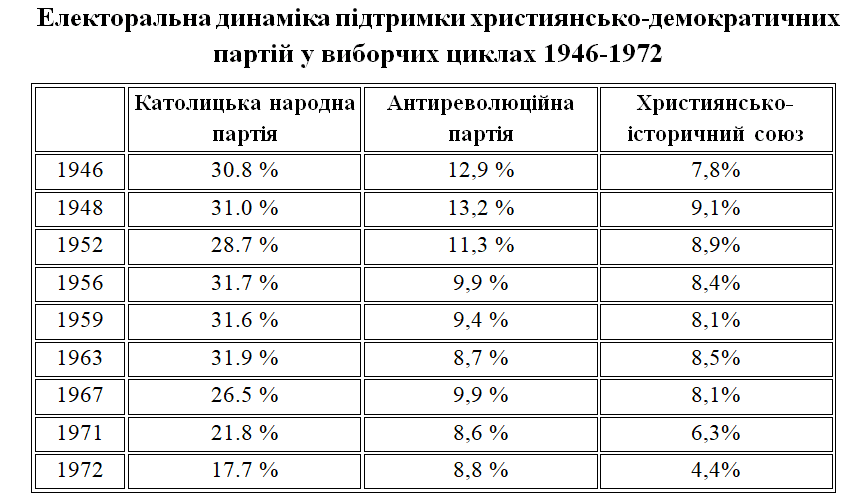
In the 1972 elections, the combined total of all three Christian parties dropped to 30.9%. The leaders of the Christian Democratic parties realized that without unification the trend would lead to the gradual marginalization of all three political forces.

In the 1977 elections, three parties formed the Christian Democratic Appeal bloc. The joint list gained 31.89%. And in 1980, the three parties merged into one – the Christian Democratic Appeal (Christen-Demokratisch Appèl (CDA).

From 1977 to 2021, the Christian Democratic Appeal was a member of the ruling coalition, with minor interruptions. As of today, the Christian Democratic Appeal positions itself as a non-denominational and non-religious party. The appeal to Christianity is rather an appeal to the values embodied by the religion. The party controlled the government coalition for a long time, had its own prime ministers, and carried out a number of reforms, including reform of old-age and disability pensions and liberalization of public services. From 2002 to 2010, CDA leader Jan Peter Balkenende headed the government.
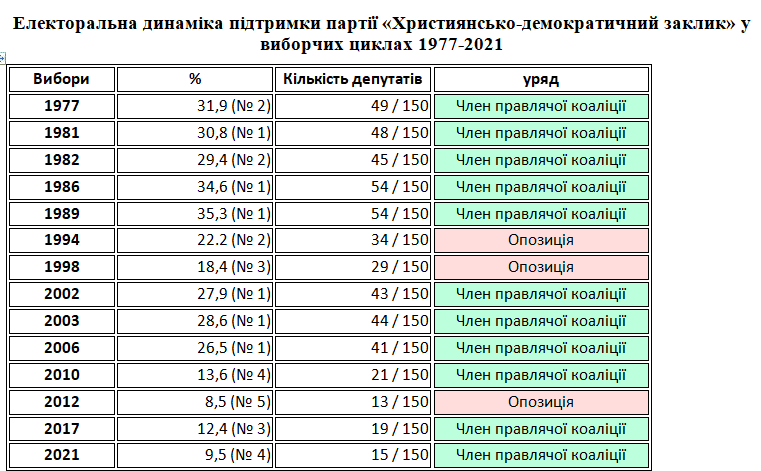
In the last parliamentary elections, the party won 21 seats out of 75 in the first chamber and 21 seats out of 150 in the second chamber of the General States. In addition, the Christian Democrats have 5 seats out of 25 allocated to the Netherlands in the European Parliament, where the party is a member of the European People’s Party faction.

In addition to the Christian Democratic Appeal, there are several other parties in the Netherlands that appeal to Christian democratic values and have been part of government coalitions. In particular, the Christian Union (CU) is a Christian democratic party founded in 2000. The party belongs to the parliamentary parties and has 4 seats out of 75 in the first chamber and 5 seats out of 150 in the second chamber of the General States. It also holds 1 seat out of 25 assigned to the Netherlands in the European Parliament and is a member of the European Conservatives and Reformists faction. The party’s ideology combines conservatism in ethical and foreign policy issues and left-wing centrism in social issues. The general positioning of the Christian Union is social Christianity.

The active work of the Dutch Christian Democratic parties has contributed to the positive social situation and economic development of the country. The Netherlands is a small country with a population of just under 17 million, but in terms of economic size, it is the fifth largest country in the EU. The Netherlands is the second largest exporting country in the EU, second only to Germany.

Exports of goods and services account for 30% of national GDP. The main export items are not tulips, but technical equipment and its components and spare parts. This export item brings tens of billions of euros to the country annually.

Much of the economic prosperity, social stability, and progress of the Netherlands is due to the Christian Democratic forces that have been working on the country’s development for many decades.

Author: Valeriy Maydanyuk
April 21, 2024
FacebookTwitterLinkedinWhatsappTelegramViberEmail
News

Zelensky: We agreed to provide Ukraine with more air defense systems. We need seven more Patriot systems, and this is the minimum number

від Савицький Олексій April 19, 2024

The President spoke at the NATO-Ukraine Council and called on the partners to provide Ukraine with the necessary weapons as soon as possible.

During a meeting of the NATO-Ukraine Council, Zelenskyy voiced five priorities that he asked his partners to focus on:

  • Ukraine needs at least seven more Patriot or similar air defense systems for defense – they can save many lives and make a real difference.
  • One million artillery shells for Ukraine must finally be delivered to the front line.
  • Long-range capability. “It is absurd when partners are afraid of their strength. The more long-range weapons our soldiers have in their hands, the closer the peace. We need long-range missiles and artillery on the front line,” the President emphasized.
  • Aviation. “If we have a coalition of fighter jets, then we need a sufficient number of planes to really overcome the Russian air force. It’s not about the number of promises, but about the real number of planes in the sky,” Zelensky added.
  • The fifth point is speed. “This year we cannot wait for decisions to be made. I ask you to consider our request for your determination – each of its elements – as soon as possible,” the head of state said, adding that “Putin must be brought down to earth, and our skies must become safe again.”

NATO Secretary General Jens Stoltenberg said that NATO countries have committed to providing Ukraine with more air defense systems. He said this at a briefing following the NATO-Ukraine Council.

Stoltenberg did not name the exact number of air defense systems that could be provided to Ukraine, but assured that, in particular, Patriot is available for transfer.

“NATO has identified systems among the available capabilities that can be provided to Ukraine,” he said, adding that he expects NATO partners to announce deliveries soon.

He added that in addition to the US Patriot systems, “there are other types of weapons that the allies can provide, such as the [French] SAMP/T.”

“Many other countries that do not have affordable systems have promised to provide financial support to buy them for Ukraine,” said the NATO Secretary General.

President of Ukraine Volodymyr Zelenskyy, who attended the meeting, said that in addition to air defense, Ukraine also needs artillery shells, long-range weapons, and aircraft. According to Stoltenberg, each NATO member can decide what to supply to Ukraine.

Also today, the Group of Seven (G7) countries announced that they would strengthen Ukraine’s air defense to save civilian lives and protect critical infrastructure.

On April 16, it became known that Kyiv was initiating a meeting of the NATO-Ukraine Council. This was announced by President Volodymyr Zelenskyy in his evening video address to Ukrainians.

April 19, 2024
FacebookTwitterLinkedinWhatsappTelegramViberEmail
News

SBU detains Shufrych’s aide who financed Russian Guard in Crimea

від Савицький Олексій April 18, 2024

Shufrych’s assistant suspected of financing Russian Guard in temporarily occupied Crimea detained by SBU

According to the case file, the offender is an assistant to the MP who was responsible for the legal aspects of the deal. In particular, the defendant was involved in concluding an agreement with the Russian Guard for the protection of elite real estate in Crimea controlled by the MP.

In just 3 months, more than half a million Russian rubles were transferred to the occupiers’ accounts.

In early February 2024, MP Shufrych was already notified of the suspicion.

As a result of the measures taken, SBU investigators and operatives detained Shufrych’s business partner and served him a notice of suspicion under Part 3 of Article 110-2 of the Criminal Code of Ukraine (financing actions committed with the aim of violent change or overthrow of the constitutional order or seizure of state power, changing the boundaries of the territory or state border of Ukraine).

The investigation is ongoing to establish all the circumstances of the crime. The offender faces up to 8 years in prison with confiscation of property.

April 18, 2024
FacebookTwitterLinkedinWhatsappTelegramViberEmail
Europe

Alleged Russian agents arrested in Bavaria : Germany arrests two Russian agents who planned to disrupt military aid to Ukraine

від Савицький Олексій April 18, 2024

Two agents working for Russia’s intelligence services and intending to sabotage military infrastructure to undermine military support for Ukraine have been detained in Bavaria, Germany – Spiegel.

This morning, Federal Attorney General Jens Rommel approved the arrest of two people suspected of spying for Russia. The suspects were trying to obtain information about American military bases in Germany and were also preparing attacks on military transportation routes in the country. As the publication has learned, police detained the suspects in Bayreuth.

One of the defendants is 39-year-old Dieter S. from Bavaria, who has Russian and German citizenship. From 2014 to 2016, he fought on the side of the DNR terrorist group.

Dieter photographed US military facilities in Germany and discussed possible sabotage with Russian intelligence services. Among other things, the agents were monitoring a military training ground where the US military trains Ukrainian soldiers.

It is believed that Dieter S.’s accomplice was 37-year-old Alexander Y., also of Russian-German descent, whom the federal prosecutor’s office accuses of being a Russian intelligence agent.

Since he was in possession of a firearm, the federal prosecutor’s office also opened an investigation against him on suspicion of preparing a violent act that threatens the state.

According to the newspaper, one of the facilities the detainees were spying on is located in Grafenwoehr, Bavaria. There is, among other things, an important military training ground where the US Army trains the Ukrainian military, for example, on Abrams main battle tanks.

According to Der Spiegel, Dieter agreed to carry out arson attacks and bombings on military infrastructure and industrial facilities. His focus, in particular, was on transportation routes used to transport military supplies.

According to the investigation, the suspects intended to prevent the delivery of military aid from Germany to Ukraine.

April 18, 2024
FacebookTwitterLinkedinWhatsappTelegramViberEmail
Internal front

Audit reveals violations worth more than UAH 10 billion in the Ministry of Defense

від Савицький Олексій April 16, 2024

After the change of minister in the department, an internal audit conducted by the Ministry of Defense revealed ineffective management decisions and risks in the management of assets totaling more than UAH 10 billion. This was stated by Deputy Defense Minister Yuriy Dzhyhyr in an interview with Ukrinform.

The audits covered such processes as:

▪️нарахування and payment of additional remuneration to the military;
▪️закупівлі food for the Armed Forces;
▪️функціональне management of state-owned enterprises;
▪ organization of financial and logistical support for the units of the TRO Forces;
▪️використання resources in the field of activity of the Land, Navy and Air Forces Commands of the Armed Forces of Ukraine.

Internal audits, in particular, were aimed at preventing such incidents and the implementation of audit recommendations resulted in an economic effect totaling more than UAH 1.5 billion.

“The Ministry of Defense is a huge mechanism with a large number of structural units. But every few years, at least high-risk areas should come under audit, and there should be a conclusion and an appropriate response. As for the risky areas, they have been identified,” said Dzhyhyr.

April 16, 2024
FacebookTwitterLinkedinWhatsappTelegramViberEmail
History

Ludwig Erhard: the formula of welfare and Christian values

від Майданюк Валерій March 25, 2024

Despite the fact that Konrad Adenauer is recognized as the “father” of the German economic miracle, his “right hand man” and a key member of the Christian Democratic reform team was Ludwig Erhard. He was the Minister of Finance in Adenauer’s government, who became Chancellor himself, and many Germans are still convinced that Germany owes its economic leap to Erhard.

Ludwig Erhard, the son of a textile entrepreneur in Bavaria, became one of the most brilliant economists in postwar Europe. Erhard’s family valued hard work, family care, modesty, obedience, and respect for the church and God. After graduating from high school in Nuremberg, Erhard was sent to the fronts of World War I, where he was wounded and received a lifelong disfigurement of his arm. After returning from the hospital, Erhard became interested in economics and, after earning a degree in economics, soon defended his doctoral dissertation. During the Second World War, Erhard worked at the Research Institute for Economic Research, where he learned to see the economy from the point of view of the consumer. However, his stubborn unwillingness to join the Nazi party, as demanded by his superiors, forced him to leave his job.

After the war, Erhard, a talented economist, became the Minister of Finance of Bavaria, then was promoted to the post of Minister of Economy of the American occupation zone. In 1948, Erhard implemented a monetary and economic reform that filled empty storefronts with goods that people had not seen for a long time. Working with Christian Democratic leaders Hanns Seidel and Konrad Adenauer, Erhard gained respect and status as one of the best specialists in the CDU/CSU. However, his rivals from the Social Democratic Party were not averse to having Erhard on their team. When Germany was proclaimed in 1949, no one doubted that Ludwig Erhard would become Minister of Economy in the Adenauer government.

Committed to the ideals of a social market economy, Erhard actively worked for the welfare and prosperity of West Germany and became the main executor of the reforms that led to the “German economic miracle.” Erhard’s motto was “Welfare for all!”. He relied on the morality of the people, in which he sincerely believed, and called the consent of the German people to his actions his source of inspiration. Erhard’s main task was not only to feed the hungry, but also to establish fair rules of the game for all, to restore dignity and self-confidence to the people. When the “Adenauer era” was coming to an end, in 1963, fellow party members nominated Ludwig Erhard, a longtime ally and the second most influential politician of the CDU/CSU, for the post of chancellor.

Erhard sought to minimize the state’s influence on the economy, which he wanted to make social through market mechanisms, not by handing out money left and right. “I am ready,” he said, “to persuade every single German citizen until they are ashamed of not supporting the efforts to maintain the stability of the currency. The German GDP growth rate in the 1950s was the highest among developed countries, and the price growth rate was the lowest. However, Erhard’s straightforwardness and the difficulty of finding compromises with politicians made his rule short-lived – Erhard resigned in 1966. But it was during his chancellorship that many reforms were introduced, including the very popular housing allowance.

In 1977, Ludwig Erhard died, but he will forever be remembered as the “father” of the “German economic miracle” who made Germans regain their dignity and look to the future with confidence.

Author: Valeriy Maydanyuk

March 25, 2024
FacebookTwitterLinkedinWhatsappTelegramViberEmail
History

The “Decline” of Christian Democracy: Causes and Consequences

від Майданюк Валерій March 24, 2024

After its triumphant rise in the mid-twentieth century, Christian democracy experienced a decline in popularity in the late 1960s, one of the largest in its history. In the 1960s, the Vatican stopped providing any advice to voters, distancing itself from influencing Christian parties, which became completely independent of the Church’s position.

The electoral failures of the Christian Democrats in the 1980s were partially compensated for after the fall of socialism in 1989, when the Christian Democratic “expansion to the East” took place. Christian democratic parties emerged in Central Europe and the post-Soviet states. They gained considerable weight in the Baltic States, the Czech Republic, Hungary, Romania, Slovakia, and Slovenia. At the same time, the first Christian Democratic Party (UCDP) in Ukraine was founded.

However, in the 1990s, Christian democrats in Western Europe, except for Germany, suffered such serious electoral losses that the world began to talk about the global “decline” of Christian democracy. In Europe, Christian Democrats lost ground in Belgium and Sweden and reduced their political representation in the Netherlands.

Christian democrats in Latin America, particularly in Chile and Venezuela, have also lost their positions of authority. The Christian Democratic presidents in Chile in the 1990s, Patricio Aylwin and Eduardo Frei Ruiz-Tagle, did not change the neoliberal economic model adopted during the Pinochet years, which led to a noticeable disappointment of voters. In the 1990s, Rafael Caldera, a longtime leader of Venezuelan social Christians, again became president of Venezuela, but as a candidate from a different coalition, and this political success was short-lived and ended in the victory of his ideological opponents, the socialists. Similar to the events in Europe, Latin American Christian Democrats also faced a transformation of the population’s attitude toward Christian political values in the course of the processes of modernization, secularization, and individualization that were influential in Latin America. Political values based on Christianity no longer resonated with large groups of society.

At the beginning of the twenty-first century, not only Christian Democrats, but also their ideological allies, the conservatives, saw a decline in support. As political history shows, Christian democrats and conservatives have many common positions on social and political life. Usually, in countries with strong Christian democratic positions, conservative electorate votes for Christian democratic parties. In countries with a dominant conservative party, Christian voters tend to support the conservatives instead of creating a separate Christian democratic party that would compete for the same electorate. In the twenty-first century, however, parties inspired by Western European Christianity have begun to gain less support. The Italian Christian Democrats, after more than half a century of rule, lost power in the early 1990s, and in Germany, the CDU/CSU coalition lost power to the Social Democrats in 2021.

Obviously, the main reasons for such challenges for Christian democrats are the growing conformism and pragmatism in their political practice. These are the reasons for the weakening of Christian democracy in the world, as identified by such well-known researchers of this topic as Edward Lynch and Scott Mainwaring. In particular, as Edward Lynch noted, “Christian Democrats have not succeeded in utilizing their potential because they have retreated from their own ideological principles.” And Scott Mainwaring notes that “demo-Christian parties have become less idealistic and consistent in their programmatic attitudes in order to become more pragmatic in order to expand their ranks of supporters. However, this inevitably led to the loss of the nuclear electorate, for whom Christian values and morality were not an empty sound. In the twenty-first century, the political practice of Christian democratic parties is characterized by much more conformism and political pragmatism and much less religious values.

As the experience of European and Latin American Christian democracies shows, Christian democratic parties succeed when they consistently adhere to their own principles and programmatic foundations based on Christian values and the ethics of the Gospel. When Christian Democrats waged an uncompromising fight against corruption, the mafia, and monopoly, and successfully solved socioeconomic problems, their rating was high. At the same time, the conditional “decline” of Christian democracy primarily affects voters who fall victim to leftist populism and false political ideologies.

The Christian Social Union, which has been in power in Bavaria for more than half a century, remains an example of the most successful and longest-lasting Christian democratic project. The CSU effectively ensures the economic and social development of citizens and makes a significant contribution to the revival of the European Christian democratic movement. Today, it is one of the most successful examples in the world of implementing the theory of the international Christian democratic movement, because for more than 50 years, the residents of democratic Bavaria have never doubted the effectiveness of the Christian Social Union and have supported them in every election. Modern Bavaria is not much bigger than an average Ukrainian region, but its GDP is almost five times higher than the GDP of the whole of Ukraine, which is evidence of a well-chosen economic course based on Christian democratic principles.

Author: Valeriy Maydanyuk

March 24, 2024
FacebookTwitterLinkedinWhatsappTelegramViberEmail
publication

Pope, IPSO and other troubles

від Юрій Гончаренко March 13, 2024

I have been observing the situation of an interesting IPSO in the information field for a long time.

The parameters are set: a generally suspicious dude named Bergoglio, also known as the Pope. Although I don’t want to give him an assessment here, I can only say one thing from my observations: he is a clear case of “not everything is so clear,” that is, the guy is in a situation “between,” that is, between yours and ours, but not on the pro-Moscow side, as many have begun to claim here.

The situation has been evolving for more than a year now, with topics that are clearly aimed at showing that we hate him, the pope, etc. It’s very similar to the way information about our “bad allies,” “bad Poles,” Americans, Trumps, Bidens, etc. What is the goal, I ask you? Isn’t everything clear? And here you read hundreds of unreasonable statements that Ukrainian Roman Catholics and Greek Catholics should break with the Vatican (often written by people who are not involved in these churches or religion in general, who do not understand anything about it), strange poems of some pagan from Lutsk, which are already attributed to Shevchenko, are being spread (the funny thing is that this pagan is reposted by true believers who do not really want to delve into the essence of the text of this work), people repost it all, the media chew it all up and pass it on… What good we are! We are cutting the branch we are sitting on.

The situation is similar with Bergoglio’s latest interview with a Swiss publication. There are some strange cropped and manipulated versions that are being circulated and picked up by our sub-media. A closer look reveals that our information space is flooded with cheap manipulations aimed at breaking up existing pro-Ukrainian alliances, including with such difficult “allies” as the current pope.

Conclusions: if we look a little more closely, a slightly different picture emerges: Pope Bergoglio may not be our friend, but he is not our enemy, and we do not need to make him one, at least not yet, we have enough of them for now. Someday we will get our hands on him, when we have already defeated the patsy, dealt with the ROC, traitors and collaborators, evaders and cheap political speculators here. Then we will have time for our enemies.

I think all thinking people have long realized that characters like Erdogan, Pope Bergoglio, Patriarch Bartholomew of Constantinople, and Indian Prime Minister Modi are trying to be leaders and spokespersons for the global South. Of course, they are more on our side than their competitors in this market – Brazil, China, or South Africa, for example. Therefore, it would be stupid and ridiculous to demand a clear pro-Ukrainian and anti-Russian policy from them. We should have other tasks for them, which we can talk about next time.

P.S. For all those who are outraged to the core by the actions of Radish Bergoglio, I would add that if you are interested in the reaction of the RCC/UGCC, the All-Ukrainian Council of Churches, just google it and you will find quite good and worthy answers. Of course, no one uses harsh words there, no matter how much we would like to. Our churches responded quite well, and I think Mr. Bergoglio was hiccupping there more than once. Next time he will be even more careful. And the statement of the UGCC says it well: if someone thinks that Ukraine should put up a white flag, it is better for him to go to confession and repent.

P.P.S. I once thought of this in a southern resort… I’ve already typed the letters…

P.P.S. I also laugh at those who write about Putin’s money in the Vatican Bank-100 billion, when in numbers the turnover there does not exceed 5 billion a year.

Someone has played a cheap game, and you are playing it. Astanavit!

P.P.P.S. If you still want to fight and get indignant with someone, find the faithful of the ROC (UOC-MP) and engage them. You don’t feel sorry for them, so you will have more fun and maybe do something useful ?

Author: Yuriy Mindyuk

March 13, 2024
FacebookTwitterLinkedinWhatsappTelegramViberEmail
publication

Personalism as the basis of Christian democracy

від Майданюк Валерій March 11, 2024

Christian democracy as a worldview ideological doctrine was formed, among other things, on the basis of religious philosophical concepts, in particular personalism. Personalism – the vision of a person as a person in the context of his or her social responsibility to society and future generations – has become part of the political platform of all Christian democratic parties.

In social matters, personalism is focused on universal values: the right to life, human dignity, freedom, private property, and a civil society dominated by the rule of law. Personalism is strongly opposed to socialism, especially its Soviet model, as well as to capitalism with its social ills. These values became the basis of the socio-political doctrine of Christian democracy.

The philosophy of the prominent Christian thinker Jacques Maritain was the greatest contribution to the formation of personalism. He participated in the drafting of the UN Declaration of Human Rights, and the Second Vatican Council approved many of his ideas as part of modern Catholic philosophy. Having received a Protestant upbringing and studied biology at university, Jacques Maritain nevertheless converted to Catholicism in 1906.

Maritain saw a way out of the crisis of modern times in the establishment of “theocentric humanism,” “personalistic democracy,” the Christianization of all spheres of spiritual culture, and the ecumenical rapprochement of religions. He considered his task to be the integration of modern philosophy and the ideas of St. Thomas Aquinas.

In opposition to liberal individualism and socialist collectivism, Maritain substantiated the personalist concept of man. Personalism as a philosophical trend emphasizes that a person is not just an individual, but first and foremost a person, and has social obligations – family, community, and society – and exists as a member of society. The human being, according to the thinker, always has a spiritual aspect, which materialistic liberalism did not recognize. Maritain introduced the principle of responsibility into Christian democracy and substantiated the importance of the family and private property for the development of the state. At the same time, the thinker insisted on the need to reduce the influence of the state on social interactions of the population.

Maritain’s philosophical works and ideas influenced the policies of the Christian democratic parties that ruled Germany, Italy, and the Benelux countries after 1945. Jacques Maritain opposes the humanistic individualism of the New Age with “integral humanism,” according to which man is perceived as a unity of the natural and the supernatural. According to Maritain’s concept, only the improvement of modern democracy through its gradual Christianization is the way that opens up the possibility of integral humanism. Jacques Maritain’s Christian democracy is an ideology that, based on humanism, the doctrine of human rights, and democratic values, at the same time adds to them the values of integral humanism – goodness, mercy, and mutual assistance. In 1967, in his encyclical “On the Progress of Peoples” (“Populorum progressio”), Pope Paul VI proclaimed the Catholic Church’s desire to realize the ideal of “integral humanism.”

Supporters of the philosophy of personalism are characterized by a desire to move away from the outdated dogmatism of the Christian concept of man, to update it and fill it with modern content. One of the main ideas of personalism is the active participation and dialogue of Christians with modernity, their involvement in active public life, so that Christianity plays a more significant role in politics and the social sphere and contributes to the realization of changes in the world for the better.

Personalism is a philosophical doctrine that, in understanding the modern world, proceeds from the problem of “total” human development based on the priority of spiritual values. The crisis of the modern man is explained as a consequence of the crisis of civilization as a whole, where the shortcomings of the distribution system lead to a decline in morality, deprive people of self-development, and the dominance of comfort turns people into consumers. As the Dutch publicist Jeff Fontaine rightly points out, personalism emphasizes the centrality of the individual in human activity, where a person’s identity is revealed and defined through his or her relationships with others. In politics, personalism is reflected in the programs of Christian democratic parties, which came to power in many European countries after the war and still play a significant role in Germany, France, the Netherlands, Poland, and, thanks to the activities of the European People’s Party, in the European Parliament.

Author: Valeriy Maydanyuk

March 11, 2024
FacebookTwitterLinkedinWhatsappTelegramViberEmail
Analytics

Christian Democratic Nostalgia in Venezuela

від Майданюк Валерій March 5, 2024

Venezuela has the world’s largest oil reserves and could have had every chance to be prosperous if not for the government’s populism and failed socialist experiments. Until recently, Venezuela was one of the largest economies in Latin America, thanks to its oil reserves, which put it ahead of Saudi Arabia. However, without any war, just the reforms of two presidents, the country has slipped into hyperinflation, power outages, hunger, and shortages of food and medicine. And gasoline became scarce in a country whose main export was oil.

In Venezuela, where power has often changed hands in an undemocratic manner, one of the most influential Christian democratic parties operated until recently. Under the military dictatorship, the Social Christian Party of Venezuela was founded in 1946 . Until 1948, it was called the Committee for the Independent Political Organization of Voters (COPEI), but the party uses the old name in everyday practice. The COPEI party was formed on the basis of student and conservative organizations and is guided by Christian values, the primacy of morality, the common good, the subordination of politics to ethical norms, and pays great attention to the development of civil society. The Venezuelan Christian Democrats viewed the state as a regulator of relations between social groups and an arbiter in mitigating social conflicts. At the same time, an important function of the state was the social aspect: to cut off a piece of the “fat” social pie that would allow for more and more portions to be given to the poor.

The COPEI promoted the creation of a society of social justice in a peaceful way, while preserving civil liberties, and its main goal is to create a “communitarian society” in which the interests of the individual are organically combined with the interests and needs of society. For a long time, COPEI relied on a broad social base and held the sympathies of almost all strata and social groups, combining the interests of workers, the middle class, peasants, urban residents, and trade unions. The COPEI, together with the Democratic Action, was the ruling party in Venezuela from 1958 to 1998, and its candidates held the presidency three times.

In 1968, the leader of the Social Christian Party, Rafael Caldera, was elected president of Venezuela and served until 1974. It was Caldera who became one of the founders and key theorists of Venezuelan Christian democracy. His Christian position became the theoretical basis for the main Christian democratic principles such as communitarianism, the concept of the “third way” and the social role of the state. Like Jacques Maritain, Caldera emphasized that the tragedy of modern democracies is the inability to put democratic principles into practice.

In 1993, as a result of the population’s disappointment with the neoliberal reforms of the previous government, the Christian Democrats again gained the support of voters and R. Caldera became president for the second time, declaring the continuation of the process of democratization of the country’s social and political life. Further decentralization of public administration was carried out, the posts of governors became elective, and social programs were launched. However, at the end of 1993, a banking crisis erupted in the country, more than 70,000 small and medium-sized enterprises went bankrupt, and poverty increased. The situation was aggravated by the global oil crisis. In need of assistance from the International Monetary Fund, Caldera was forced to take neoliberal steps, which led to public protests and the rise of left-wing populism. This was facilitated by a presidential amnesty for military participants in the coups of 1992 and 1993, including the socialist Hugo Chavez. In 1998, Caldera refused to run for president because of his advanced age, and power passed into the hands of socialist populists. Venezuelans, who liked the cheerful and joking President Chavez, did not even realize that their country’s path to the abyss had begun.

Without a war, in peacetime, the world’s richest country in terms of oil reserves saw its GDP plummet by 48.3% between 2013 and 2018. By comparison, in 2022, Ukraine’s GDP fell by 29.1%, after a military invasion, seaport blockade, emigration of millions of citizens, and destruction of many businesses.

In 2014, 48.4% of the population in Venezuela lived below the poverty line, and in 2018 this figure reached 91.3%. Under the government, which prioritized taking care of the poor, 27 million people became poor. Failed economic policies resulted in a humanitarian crisis that caused more than 3 million people to emigrate abroad.

In 2019, hyperinflation in Venezuela reached 1,300,000%. Prices doubled on average every 19 days. According to opinion polls on food shortages, 8 out of 10 respondents in 2017 said they were eating less because they had no food at home. 6 out of 10 said they went to bed hungry because they had no money for food. 64% lost weight in 2017, by an average of 11.4 kg. The poorest segments of the population lost the most weight.

Despite the fact that South America is the birthplace of the potato, under the leadership of the socialist government, Venezuelans were forced to switch to a cheaper potato substitute, the yucca root vegetable or cassava. The McDonald’s fast food chain, in response to the food crisis in the country, replaced French fries with yucca fries on its menu. Gasoline prices began to rise sharply in the country, and long lines formed at gas stations. As a popular saying goes: “If the Communists occupied the Sahara Desert, there would soon be a shortage of sand.”

Back in the days of Hugo Chavez, the socialist government introduced a disastrous nationalization program that forced many fishing companies to leave the country. The subsequent collapse of the Venezuelan economy, hyperinflation, and impoverishment of the population led to the emergence of pirates in the Caribbean. Just like in Somalia, impoverished Venezuelan fishermen with access to boats and weapons turned to sea robbery instead of catching tuna, octopus, or shrimp. Weapons were easy to get on the streets of Venezuelan cities, where lawlessness is increasingly prevalent.

However, while Somali pirates hunted large ships for a large ransom, Venezuelan corsairs attacked mostly poor fishermen and exchanged weapons and drugs in foreign ports for diapers, rice, oil, soap, and other scarce goods in the world’s richest oil country.

The populist government continues to divert public attention to the “external enemy” by declaring an “economic war” against Venezuela, blaming Western sanctions, and intimidating the people with foreign military intervention by capitalists. Meanwhile, the Venezuelan people nostalgically recall the “golden days” of the Christian Democrats’ rule, when peace, economic growth, and government responsibility reigned supreme.

Author: Valeriy Maydanyuk

March 5, 2024
FacebookTwitterLinkedinWhatsappTelegramViberEmail
Новіші
Старіші

ВАЖЛИВЕ

Who forms the “hawkish” wing of the US...

January 22, 2026

Stepan Tomashivsky is a conservative who warned of...

December 28, 2025

A Pole who believed in Ukraine earlier than...

December 26, 2025

Being yourself and not pretending: how conservatism is...

December 10, 2025

MAGA as a new ideology of American conservatism

December 7, 2025

UKRAINIAN EXPERTS TALKS’S PODCAST

Новини

  • The Conservative Platform has gathered the best scholars to launch a systematic work on debunking Russian myths

    December 1, 2025
  • Budanov has a sober view of geopolitics and leads an effective team – blogger

    July 3, 2025
  • CDU/CSU leader pays support visit to Kyiv

    December 9, 2024
  • With the help of Russia, the Taliban wants to build an air defense of Afghanistan

    September 11, 2024
  • Americans to deploy Typhon missiles capable of reaching Russia on Japanese islands – media

    September 10, 2024
Назад Вперед

Спротив.News

«
Prev
1
/
213
Next
»
loading
play
Мінуснули три мости за раз! Сили оборони ламають логістику окупантів на ТОТ!
play
Крим переходить у режим ізоляції? Окупанти скасовують масові заходи до 1 вересня!
play
«Гордість, Єдність, Мрія»? Як РФ перетворює День молоді на ТОТ на шоу пропаганди
«
Prev
1
/
213
Next
»
loading

Реалізується ГО Фонд сприяння демократії за підтримки Фонду Ганнса Зайделя в Україні

Copyright © 2017 Фонд сприяння демократії Наші Політика конфіденційності,  Умови використання сайту
Facebook Youtube Telegram Spotify Instagram Linkedin
Консервативна Платформа
  • News
    • Analytics
    • Worldview
    • Anti-imperial front
    • Weapons
    • Geopolitics
  • publication
  • Position.
  • Events.

Shopping Cart

Close

No products in the cart.

Close
  • Українська (Ukrainian)
  • English