Консервативна Платформа
  • News
    • Analytics
    • Worldview
    • Anti-imperial front
    • Weapons
    • Geopolitics
  • publication
  • Position.
  • Events.
Friday, August 28, 2026
  • English
    • Ukrainian
Консервативна Платформа
  • News
    • Analytics
    • Worldview
    • Anti-imperial front
    • Weapons
    • Geopolitics
  • publication
  • Position.
  • Events.
Консервативна Платформа
  • News
    • Analytics
    • Worldview
    • Anti-imperial front
    • Weapons
    • Geopolitics
  • publication
  • Position.
  • Events.
Copyright 2021 - All Right Reserved
publication

Christian democracy. Solutions for Ukraine and Europe

від Майданюк Валерій March 4, 2024

What made postwar Europe one of the most attractive places on Earth with perhaps the most favorable material and spiritual conditions for life and human development? On the basis of what ideology did Germany become the richest country in Europe and the European Union become a space of reconciliation and prosperity? One of the reasons for this rise was a good ideological foundation that created the institutions and values that made rapid development possible.

After World War II, Christian principles of mutual aid, solidarity, and social responsibility were combined with political programs. Christian democracy, an ideology that aims to integrate Christian and democratic principles, became the ideological basis for the reconstruction and development of postwar Europe. It sees the solution to the most important social problems in the ideas of Christian morality and humanism.

It was Christian democratic governments and parties that were the authors of the “economic miracle” of Germany, Italy, the Netherlands, and Austria. The social reforms of the Christian Democrats have done much to make Europe today perceived as a “paradise of social welfare.” Thanks to the Schuman Declaration, the economies of the postwar states reoriented from aggressive struggle to cooperation based on the principle of positive sum. Instead of socialism, common-sense politicians chose the path of reforms based on the formula of a social market economy, adopting the Protestant ethic, initiative, and the principle of “who cares, has.”

According to Professor Udi Greenberg, after the Second World War, Christian democrats achieved the unthinkable by uniting the heterogeneous legal systems of Europe into a democratic community. High social standards, a significant level of security protection for citizens, and continental integration are largely the achievement of Christian democrats. Christian democratic leaders such as German Chancellor Konrad Adenauer, French Foreign Minister Robert Schuman, and Italian Prime Minister Alcide de Gasperi laid the foundations for the postwar economic revival of Germany, France, and Italy. They also created the institutional and ideological foundations of the European Union, which were based on classical Christian political principles of solidarity, responsibility, subsidiarity, and social justice.

In Ukraine, few people know that the founding fathers of the European Union were Christian democrats who laid Christian values in the ideological foundation of the common European home. All of the ministers who signed the 1951 agreement establishing the European Coal and Steel Community were representatives of European Christian Democratic parties. This community became the basis on which the EU was created.

The book “Christian Democracy. A Solution for Ukraine and Europe” was published in Ukraine, which is devoted to a detailed analysis of the formula for European economic growth and political reconciliation between the age-old competitors who today peacefully coexist in the European Union. The book, authored by civic activist Yuriy Mindyuk, journalist Kostyantyn Kanishev, and political scientist Valeriy Maidaniuk, was published by the Democracy Promotion Foundation with the support of the European Foundation Sallux.

The book “Christian Democracy. Solutions for Ukraine and Europe” tells the stories of Christian democratic success stories, successful and unsuccessful struggles to build a society of welfare, justice and values. It explains why Christian democrats in Germany, Italy, or the Netherlands managed to build a successful state, while Venezuela, where Christian democrats were forced to cede power to socialists, had to slide into poverty, inflation, and long lines for the most basic necessities.

The book is intended for a wide range of readers, politicians, political scientists, journalists, civic and religious activists, students, Christians, and anyone interested in the principles of building successful and socially oriented states. The book can be found on the website of the Conservative Christian Platform https://conservative.org.ua/

Author: Valeriy Maydanyuk
March 4, 2024
FacebookTwitterLinkedinWhatsappTelegramViberEmail
Analytics

Budanov and Macron’s “assassination” is a large-scale but primitive Russian fake: analysis and refutation

від Юрій Гончаренко February 14, 2024

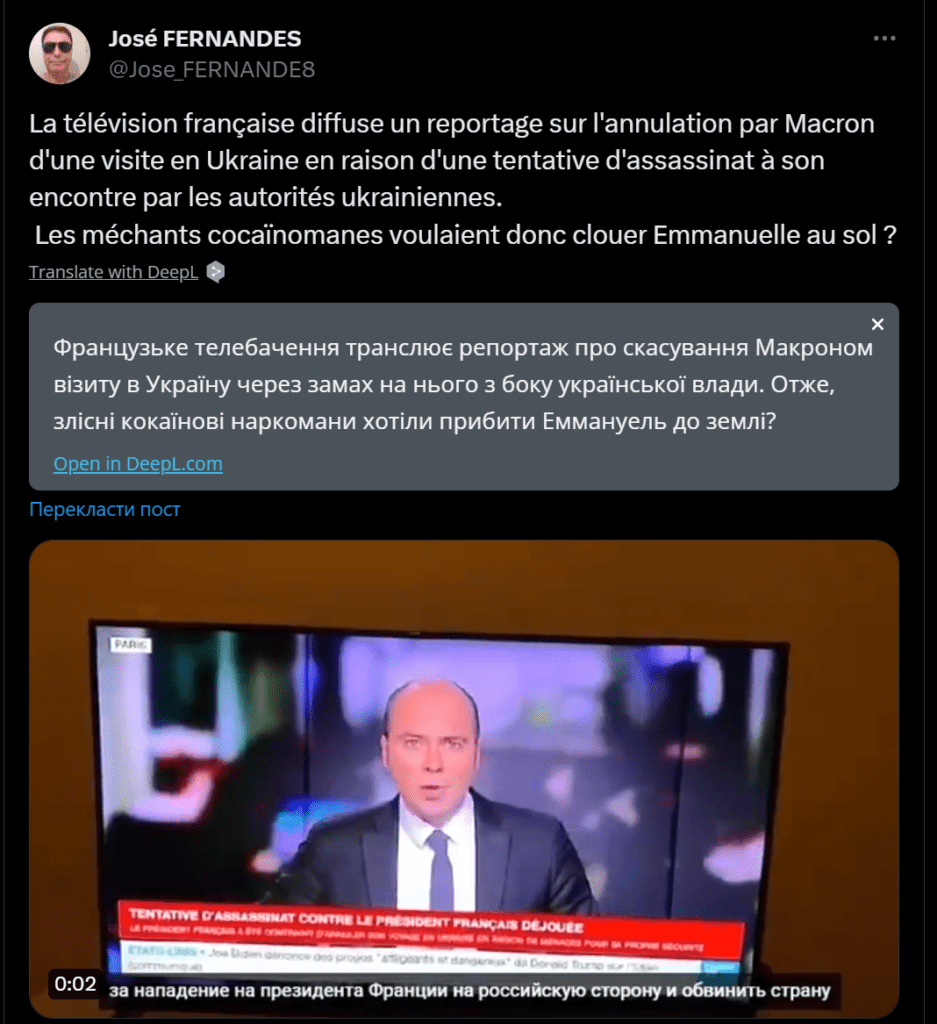
On February 14, the Russian segment of the Internet began to be full of reports of an alleged attempted assassination attempt on French President Emmanuel Macron. The attempt was allegedly being prepared by the President of Ukraine Volodymyr Zelenskyy, the “operation” was supervised by Kyrylo Budanov, and the attempt was prevented by Valeriy Zaluzhnyi. The research and analysis group InfoLight.UA research and analysis group verified this information using artificial intelligence-based narrative tracking systems.

So, in most publications from February 14, the only source of this “information” is a very poor quality video from a TV. The video is so bad that it is technically impossible to make sure that it is not a dipfake.

We would like to point out that the video has Russian subtitles that are wider than the TV in the frame. But according to Russian propaganda, the video was posted by a user of the X network with the nickname @Jose_FERNANDE8. And it is allegedly a story from French television, France 24.

The user exists, but the story on television does not. However, does this concern the Russians, in particular the so-called Deputy Chairman of the Security Council of the Russian Federation, Dmitry Medvedev, who is always inspired by delusions.

However, the Russian captions on the video from allegedly France are not the only gap in this fake. In fact, the screenshots mentioned in the video appeared on Telegram on February 12.

Anyone who enjoys studying the clumsy “hellfire” can find something for themselves here. It is clear to everyone in Ukraine that even for Surzhik it is too much)

We publish a timeline of this fake and continue to monitor its development.

February 14, 2024
FacebookTwitterLinkedinWhatsappTelegramViberEmail
publication

Panic, despondency, persecution, assassination attempts. Russia has launched a new information attack “Maidan-3” on Ukraine. Exclusive from online.ua

від Юрій Гончаренко November 13, 2023

On November 1, Russian special services launched a large-scale information attack called “Maidan-3” aimed at destabilizing Ukraine. This was reported by online.ua, citing its own sources in the security and defense sector.

Ukrainians should remember that a “war of attrition” is about resilience to internal confrontations that Russia actively provokes.

Russia’s new information attack against Ukraine

The timing of a new information attack by Russian special services on Ukraine is November-December 2023.

The operation was supervised by the First Deputy Chief of Staff of the Russian Presidential Administration, Sergei Kiriyenko, and the ideologist was Vladislav Surkov, one of the authors of the Novorossiya project.

Online.ua learned about this from its own sources in the security and defense sector of Ukraine and confirms a cursory glance at the Ukrainian information space.

According to the Russians’ audacious plans, the operation will be conducted in different parts of the world and will be comprehensive and multi-vector.

The goal set by Russian special services and propagandists is to destabilize political life, provoke protests and conflicts in Ukraine itself, and influence the international anti-Putin coalition.

The methodology of Russia’s new information attack will remain traditional for Russian ISIS – panic, despondency, and artificial pitting of politicians and the military.

Russia’s IPSO: imaginary “futility of resistance” of Ukrainians

As for the main topics of information influence of Russian special services on Ukrainian society, there are no surprises.

Some of the real issues that concern Ukrainians today will be raised again: general fatigue from the war, the alleged “futility of resistance,” corruption, the ineffectiveness of international organizations, the suspension of aid from international partners, the ineffectiveness of the political leadership, and various “conspiracy theories.”

A separate item is the “language issue,” which is being artificially put back on the agenda again and again.

At the same time, a number of “peaceful” actions are planned to be organized in Kyiv and the regions, which will have absolutely non-peaceful goals.

For this purpose, Russian special services are actively using the stressful state of Ukrainian society.

In particular, the painful issues of prisoner of war exchanges and military rotation in the combat zone are being raised to a new level.

Active information attacks aimed at disrupting the mobilization process continue. The relatives and friends of the Ukrainian military are being provoked to take aggressive actions that further undermine society.

It is for this purpose that Russia has blocked the process of exchanging prisoners of war.

Russia’s attack against Ukraine’s military and political leadership

The first stages of this operation can already be observed on both Ukrainian and international information platforms, including pro-Russian ones and those targeting the Russian-speaking audience.

New voices in the form of “mothballed” agents of influence (self-styled “experts” and commentators) have been joined by a certain number of Ukrainian politicians and opinion leaders who unconsciously spread Russian narratives for their own PR.

Currently, the main information attack is aimed at discrediting certain government agencies and representatives of the political and military leadership of Ukraine.

In particular, an imaginary “conflict” between different branches of government and specific state figures is being fanned.

According to sources, Russia’s biggest bet in information attacks is on propaganda on the Telegram messenger, which is of Russian origin. This area alone has already been allocated $230 million.

Overall, Maidan-3 was the most expensive Russian information operation against Ukraine since 2014, with a total budget of one and a half billion dollars.

Russian special services are preparing assassination attempts on Ukraine’s leadership

It is planned to organize a series of assassination attempts on a number of officials. For this purpose, several groups of performers have been trained.

Some participants are already on the territory of Ukraine, while others are preparing to enter from the territory of Russia’s “shadow allies.” The operation will be managed directly from the territory of the Russian Federation.

According to the sources, if the assassination attempts are successful, some of them will be presented as evidence of Ukraine’s “weakness” and inability to protect iconic figures. Other assassination attempts will be presented as alleged “internal Ukrainian showdowns” that have reached a boiling point.

The special operation of the Russian special services is to reach its peak on the anniversary of the beginning of the Revolution of Dignity. According to the “authors”, this will add emotion and symbolism to the events.

In addition, it is during this period that Russian missile attacks on Ukrainian civilian critical infrastructure are expected to peak.

The combination of all these components will naturally increase the psychological impact on Ukrainians and contribute to panic and surrender.

Russia’s destabilization of the world: aid to Israel and Nord Stream

In the international arena, Russians will continue to promote the Middle East in order to divert attention from the war in Ukraine and reduce international aid.

Ukraine itself will be presented as a continuous “Gulyaypole”, devoid of any signs of civility and legality with constant quarrels at the level of the state’s top leadership.

Theories about Ukraine’s involvement in the undermining of Nord Stream will gain new strength.

The ultimate goal of the Russian special services’ information “project” is to prove Ukraine’s failure as an independent state, as its leadership is allegedly “incapable of effective governance, and the people cannot elect worthy leaders.”

That is, it is another attempt to present Ukraine as a “failed state”.

Therefore, political forces in the “West” that are partners with Russia will convince their opponents and voters to switch the vector of support from Ukraine to Israel.

The Ukrainian special services will resist such attacks, but it is important for all Ukrainians to remember that a “war of attrition” is not just about mobilization, tanks and drones. It is about resilience to internal confrontations that Russia will actively provoke.

Russian strategists are confident that their regime and society are much more stable and resistant to information and security influences.

Source: online.ua

November 13, 2023
FacebookTwitterLinkedinWhatsappTelegramViberEmail
Analytics

The IAEA is “fascinated” by the Russians at ZNPP. How Moscow blackmails the world with a nuclear disaster

від Юрій Гончаренко September 15, 2023

According to the words of Viktor Kurtiev, an entrepreneur and power engineer who is involved in the anti-crisis plan for ZNPP, the criminal army of the Russian Federation is already preparing conditions for a large-scale accident at the plant and blackmailing Ukraine and IAEA representatives.

What is known about the Russian army’s preparation of conditions for an accident at ZNPP

Kurtev notes that since July last year, he has been involved in the anti-crisis plan for Zaporizhzhia NPP and has had contacts with IAEA Director General Rafael Grossi, as well as attended events at various levels and participated in the development of security plans and response to all types of threats.

According to the information I have, the purification system for blowdown water of power unit No. 6 steam generators, the SWO-5 (special water treatment) unit, has recently completely failed. The probable cause is the negligence and unprofessional actions of the Russian “shift supervisor” of the chemical shop, who missed the moment of saturation of the SVO-5/2 filters. This led to the ingress of radioactive borated water into the engine room of Unit 6. The liquid got into the condensate-feed path and the boric acid solution present in it reacted chemically with the metal of the pipelines and the equipment of the second circuit, which is made of unalloyed steel grade St20. To remedy the situation, the second circuit coolant is currently being cleaned by water exchange. That is, radioactive borated water is diluted with chemically purified water. The mixture is poured into the drainage circulation waterway and the cooling pond. This violates all sanitary norms and rules established for the operation of nuclear power plants, as radioactive coolant is released into the environment.

says Kurtev.

What Russians are preparing for ZNPP

He emphasized that when Ukrainian employees of the plant asked why power unit No. 6 was not put into cold shutdown and power unit No. 4 into hot shutdown, Russian “experts” explained that it was “Moscow’s demand.”

– ADVERTISEMENT –

This information is of great concern. Russia’s reaction in the form of inaction gives grounds to talk about creating the basis for blackmailing Ukraine and the world with a future nuclear disaster.Therefore, this confirms the idea that Rosatom decided to use power unit No. 6, where there is a leak from the first circuit to the second, to implement a chain scenario of violation of all safety barriers. This implies supercooling and damage to the reactor, as well as guillotine destruction of steam generator tubes, which will cause the maximum domino effect

emphasizes the power engineer.

He assumes that Russian war criminals and propagandists will try to achieve maximum information effect in order to deter the Ukrainian Armed Forces counteroffensive in the south by blackmailing the IAEA with the threat of a disaster at the ZNPP.

Despite blatant safety violations, including the loss of integrity of the first and second circuits and the release of radioactive media into the environment, gross violations of radiation and nuclear safety at ZNPP continue. Technological regulations and emergency instructions are not being implemented. Neither the State Nuclear Regulatory Inspectorate of Ukraine (SNRIU), nor Energoatom, nor the IAEA are informed of the real state of affairs. The lack of reaction to such actions by the IAEA inspectors, who seem to be “fascinated” by the Russians and do not see or understand the scale of the violations, is surprising. Instead, they are fishing in the cooling pond (into which radioactive water is actually drained) in the company of Yuriy Chernichuk, a collaborator who was appointed “Director General of the Zaporizhzhia NPP” by the occupation authorities. That is, the IAEA inspectors are literally used as an information “smokescreen” to conceal violations and create an “alibi” for the Russians

emphasizes Kurtev.
September 15, 2023
FacebookTwitterLinkedinWhatsappTelegramViberEmail
Position.

What Budanov is silent about. The war will inevitably move to the territory of the Russian Federation

від Юрій Гончаренко September 13, 2023

Another silent video address by Kirill Budanov on the Day of the Main Intelligence Directorate last week caused a storm on social media. The DIU chief’s ambiguous hints and omissions about Russia usually provoke such a public reaction. It can be explained by the fact that in such cases it is a non-verbal announcement of events on the enemy’s territory. This makes the Russians hysterical, while we are in joyful anticipation.

Already in the first months of Russia’s full-scale war against Ukraine, it became clear that the enemy would not be able to achieve its original goal. It was not able to quickly capture Kyiv, establish an occupation regime here, and take over all or almost all of Ukraine. The next stage of the war was a dynamic confrontation between the two armies, when the Russians tried to attack where they could, and the Ukrainian army, holding the front, began counteroffensives where it was possible or appropriate. Now the war is moving to the next stage, where the Ukrainian Armed Forces are preparing to liberate the occupied territories along the entire front line, and the Russians are preparing to defend the entire occupied area. The enemy has well and deeply equipped its defense line, and this creates difficulties for the counteroffensive.

Under the current circumstances, there is a risk that the war will turn into a long and exhausting confrontation with relatively little progress by our troops on the ground. Such a rhythm of combat operations requires a lot of resources and will cause losses among our military without significant success. This creates an optimal context for the political decisions desired by the Kremlin. Counting on the exhaustion of Ukraine and the fatigue of our Western partners, the Russian leadership dreams of forcing everyone to sit down with them at the negotiating table, whereby the Russians want to achieve several goals:

  • to slow down the war and get time to recover;
  • establish more reliable control over the occupied territories of Ukraine;
  • avoid responsibility for the armed aggression against Ukraine;
  • to ease the sanctions pressure on itself and begin to emerge from international isolation.

The expected scenario of two armies confronting each other along the front line is exhausting for both sides, and the only question is which of them is ready and able to make greater sacrifices. It is important to add that the frontline runs through our land, and the enemy also has more opportunities to launch devastating air strikes across the country, which means we are still suffering more losses.

It has long been obvious that the condition for Russia’s defeat must be destructive events and processes on its territory. And it is not only or not so much about moving the front line of the Russian-Ukrainian war to Russia. We are talking about events and processes that will be self-destructive for our enemy. Although on the map Russia looks like a large-scale state, in reality it is a very vulnerable construction that rests only on the repressive vertical, which must constantly prove its capability.

Very few in the West, and even in Ukraine, dare to view the Russian-Ukrainian war from this perspective. In Ukraine, the main driver of this paradigm is the Main Intelligence Directorate, whose day we celebrated last week. In addition to the fact that military intelligence is involved in the liberation of our territories on the battlefield and, by its very nature, is aimed at collecting important information and implementing covert actions on the enemy’s territory, the DIU and its head, Kyrylo Budanov, publicly voice the goal of our struggle as structural destructive changes in the Russian Federation, up to its collapse into smaller parts. Among Ukrainian citizens, there are enough supporters of this concept of waging war against Russia, because we must strive not only for our victory, but also for Russia’s systemic defeat. Our task is to make the enemy unable to threaten Ukraine in the future. This is a natural and just aspiration of Ukrainians.

Russia is facing the fate of the USSR, when it began to crack from internal tension and its own aggressiveness. Today, Russia faces the same problems, and in some places they are much greater: the same diverse ethno-national structure, but a higher level of internal xenophobia than then; even greater technological and economic dependence on the outside world and infrastructural poverty; even greater uneven distribution of benefits than in the Soviet era; and a much higher level of corruption in the management vertical. And this is not all that gives rise to optimistic hints and omissions by Ukrainian military leaders.

Author: Mykhailo BASARAB, political scientist, officer of the Armed Forces of Ukraine, for Gazeta.ua

September 13, 2023
FacebookTwitterLinkedinWhatsappTelegramViberEmail
publication

Conservative thinking

від Юрій Гончаренко December 19, 2021

To develop a full-fledged conservative mindset, a preliminary coordinate system is needed.

This requires a broad revision of scientific humanitarian and social concepts. This can be done by dividing conservatism as a psychological motivation at the level of the individual and as an ideology based on a value platform ready to fight for the right to define modernity.

And to raise questions about his political implantation in the government.

Otherwise, we will give birth to another simulacrum.

Let’s change the way we think!

Ukrainians are always offered the same political set, but under different party wrappings – the power of the oligarchy, officials (who have nothing in common with ordinary citizens in terms of origin, education and culture), tolerant madness, social populism in domestic policy and semi-colonialism in foreign policy.

And all this is because most Ukrainians are naive realists in their style of thinking – they equate essence and phenomenon, believing that things are essentially what they are given to cognition in phenomena.

However, the unity of essence and phenomenon does not mean their coincidence. It is a dialectical unity of difference: essence is always hidden behind phenomena. Essence always appears as the inner content of phenomena, hidden from direct perception.

But to change the style of thinking means to move from the sphere of perception of the phenomenon itself to the sphere of the realized essence, which is a movement from the imaginary to the true, from the simulacrum to the original, from the inauthentic to the authentic. And finally to give yourself an answer: “Who and why has been imposing this power on us for so many years in a row!”

In the political realm, this means moving from politics to political metaphysics, from phenomena to entities – starting to think in terms of the meanings, principles, and structures that underlie today’s specific politics and economy. Act proactively.

The conceptual and philosophical dimension of a different style of thinking should be not only the destruction of the outdated comprador system, which has completely discredited itself, but a complete reboot of society. Therefore, it will not only be about the degradation of traditional moral and cultural values, the loss of national identity, and the hypocrisy of the authorities.

First and foremost, it is about the rejection of liberalism and various leftism as two versions of the Enlightenment project.

This means fighting for a person rooted in tradition and society, protecting human identity from any concepts of a liberal vision of the individual, the superiority of the political dimension of social life over the economic one, etc.

It is this style of thinking that will provide an answer to the economic and political processes and challenges posed by the twenty-first century and the opportunity to decisively reject the country’s provincial status.

And there is nothing difficult here – after all, a style of thinking is just the skills of perceiving and describing reality that a person uses in his or her own mental activity.

December 19, 2021
FacebookTwitterLinkedinWhatsappTelegramViberEmail
publication

Rock ‘n’ roll is long dead

від Юрій Гончаренко December 13, 2021

– Translated from The American Conservative

We invite you to read Matthew Walter’s controversial article “Rock and Roll is Long Dead” (The American Conservative – 10/21/2021). It raises a deeper, more fundamental issue than just musical preferences. It deals with trends in the development of world culture. Which are critically described by the author against the backdrop of Covid-19 – as a tribute to the fierce internal American political competition – so you should not focus on this aspect when reading the text. What is important is that the energies that were destroying Western culture from within have accomplished their task and have subsided. Rock ‘n’ roll as a social phenomenon has disappeared, died. What will happen tomorrow: Camo coming? ***All of our artists became conformists long before the Qovid regime demonstrated their loyalty.

Covid-19 has revealed very little we didn’t already know about American society. All the cracks it has exposed existed long before the pandemic and were visible to anyone who looked closely.One of the best examples of this is the death of “rock and roll”. The spirit of rock music was voluminous. The Rolling Stones were rock stars, as were the members of NWA, a rap group whose name hides a phrase that cannot be printed in a family magazine. Half a century ago, rock was at the forefront of a cultural revolution whose scope is almost impossible to describe. When John Lennon declared that the Beatles were “bigger than Jesus,” or suggested to us: “Imagine there is no heaven,” the world took notice.

The previously unimaginable combination of antinomian views and mass consumer appeal has given way to a combination of mass consumerism.

Back in 2021, it’s hard to avoid the conclusion that rock is dead, and so is the spirit that made it possible. Today, popular musicians are simply an extension of the professional and managerial classes. Their task is to strengthen the elite’s worldview, not to question it. Try to imagine Keith Moon of The Who having fun driving a sports car into a swimming pool and taking the wearing of masks seriously, or Janis Joplin passionately telling us that she was injected with something other than heroin because the president said it was necessary.

The death of rock shows us that the cultural revolution to which it contributed most is over. A new establishment has emerged, and popular music exists to maintain the consensus, not to refute or even question it in the mildest terms. This is why, instead of praising her as a rebel, the liberal media establishment ridiculed Nicki Minaj for expressing doubts about vaccines that are widely distributed among African Americans.

The Mountain Goats is not a name that might appeal to most, but suffice it to say that in a world of 30-year-old men who know all about beard care kits and bad relationships with their parents, they are very appealing. In this bleak realm, they are considered one of the best rock bands of the last 20 years or so. So naturally, a few weeks ago, the band wrote a post on their official Twitter account hysterically complaining about an American Airlines pilot who drew attention to the fact that the CDC (Center for Disease Control and Prevention in the United States) hasn’t exactly been a model of scientific clarity in the last year and a half.

Thank goodness a few aging rockers know nothing about it. Van Morrison and Eric Clapton worked together last year on a song (admittedly awkward and almost “unlistenable”) in which they express their disagreement with lockdowns. Megadeth’s Dave Mustaine recently told an audience in New Jersey that he was fed up with what he called the “tyranny” associated with Covid. Three decades ago, metalheads like Mustaine preached the destruction of all societal values, and were heroes to everyone except a certain fountain of sanity, Tipper Gore (former second lady of the United States). Now they are second only to Satan in the eyes of secular liberals.Let’s not lose sight of the main point. The question is not whether Morrison and Clapton were right (although I agree with them) about the lockdowns. The question is whether they were acting like rock stars in rejecting the consensus. They certainly were, and what’s striking is how little attention their arguments have garnered. Certainly, to lovers of classical music and jazz, its achievements today seem relatively insignificant. We could also do without the carelessness in dress and manners that it brought. Nevertheless, I can’t help but think that we should mourn this loss the way we would mourn the demolition of an ugly but iconic building. When rock was destroying the consensus culture of the 1950s, it could have thrown the baby out with the bathwater (idiom, overreaching). But he was still skeptical, which is not the case with today’s artists.

Matthew Walter is the editor of The Lamp magazine and the editor of The American Conservative magazine


Translation by Stanislav Bychek

December 13, 2021
FacebookTwitterLinkedinWhatsappTelegramViberEmail
publication

PUTIN BEAT BAYDEN AGAIN: Can the Irreparable Be Fixed?

від Юрій Гончаренко December 13, 2021

In an interview with Mark Feygin about Biden’s virtual meeting with Putin, the well-known political analyst Andrei Piontkovsky noted in a scathing tone: if a former KGB major can outplay two American presidents like boys, it says a lot about the level of the current American political class. He should try to do the same with Reagan, Thatcher, the elder Bush, or at least Clinton…

Although this statement was made “by the way,” it has great symbolic significance. As Alexander Gradsky once sang, “nothing goes unnoticed,” and here, the global “cultural” policy of the liberals, with its constituent elements of denationalization, de-heroization, and de-individualization of the human being, of course, under the slogan of protecting his or her natural rights, began to be reflected in the cultural tragics themselves or in their descendants. Instead of the expected “face of perfection”, the “snout of degradation” is breaking through. On December 7, Putin won three situational victories during a virtual meeting with Biden. Commenting on the outcome of their meeting, US National Security Advisor Jake Sullivan said that, first, the Biden administration is ready to help implement the Minsk agreements. Secondly, the Americans, together with their allies, will consider the issue of guaranteeing Russia’s security. Thus, he gave grounds for experts and journalists to speculate about this thesis as an agreement to at least take into account the Kremlin’s claims to the territories once occupied by the USSR as zones of Russia’s special interests. And so, step by step, they may limp to a new Yalta. Third, on the eve of the summit between the two presidents, Congress removed from the draft military budget the articles on sanctions against Russia for military aggression; more precisely, it changed their disposition from those that would be imposed now to those that would be imposed when Russia attacks Ukraine.

And then everything began to look completely ridiculous, either as a sign of personal revenge against the President of Ukraine for his previous playing along with Trump in the election – remember how the younger Derkach, together with the FSB, played the suckers from Bankova Street, “sticking” them to the corruption scandal with Biden’s son – or maybe to annoy all Ukrainians, it was reported that Biden would inform the Ukrainian president about the Ukrainian issue discussed at the summit in two days. About us, without us, for us – democratically and liberally, I tell you, gentlemen. This kind of thing used to be seen only on Skobeeva’s talk show, and now it is being practiced in US foreign policy.

Moving on, immediately after the phone conversation with Biden, Zelenskyy tried to retell it in an interview with 1+1 TV channel. But in such a way that only one thing could be understood from everything he said: he, Zelensky, truly loves and appreciates Biden. Whatever he does, it is the truth in the last resort. The rest of the interview consisted of clumsy efforts to hide its true meaning. And suddenly, like “Peter and the Starcatcher,” he jumps out with the news that he will consult with the Ukrainian people through a referendum on all controversial issues. Probably, through the use of this institution of expressing the will of the people, he wants to escape responsibility for making unpopular decisions that limit the sovereignty and territorial integrity of our country. Decisions imposed on him by Biden. Shameful and despicable. After that, it became disgusting to look at him, let alone think about what he is worth. Although, for the sake of objectivity, it must be admitted that before that, he tried to take positive steps in a different direction, for example, by neutralizing Medvedchuk. And the meeting in 2019 with Putin in Paris, within the framework of the Normandy format, when Zelenskyy first lured the Russian president there by agreeing on surrender documents prepared by Yermak and Surkov at the level of working groups, and then, showing off for the cameras against the backdrop of European leaders, resolutely refused to sign them. This caused an explosion of rage in Putin, who realized that he had been simply “tricked” into surrendering, and then simply “dumped.” In addition to Putin, Surkov also suffered from this, as he was fired from his job for its obvious failure. Zelenskyy cannot afford to treat Biden in this way, by definition. Therefore, when he received the offer, he immediately began to think about how to fulfill it with the least personal losses. Simply put, if you can’t divorce Biden, why not divorce the people who love him? And what if the suckers liked him, it doesn’t mean that they should be treated as equals. A sucker is a sucker. His main social purpose is to be a deceived crook. We elected a clown as president, so now laugh and rejoice until your heads fall off. We must recognize that the situation is difficult, but not catastrophic. To see a way out of it, we need to apply a broader scale of thinking, one that includes the past, present, and future, that is, the trend of historical development. In this case, it has been repeatedly publicized by both the previous and current presidents of America, and it is to contain China. And it is this containment policy that determines the rest of the accompanying steps. As the confrontation between these world giants intensifies, Russia will have to decide who it is really with. All these current half-hints to the Americans that “we can be allies if you change your attitude towards us,” give security guarantees, “put Ukraine in its place,” and so on, will cease to influence even that part of the Biden administration that is still conventionally called the “Russian party” – Jake Sullivan, William Burns, John Kerry. Given the current state of Russian society, its phobias and values cultivated over the centuries, it is 100% certain that they will be close to China.
The intensification of the struggle for world power will radically change the attitude towards Ukraine. Therefore, realizing this, as well as the fact that we cannot defeat Russia without an alliance with the United States, Ukrainian politicians should sabotage and neutralize all anti-Ukrainian Putin-Biden initiatives. Also, Ukrainian intellectuals, for example, the December 1 Initiative, should appeal to American intellectuals to join the resistance to the policy of “appeasement of the aggressor.” After all, it is unbecoming of a citadel of democracy to be treated like the creators of the Munich Conspiracy.

Representatives of the Ukrainian diaspora should also be involved in mass protests. And so on and so forth. As Piontkovsky said, the Ukrainian people must demonstrate their subjectivity in full. Remembering also that not everyone, not only in the political class, but even in the Biden Administration, shares the policy of “appeasement of the aggressor.” There are many of our allies among them. Let’s act.

Over time, all of this will allow new events and contradictory processes to “eat up” the unfavorable foreign policy situation. We need to wait it out, to digest the unfavorable foreign policy environment. Of course, at the same time, as I have said many times before, we need to make every effort both on the foreign policy front and in preparing the country’s military defense. The new time will shape the new course of political events in a new way, we just need to ride it in time. Russia must fall!

Author: Oleksandr Tkachuk, First Deputy Head of the Ukrainian Helsinki Union Veterans’ Association

December 13, 2021
FacebookTwitterLinkedinWhatsappTelegramViberEmail
publication

“NOTES FROM A DEAD HOUSE” about optimistic Russian conservatism

від Юрій Гончаренко December 13, 2021

On November 7, the host of the Vesti Nedeli program, Dmitry Kiselev, read out an ideologically charged text on the 200th anniversary of the birth of Fyodor Dostoevsky (11.11.1821 – 09.02.1881) with penguin-like contempt. He read it out, because the meanings proclaimed in the program clearly exceeded his competence.

First, there was an ironic summary based on Dostoevsky’s statements about the perception of Russians by Europeans as special people, supposedly similar to them and, at the same time, barbarians. The text was naturally emphatic: “The West has always been hostile to Russia, as it was then and as it is today. After that, Kiselev began to reveal the basic concept of what the Russian world is. “According to Dostoevsky,” the host emphasized, “Russianness is not so much about blood as it is about the ability to feel and perceive the culture of other nations. Thus, in a speech dedicated to the unveiling of the monument to Pushkin in Moscow, Dostoevsky, he continued, had to prove that Pushkin’s Ethiopian roots did not contradict his Russianness: “To become a true Russian, to become fully Russian, perhaps, only means (in the end, write this down) to become a brother of all men, a universal man, if you will.”

This thesis, if taken literally, breaks with all the templates of past or present ideas about Russian chauvinism. The viewer gets the impression that this kind of political thinking is the pinnacle of global humanism. Russia is the City of Heaven, and the Russian people are the “God-bearers.” We are witnessing a rather professional attempt to build an imperial conservative ideology based not on force but on the principles of Christian morality. Everything looks quite convincing, of course, if we take these postulates on faith, out of the historical context. When the formed ideological concept is placed in a historical context, the glossy, onion-like picture of “humane Russianness” crumbles to dust. For Dostoevsky’s geopolitical visions of the ultimate need to conquer Constantinople and move the capital of the Russian Empire there immediately come to mind. To conquer, despite the blood, violence, and ruins that would necessarily accompany such actions. For this, they say, is the allegedly universal mission of the Russians to restore historical justice, which was trampled on by infidels five hundred years ago.

It is paradoxical that whatever the Russians build, whether socialism, communism, or conservatism, they always end up with condensed totalitarianism. They think and talk about Paradise, but build Hell. With hundreds of thousands of dog-heads-police officers, guards, executioners. Who perform their work with a sense of their own election, correctness and truthfulness, with a sense of “brotherly love for all people.” In fact, there is nothing new here; the policy of “brotherhood of the three Slavic peoples” was built on this distorted hybrid ideology. Ukrainians, according to its postulates, must recognize that they are enslaved to their older Russian brother, and those who disagree must be destroyed as non-humans, Banderites. Of course, for the sake of establishing something higher, brighter, more humane, more just. As for Peter the Great, Lenin, Stalin, and Putin, everything is clear, but with figures like Dostoevsky, it is much more complicated. It is surprising that the philosophically penetrating, culturally sophisticated mind of the talented writer did not see, or did not want to see (the temptation of pride), either a logical or moral contradiction in his proclaimed theses, when he mixed humanism with imperial violence into one essence.

At the same time, it must be recognized that Dostoevsky is undoubtedly a brilliant writer, without any conventions or reservations. His unique talent manifested itself not only in the depiction of colorful artistic images, complex storylines, or the disclosure of the paradoxical depths of the cultural background, although all of these are undoubtedly present in his works, but, most importantly, some of his judgments were characterized by irrational insight, the ability to tear the fabric of existence and enter into what ordinary people are not able to penetrate, into the future. It’s amazing.

When I carefully read Dostoevsky’s main work, The Brothers Karamazov, at a fairly mature age, I was so impressed and enthusiastic that I studied a number of other critical reports about the author himself, from Konstantin Leontyev and Vasily Rozanov to Ivan Ilyin. Of course, he did not ignore Dostoevsky’s liberal critics.

The semantic center of the main novel The Brothers Karamazov is the chapter entitled The Legend of the Grand Inquisitor, which some literary critics also call a novel within a novel. In this chapter, Dostoevsky acts not only as a writer but also as a religious philosopher who, starting from the three temptations of Christ in the desert, tries to reveal the essence of man in the process of social change.

This is a special episode in the life of Jesus Christ, when, after his baptism in the Jordan and the descent of the Holy Spirit, he learns about his Mission on Earth; but before he begins to realize it, Christ retires to the Sinai desert to pray, to gather himself, to be confirmed. He is still defenseless, vulnerable, and has yet to become the person we all know – our Savior. It is at this point that the Prince of Darkness approaches him and tries to tempt him, to lead him astray. It should be noted that in the Gospels this is reported in a lapidary manner, although figuratively and expressively, but in Dostoevsky’s work the Devil seems to come to life, appearing before the readers in all his cosmic stature, as absolute evil, as another, pulsating alternative for humanity in relation to Christ. An alternative that is currently being realized through the temptation of bread, power, and pride. An alternative that Dostoevsky sees in the then newfangled socialism. Dostoevsky’s great work is one of the unique attempts in world literature to get to the very foundations of its inferiority and falsity. Moreover, in his diaries, Dostoevsky explicitly states that socialism in Russia will end in a bloody massacre for millions of people.

It should be emphasized that the Kremlin’s current attempt to build an imperial ideology based on conservative principles, in particular those present in the works of Fyodor Dostoevsky, automatically places it under the cognitive criticism applied by the thinker to socialism and liberalism. Conservatism, embedded in the body of Russian imperialism, ceases to be itself, transforming into a kind of Russian fascism.

Today, we are witnessing the Great Russian Deception and Self-Deception unfold before our eyes, a new attempt to revive a dead house. A house with rotten walls and a leaky roof – the Russian Empire. The tower of Babel is bound to fall, covering its fussy and reckless inhabitants with rubble. Of course, to the universal joy of its terrorized neighbors. “For with the measure you use, it will be measured back to you.” Steadily.

Author: Oleksandr Tkachuk, First Deputy Head of the Ukrainian Helsinki Union Veterans’ Association

December 13, 2021
FacebookTwitterLinkedinWhatsappTelegramViberEmail
publication

Russell Kirk: Ten principles of conservatism

від Юрій Гончаренко November 30, 2021

Being neither a religion nor an ideology, the concept of conservatism has neither its own scripture nor its own “Capital” to provide dogma. To the extent that it is possible to define what conservatives believe, the first principles of conservative belief are derived from what leading conservative writers and public figures have professed over the past two centuries. After some introductory remarks on this general topic, I will proceed to list ten such conservative principles. Perhaps it would be correct to use the word “conservative” primarily as an adjective. Because there is no typical conservative, and conservatism is essentially a negation of ideology: it is a state of mind, a type of character, a way of looking at the civil social order.The attitude that we call conservatism is not supported by a system of ideological dogmas, but by a set of attitudes. We can say that a person who considers himself or herself a conservative can be called a conservative. A conservative movement or set of concepts can accommodate a wide variety of views on many subjects, and there is no single text of the oath of the Thirty-nine Articles of Conservative Faith (the oath of a civil servant in old England and the rules of the Anglican religion – ed.) In essence, a conservative person is simply someone who finds things that are constant more pleasant than Chaos and the Old Night. (However, conservatives know, along with Burke, that healthy “change is the means of our preservation.”) The historical continuity of human experience, the conservative says, offers policy guidance far better than the abstract ideas of coffeehouse philosophers. But, of course, there is more to the conservative belief than this general attitude.

Although it is impossible to compile a detailed catalog of conservative beliefs, I offer here ten short and general principles; it is safe to say that most conservatives would endorse most of these maxims. In the various editions of my book The Conservative Mind, I have listed certain canons of conservative thought – but the list varies somewhat from edition to edition; in my anthology The Portable Conservative Primer, I offer variations on this theme. I now present to you a summary of conservative assumptions that differ somewhat from my canons in these two books. In fact, the diversity of ways in which conservative views can find expression is itself proof that conservatism is not a fixed ideology. What specific principles conservatives emphasize at any given time will depend on the circumstances and needs of that era. The following ten articles of faith reflect the emphasis of conservatives in contemporary America.

First, the conservative believes that there is a stable moral order. This order was created for man, and man was created for it: human nature is stable, and moral truths are constant. This order of words means harmony. There are two aspects or types of order: the inner order of the soul and the outer order of the commonwealth. Twenty-five centuries ago, Plato taught this doctrine, but even the educated today have difficulty understanding it. The problem of order has been a major concern of conservatives since conservatism became a political term. Our twentieth-century world has experienced the terrible consequences of the collapse of faith in moral order. Like the atrocities and catastrophes in Greece in the fifth century before Christ, the demise of great nations in our century shows us the pit into which societies fall when they confuse reasonable interests or ingenious social control with palatable alternatives to the old-fashioned moral order. Liberal intellectuals have said that the conservative believes that all social issues are essentially matters of private morality. When properly understood, this statement is quite true. A society in which men and women are guided by a belief in a stable moral order, a strong sense of right and wrong, and personal convictions about justice and honor will be a good society – no matter what political mechanism it uses; while a society in which men and women are morally wandering, ignorant of norms, and driven primarily by appetite will be a bad society – no matter how many people vote and no matter how liberal its official constitution.
Secondly, the conservative adheres to custom, convention, and continuity. It is the old custom that allows people to live together in peace; the destroyers of custom destroy more than they know or want. It is through conditionality, a word that is much abused these days, that we try to avoid constant disputes about rights and obligations: the law is basically a set of conditions. Continuity is a means of linking generation to generation; it matters to society as much as to the individual; without it, life has no meaning. When successful revolutionaries destroyed old customs, ridiculed old conventions, and disrupted the continuity of social institutions, why do they now find it necessary to establish new customs, conventions, and continuity? But this process is painful and slow; and the new social order that eventually emerges may be far worse than the old order that radicals overthrew in their quest for an earthly paradise. Conservatives are the champions of custom, convention, and continuity because they prefer the devil they know to the devil they don’t. Order, justice, and freedom, in their view, are artificial products of long social experience, the result of centuries of trial, reflection, and sacrifice. Thus, the social body is a kind of spiritual corporation, comparable to a church; it can even be called a community of souls. Human society is not a machine to be handled mechanically. Continuity, the lifeblood of society, must not be interrupted. Burke’s reminder of the need for prudent change is in the conservative’s mind. But the necessary changes, conservatives argue, must be gradual and discriminating, never eliminating old interests at once.
Thirdly, conservatives believe in what can be called the principle of prescription. Conservatives feel that modern people are dwarfs on the shoulders of giants, able to see further than their ancestors only because of the tall stature of those who were our predecessors in time. That is why conservatives often emphasize the importance of precepts, i.e. things that have been established from time immemorial so that the human mind does not fall into contradictions. There are rights whose main sanction is their prescription, such as property rights. Similarly, our morality is largely prescriptive. Conservatives argue that we moderns are unlikely to make any bold new discoveries in morality, politics, or taste. It is dangerous to weigh every issue on the basis of private judgment and private rationality. Man is foolish, but the species is wise,” Burke said. In politics, we do well to follow precedents, precepts, and even prejudices, because the great mysterious incorporation of the human race has acquired wisdom far beyond the petty private rationality of any one person.

Fourth, conservatives are guided by their principle of prudence. Burke agrees with Plato that prudence is the most important virtue in a statesman. Any public action should be judged by its likely long-term consequences, not just by temporary benefits or popularity. Liberals and radicals, according to conservatives, are reckless: they rush to their goals without paying much attention to the risk of new abuses worse than the evil they hope to destroy. As John Randolph of Roanoke said, Providence moves slowly, but the devil is always in a hurry. Because human society is complex, the cure cannot be simple if it is to be effective. A conservative claims to act only after sufficient reflection, weighing the consequences. Sudden and drastic reforms are just as dangerous as sudden surgery.

Fifth, conservatives emphasize the principle of diversity. They favor the intricacies of long-established social institutions and ways of life, as opposed to the narrowing uniformity and deafening egalitarianism of radical systems. In order to maintain healthy diversity, orders and classes, differences in wealth, and many forms of inequality must survive in any civilization. The only true forms of equality are equality at the Last Judgment and equality before a fair court; all other attempts to level differences should lead to social stagnation at best. Society requires honest and skillful leadership; and if natural and institutional differences are destroyed, some tyrant or a host of poor oligarchs will immediately create new forms of inequality.

Sixth, conservatives are criticized for their notion of imperfection. Conservatives know that human nature is irreparably plagued by some serious flaws. Since human beings are imperfect, a perfect social system cannot be created. Because of human restlessness, humanity would become rebellious under any utopian rule and would explode again in violent discontent-or disappear from boredom. To seek utopia is to end in disaster, says the conservative: we are not made for perfect things. All we can reasonably expect is a tolerably orderly, just, and free society in which some evil, maladjustment, and suffering will continue to lurk. With due attention to reasonable reform, we can preserve and improve this tolerable order. But if the old institutional and moral safeguards of the nation are neglected, then an anarchic impulse is released in humanity: “the ceremony of innocence is sinking.” Ideologues who promise the perfection of man and society have turned much of the twentieth century world into an earthly hell.

Seventh, conservatives are convinced that freedom and property are closely linked. Separate property from the private, and Leviathan becomes the master of everything. Great civilizations are built on the basis of private property. The more widespread the ownership of private property, the more stable and productive the community. Economic equalization, conservatives argue, is not economic progress. Obtaining and spending are not the primary goals of human existence; but a solid economic foundation for the individual, the family, and the commonwealth is more than desirable. Sir Henry Maine in his work “Rural Communities” strongly advocates private property, as opposed to communal property: “No one has the right to attack someone’s property and at the same time say that he values civilization. The history of these two cannot be disentangled.” Because the institution of someone’s property, i.e. private property, was a powerful tool for teaching men and women responsibility, providing motives for honesty, supporting a common culture, raising humanity above the level of hard labor, providing leisure for thinking and freedom of action. To be able to keep the fruits of one’s labor; to have a permanent job; to be able to bequeath one’s property to one’s descendants; to be able to rise from the natural state of abject poverty to the security of long-term achievement; to have something truly one’s own-these advantages are hard to deny. The conservative recognizes that owning property imposes certain responsibilities on the owner; he or she gladly accepts these moral and legal obligations.

Eighth, conservatives support voluntary community, just as they oppose involuntary collectivism. Although Americans were strongly attached to privacy and private rights, they were also a people who were characterized by a successful spirit of community. In a true community, decisions that directly affect the lives of citizens are made locally and voluntarily. Some of these functions are performed by local political bodies, others by private associations: as long as they remain local and are marked by the general consent of those concerned, they constitute a healthy community. But when these functions are taken over by default or usurped by a centralized authority, then the community is in serious danger. Everything that is profitable and reasonable in a modern democracy is made possible by the common will. If, in the name of abstract democracy, the functions of the community are transferred to a distant political entity, then true governance by the consent of the governed gives way to a process of standardization that is hostile to freedom and human dignity. For a nation is no stronger than the many small communities of which it is composed. A central administration or a corps of elected managers and civil servants, however well-intentioned and well-trained, cannot provide justice, prosperity, and peace to a mass of men and women stripped of their old responsibilities. This experiment has been tried before; it was disastrous. It is the fulfillment of our responsibilities in the community that teaches us prudence, efficiency, and compassion.

Ninth, a conservative recognizes the need to reasonably limit power and human passions. From a political point of view, power is the ability to do what one wants, regardless of the will of one’s neighbors. A state in which an individual or a small group can freely dominate the wills of its fellow citizens is despotic, regardless of whether it is called a monarchy, aristocracy, or democracy. When each person claims to be a power for himself, then society falls into anarchy. Anarchy never lasts long, being unbearable for everyone, and despite the inevitable fact that some people are stronger and smarter than their neighbors. Because anarchy gives way to tyranny or oligarchy, in which power is monopolized by a very few. Conservatives try to limit and balance political power so that anarchy or tyranny does not arise. However, in any era, men and women are tempted to overthrow the limits of power for the sake of some perceived temporary advantage. It is characteristic of the radical that he thinks of power as a force for good-as long as he has it in his hands. In the name of freedom, the French and Russian revolutionaries abolished the old restrictions on power; but power cannot be abolished; it always falls into someone else’s hands. The power that the revolutionaries considered oppressive in the hands of the old regime became many times more tyrannical in the hands of the radical new masters of the state.Knowing human nature as a mixture of good and evil, the conservative distrusts benevolence alone. Constitutional restrictions, political checks and balances, adequate enforcement of laws, the old tangled web of constraints on the will and appetites-all these are endorsed by the conservative as tools of freedom and order. A just government maintains a healthy tension between the demands of power and the demands of freedom.

Tenth, the thinking conservative understands that permanence and change must be recognized and accepted in a strong society. The conservative is not against social improvement, although he doubts whether there is such a force in the world as the mystical Progress with a capital P. When a society progresses in some aspects, it usually declines in others. A conservative knows that any healthy society is influenced by two forces that Samuel Taylor Coleridge called its Permanence and its Progress. The constancy of a society is formed by those enduring interests and beliefs that give us stability and continuity; without this constancy, sources of great depth are destroyed, and society falls into anarchy. Progress in society is the spirit and the combination of talents that drive us to prudent reforms and improvements; without this progress, the nation stagnates. Therefore, a sensible conservative tries to combine the demands of Sustainability with the demands of Progress. He thinks that liberals and radicals, blind to the just demands of Sustainability, would jeopardize the heritage bequeathed to us by trying to drive us into some dubious earthly paradise. In short, the conservative stands for reasoned and moderate progress; he opposes the cult of Progress, whose adherents believe that everything new is necessarily superior to everything old.According to conservative ideas, change is essential to the social organism in the same way that it is essential to the human body. A body that has stopped renewing itself begins to die. But if this body is to be strong, change must occur regularly, in accordance with the form and nature of this body; otherwise, change produces a monstrous growth, a cancer that devours its host. The conservative makes sure that nothing in society is ever completely old, and that nothing is ever completely new. It is a means of preserving a nation, just as it is a means of preserving a living organism. How much change a society needs and what kind of change depends on the circumstances of the era and the nation.Thus, here are ten principles that have emerged over two centuries of modern conservative thought. Other principles of equal importance could be discussed here, such as the conservative understanding of justice or the conservative view of education. But such topics I must leave to your private investigation.The great dividing line in contemporary politics, as Eric Wegelin noted, is not the division between liberals on the one hand and totalitarians on the other. No, on one side of this line are all those men and women who think that a temporary order is the only order, that material needs are their only needs, and that they can do with the heritage of humanity as they please. On the other side of this line are all those people who recognize a stable moral order in the universe, a permanent human nature, and high responsibilities for spiritual and temporal order.

Adapted from The Politics of Prudence (ISI Books, 1993). Copyright © 1993, Russell Kirk.

Translation from the page: https://kirkcenter.org/conservatism/ten-conservative-principles/
Translation by Y.M., Conservative Christian Platform. Reference to the source of translation is required

About the author: Russell Amos Kirk (October 19, 1918 – April 29, 1994) was an American political theorist, moralist, historian, social critic, and literary critic known for his influence on 20th-century American conservatism. His 1953 book The Conservative Mind shaped the postwar conservative movement in the United States. It traced the development of conservative thought in the Anglo-American tradition, emphasizing the ideas of Edmund Burke. Kirk was considered the main proponent of traditionalist conservatism. He was also a successful author of gothic and fantasy stories.

November 30, 2021
FacebookTwitterLinkedinWhatsappTelegramViberEmail
Новіші
Старіші

ВАЖЛИВЕ

Who forms the “hawkish” wing of the US...

January 22, 2026

Stepan Tomashivsky is a conservative who warned of...

December 28, 2025

A Pole who believed in Ukraine earlier than...

December 26, 2025

Being yourself and not pretending: how conservatism is...

December 10, 2025

MAGA as a new ideology of American conservatism

December 7, 2025

UKRAINIAN EXPERTS TALKS’S PODCAST

Новини

  • The Conservative Platform has gathered the best scholars to launch a systematic work on debunking Russian myths

    December 1, 2025
  • Budanov has a sober view of geopolitics and leads an effective team – blogger

    July 3, 2025
  • CDU/CSU leader pays support visit to Kyiv

    December 9, 2024
  • With the help of Russia, the Taliban wants to build an air defense of Afghanistan

    September 11, 2024
  • Americans to deploy Typhon missiles capable of reaching Russia on Japanese islands – media

    September 10, 2024
Назад Вперед

Спротив.News

«
Prev
1
/
213
Next
»
loading
play
Мінуснули три мости за раз! Сили оборони ламають логістику окупантів на ТОТ!
play
Крим переходить у режим ізоляції? Окупанти скасовують масові заходи до 1 вересня!
play
«Гордість, Єдність, Мрія»? Як РФ перетворює День молоді на ТОТ на шоу пропаганди
«
Prev
1
/
213
Next
»
loading

Реалізується ГО Фонд сприяння демократії за підтримки Фонду Ганнса Зайделя в Україні

Copyright © 2017 Фонд сприяння демократії Наші Політика конфіденційності,  Умови використання сайту
Facebook Youtube Telegram Spotify Instagram Linkedin
Консервативна Платформа
  • News
    • Analytics
    • Worldview
    • Anti-imperial front
    • Weapons
    • Geopolitics
  • publication
  • Position.
  • Events.

Shopping Cart

Close

No products in the cart.

Close
  • Українська (Ukrainian)
  • English