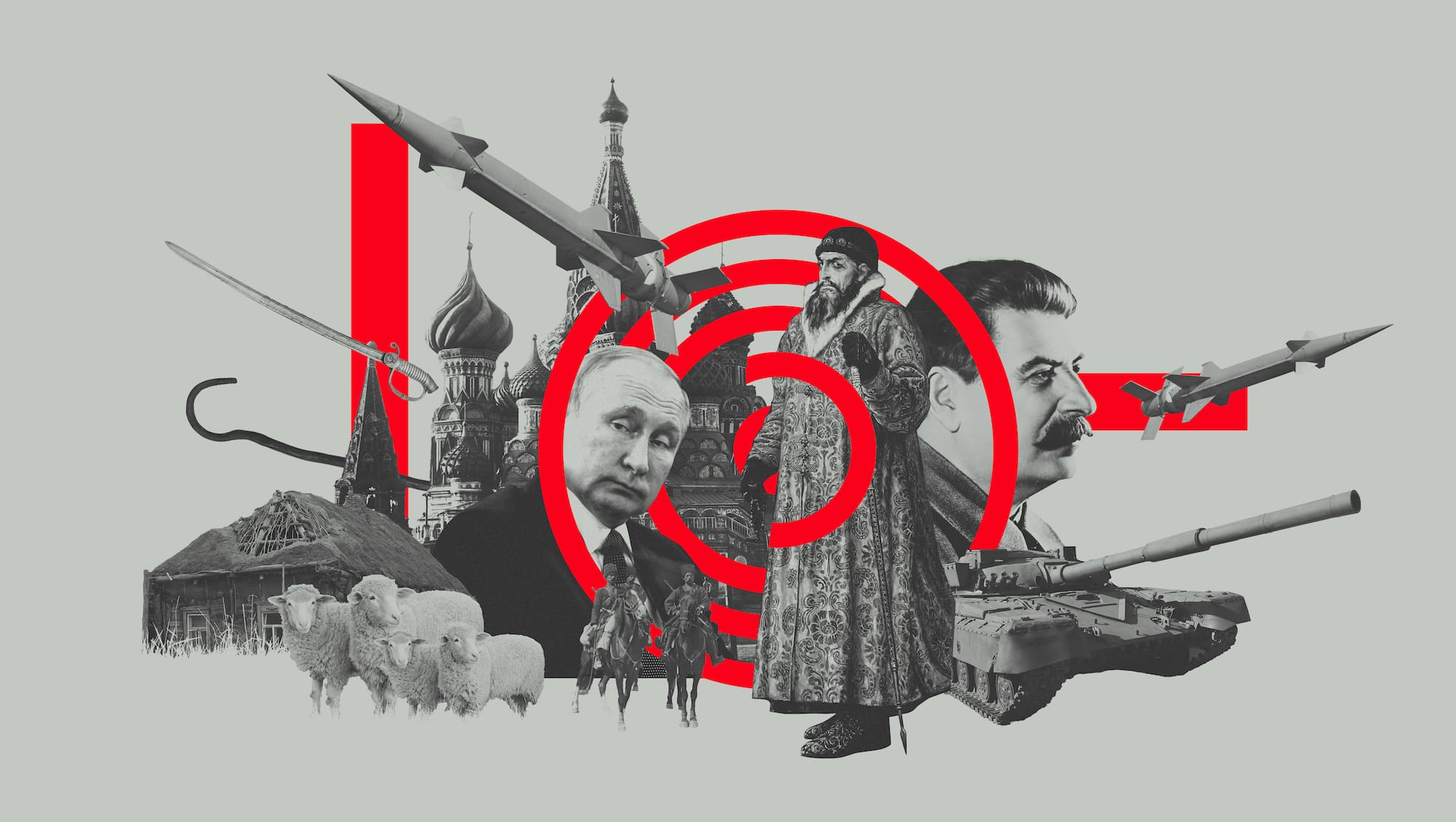
There is a special kind of intellectual crime in which a regime appropriates not territory or resources but a concept itself — tears it out of the context of a centuries-old tradition of thought, hollows out its content and hands it back to the world as a weapon. This is exactly what has happened to the category of “conservatism” in kremlin propaganda over the last fifteen years. putin’s russia, which is waging the largest war of conquest in Europe since the Second World War, has destroyed thousands of churches, cemeteries and museums in the occupied territories, deported tens of thousands of children and turned its own society into a closed military-police organism — and at the same time persistently presents itself to the world as the “last bastion” of traditional, conservative, Christian values. This substitution is not accidental rhetorical carelessness. It is a deliberately constructed ideological product aimed at a very specific audience: the disillusioned part of Western conservative circles, weary of their own culture’s relativism, which seeks support outside its own civilisation and, lacking a convincing alternative, is ready to take the mock-up for the original.
The aim of this essay is not merely to refute the kremlin’s thesis but to break it down into its components and show that each of the pillars on which “russian conservatism” supposedly rests turns out, on closer inspection, to be its opposite. We will turn to the classical canon of conservative thought — Edmund Burke, Joseph de Maistre, Russell Kirk, Michael Oakeshott, Roger Scruton — to set out the criteria by which the conservatism of any political practice can be judged at all. We will then trace the historiographical genealogy of putin’s ideological construct and show that it rests not on the continuity of tradition but on its repeated rupture and arbitrary reconstruction; we will examine the religious dimension — the instrumentalisation of the russian Orthodox Church as an apparatus for legitimising aggression; and finally we will compare the official image of a “traditional society” with real social indicators. The last section is devoted to Ukraine as the genuine, if dramatically tested, bearer of the conservative Christian tradition in Eastern Europe, and the essay ends with an analysis of why Western conservative discourse proved vulnerable to this myth and what can be set against it intellectually.
Section 1. What conservatism is: criteria, not cosmetics
Before talking about false conservatism, we must clearly define what genuine conservatism is — otherwise all further criticism risks becoming a purely rhetorical exercise. The classical tradition founded by Edmund Burke in his polemic against the French Revolution defines conservatism not as a set of symbols or slogans but as a particular way of relating to society: understanding it as a living, historically grown organism that cannot be rebuilt according to a single rational plan without destroying the fabric of ties, customs and mutual obligations between generations. Burke insisted that the social contract is a contract not only among the living, but between those who are living, those who are dead and those who are yet to be born; hence his famous warning against any attempt to abolish, at a single stroke and in the name of an abstract ideal, the accumulated wisdom of institutions.
The American scholar Russell Kirk, in his classic work The Conservative Mind (1953), systematised these intuitions in a number of canons: belief in a transcendent moral order; attachment to the variety and organic development of society as against levelling egalitarianism; the conviction that private property and freedom are inseparably linked; distrust of sophists and rationalists who promise to reach utopia through the concentration of power; and — especially important for our subject — the recognition that change is necessary, but must be organic, gradual and consistent with the existing order rather than imposed from above through violence. The Oxford philosopher Michael Oakeshott, in his essay “Rationalism in Politics”, added another criterion that is decisive for our analysis: conservatism is above all a discipline of modesty, a distrust of grand ideological projects for remaking man and society, a readiness to “sail a boundless and bottomless sea” where there is “neither harbour for shelter nor floor for anchorage”, using the available resources of tradition rather than trying to recut the very nature of the community to fit an abstract scheme. The British philosopher Roger Scruton, in The Meaning of Conservatism, adds the principle of the continuity of institutions and stresses in particular that conservatism is by definition hostile to the cult of violence and state voluntarism, since it is the institutions of civil society, not naked coercion, that carry tradition.
If we apply these criteria — organic growth, gradualism, the modesty of power, distrust of utopian design, respect for the institutions of civil society and for a transcendent moral order that stands above the state — to the practice of the putin regime, the picture that emerges is the direct opposite of what is declared. What we see is not the preservation of tradition but its total instrumentalisation by the state; not organic development but a series of revolutionary ruptures; not the modesty of power but its boundless concentration; not respect for a transcendent moral order but the subordination of religion to political expediency. In other words, by the formal criteria of the classical conservative tradition, putinism is not conservatism but its antithesis, disguised as conservatism for external and domestic consumption.
Section 2. The historiography of a forgery: how the image of the “last bastion” was constructed
The historian Marlene Laruelle, director of the Illiberalism Studies Program at George Washington University, convincingly shows in her fundamental work Ideology and Meaning-Making under the Putin Regime (Stanford University Press) that the kremlin’s turn to a “conservative” vocabulary is a relatively late and tactical phenomenon rather than a deeply rooted one. She traces how, after the protests of 2011–2012 and especially after the annexation of Crimea in 2014, kremlin ideologues began purposefully constructing a conservative narrative as an “ideology at the lowest cost” — a tool that made it possible to mobilise domestic loyalty and at the same time seek allies among the parts of Western societies dissatisfied with their elites, without requiring the state to make any real institutional changes or limit its own power. This is fundamentally different from organic conservatism: here ideology does not flow from tradition but is built by the propaganda apparatus for specific tactical tasks and easily shifts its emphasis when needed — from imperial Eurasianism to Orthodox traditionalism and back again.
The key figure that kremlin propaganda tries to present as the “philosophical foundation” of this conservatism is the russian émigré thinker Ivan Ilyin, whose texts the russian president has repeatedly quoted in major speeches. Andreas Umland, one of the leading Western specialists in the history of russian radical conservatism and neo-Eurasianism, points out in a number of analytical works that Ilyin’s legacy, which is presented as conservative classics, is in fact ideologically akin to interwar European fascism: Ilyin openly sympathised with Mussolini and early German National Socialism and championed the idea of a spiritually justified dictatorship and an organic, hierarchical, anti-democratic state that was to purify russia through coercion. The use of such an author as the “spiritual guide” of the official ideology in itself unmasks the claimed continuity: what we see is not the continuation of the nineteenth-century Orthodox-monarchist tradition but the selective and arbitrary quoting of a marginal figure of the interwar emigration, convenient because he combines religious rhetoric with the justification of authoritarian violence.
The break with tradition is even more evident in the ideology of neo-Eurasianism, whose chief public spokesman is Aleksandr Dugin. Despite attempts to present himself as an heir of Slavophilism and the classical Eurasianism of the 1920s–30s, Dugin’s construct is a typical example of what Umberto Eco, in another context, called “Ur-Fascism” — an eclectic mixture of anti-Western messianism, geopolitical determinism and the cult of the “Great Space”, lacking the internal theological and philosophical coherence of classical conservatism. Ukrainian and Western historiographical analysis (in particular the works of the historians Timothy Snyder and Serhii Plokhy) shows that such constructs arise not as a continuation of pre-revolutionary tradition but as a reaction to the trauma of the empire’s collapse — an attempt by a post-traumatic consciousness to compensate for lost status through a mythologised “special civilisational mission” that is reinvented each time to suit current political needs.
In The Gates of Europe and in his study The Russo-Ukrainian War, the historian Serhii Plokhy documents how the imperial consciousness has repeatedly reconstructed its own genealogy — from the “Third Rome” to the “russian world” — each time adjusting the historical narrative to current expansionist needs, which is the direct opposite of the conservative principle of organic, unimposed continuity.
Section 3. The state instead of tradition: the cult of force as anti-conservatism
One of the most telling signs of the substitution is that in putin’s construct the primary subject and source of meaning is not tradition, the church, the family or the community, but the state — and above all its security institutions. Classical conservatism, from Burke to Scruton, has always warned against deifying the state: for a conservative, the state is a necessary but subordinate instrument for maintaining order, itself subject to a higher moral law and limited by custom, law and the institutions of civil society. In putin’s model the relationship is the reverse: the state, and especially its repressive apparatus, appears as a self-sufficient source of legitimacy to which the church, the family and “traditional values” are subordinated — values that become a function of state security rather than an autonomous spiritual reality.
In The Road to Unfreedom (2018), the historian Timothy Snyder describes this logic through the concept of the “politics of eternity” — a regime that, instead of linear historical time with its responsibility for the future, offers society a myth of permanent siege by a hostile West, a myth that justifies any concentration of power and any violence as “defensive” by definition. This directly contradicts the conservative understanding of time as gradualness and the succession of generations: instead of cultivating a heritage, the “politics of eternity” exploits a sense of threat to justify permanent mobilisation. The journalist and historian Anne Applebaum, in Twilight of Democracy (2020), also shows how conservative rhetoric in the authoritarian and semi-authoritarian regimes of Central and Eastern Europe often serves not to preserve real institutions but to justify the personal power of elite groups that have captured the state; putin’s russia is the most developed and consistent version of this logic.
The cult of force at the heart of the putin state also contradicts conservatism because the conservative tradition has always regarded force as a means of defending an established order, not as an end in itself or an instrument of expansion. The war against Ukraine, unleashed under the slogans of “defending traditional values” and “denazification”, demonstrates the opposite: it is an aggressive war of annihilation against a neighbouring state, accompanied by mass war crimes, the deportation of children and the destruction of civilian infrastructure — that is, the direct and systematic negation of the very traditional moral norms (the prohibition on killing the innocent, respect for another’s property, the sanctity of the family, which is torn apart when children are deported) in whose name it is supposedly being waged.
A conservatism that in practice justifies genocidal rhetoric and mass crimes against civilians ceases to be conservatism in any meaningful sense of the word and turns, in the apt definition often used by scholars of totalitarianism, into a form of reactionary radicalism — an ideology that uses conservative vocabulary to pursue entirely revolutionary, destructive goals.
Section 4. The religious dimension: when the cross becomes a war banner
A particularly weak point of the kremlin’s construct is the attempt to present russia as a stronghold of Christianity destined to defend its “spiritual bonds” against the secular West. The reality of the russian Orthodox Church under Patriarch Kirill (Gundyaev) directly refutes this thesis. The theologian Cyril Hovorun, a Ukrainian Orthodox priest and scholar, author of Political Orthodoxies (2018), introduced the concept of “political hyper-orthodoxy” — a phenomenon in which a church institution merges completely with state ideology, subordinating its own theology to the need to legitimise power. This is exactly what is happening with the concept of the “russian world”, officially endorsed by the moscow patriarchate: the idea of a special civilisational community that needs military protection and the expansion of its borders is not a theological but a geopolitical construct wrapped in church terminology.
The Austrian scholar Kristina Stoeckl, author of The Russian Orthodox Church and Human Rights (2016) and co-author of studies of post-secular conflicts in Europe, documents how the moscow patriarchate has systematically used the rhetoric of defending “traditional values” on international platforms — from the Council of Europe to conferences of conservative activists in the US — building networks of influence among Western religious and political conservatives long before the full-scale invasion. This activity is clearly instrumental rather than spiritual: it aims to form coalitions loyal to the kremlin on geopolitical questions under the pretext of a shared position on family values. Nikolay Mitrokhin, a long-standing specialist in the history of the russian Orthodox Church, describes in detail in his works the structural dependence of the church hierarchy on the security services since Soviet times — a dependence that was not overcome but merely adopted a new rhetoric after the collapse of the USSR.
The culmination of this process was Patriarch Kirill’s open support for the war against Ukraine, including sermons in which the death of russian soldiers on the battlefield was equated with a sacrificial feat that “washes away all sins”. This is a direct and glaring violation of Christian ethics in its classical sense — an ethics that forbids murder, condemns pride and aggression and demands repentance rather than the sacralisation of violence. The Ukrainian religious scholar and human rights defender Myroslav Marynovych, a former Soviet political prisoner and co-founder of the Ukrainian Helsinki Group, has repeatedly stressed in public speeches and essays that genuine Christianity and genuine conservatism are incompatible with an ideology of imperial revanche, and that the attempt to combine the cross with militaristic expansion is a form of religious blasphemy capable of doing religion long-term reputational damage in the eyes of younger generations.
Much of world Orthodoxy has responded by distancing itself: the Ecumenical Patriarchate in Constantinople, a number of local churches and many theologians — in the open letter “A Declaration on the ‘Russian World’ (Russkii Mir) Teaching” (2022), signed by more than a hundred Orthodox theologians and scholars from around the world — described the “russian world” doctrine as a heresy contrary to the foundations of Christian faith. This document is probably the weightiest intellectual and theological refutation of the “spiritual bastion” thesis: the Orthodox theological community itself has recognised the official moscow doctrine as a deviation from tradition, not its defence.
Section 5. Social reality versus the advertising image
The image of a “traditional society” that the kremlin exports to the West rests on the idea of a strong family with many children, deep religiosity and a high level of trust between people. Social indicators recorded both by international research consortia (in particular the World Values Survey) and by independent russian sociologists before independent sociology was shut down in the country paint a different picture. The level of trust between citizens in russia remains one of the lowest among European countries — a long-term legacy of the atomised Soviet society that the putin regime did not overcome but deepened through the spread of denunciation, mutual suspicion and state control over private life. Studies of domestic violence carried out by independent human rights organisations before they were banned recorded a scale of the problem that contrasts sharply with the rhetoric of “protecting the family”: the partial decriminalisation of domestic violence in 2017, backed by structures close to the rpc under the pretext of “state non-interference in family matters”, shows how conservative vocabulary is used not to strengthen the family but to relieve the state of responsibility for protecting its most vulnerable members.
Demographic statistics likewise refute the image of a flourishing traditional society: long-term depopulation, high levels of alcohol abuse and related mortality among men of working age, one of the highest divorce rates in Europe — all this was recorded by official russian statistics long before the war and has only worsened since 2022 because of mass emigration and battlefield losses. The sociologist and writer Sergei Medvedev, author of the book Park of the Crimean Period (English edition: The Return of the Russian Leviathan, 2020), describes contemporary russian society as experiencing not a revival of tradition but a deep traumatic regression — the infantilisation of the citizen, who delegates all responsibility for moral choice to the state instead of being, as the conservative ethic of personal responsibility demands, the bearer and guardian of tradition within the family and the community.
It is important to stress the methodological fairness of this argument: social problems are not unique to russia; they exist to some extent in all societies, and no respectable conservative position should turn into condescending mockery of others’ difficulties. The problem is not the presence of social ills as such, but the glaring contrast between the propaganda image of a “model traditional society” and the documented reality — and, most importantly, the fact that the state systematically blocks free civic discussion of these problems by banning independent sociology, human rights organisations and investigative journalism, that is, precisely the institutions of civil society that classical conservatism, from Tocqueville to Scruton, regards as an indispensable means of tradition’s organic self-correction.
Section 6. The authentic alternative: Ukraine as heir to the conservative Christian tradition
If we look in Eastern Europe for a society that genuinely, rather than declaratively, embodies conservative values in the Burkean sense — the organic development of institutions, a plurality of communities, the autonomy of the church from the state, a living tradition of self-government — Ukraine has a far stronger claim to be that society. The historian Yaroslav Hrytsak has repeatedly drawn attention in his works on Ukrainian history to a deeply rooted tradition of communal self-government — from the Cossack republican culture of the Zaporozhian Sich, with its elected officers and assembly decisions, to the Magdeburg law of Ukrainian cities and the cooperative movement of the late 19th and early 20th centuries. This tradition is structurally conservative in the classical sense: it presupposes the dispersal of power, respect for local autonomy and distrust of centralised despotism — precisely the features that, according to scholars of russian autocracy, have historically been lacking in the political culture of Muscovy and its imperial successors.
In her studies of early modern Ukrainian history, the historian Natalia Yakovenko shows that the Ukrainian cultural tradition took shape at the intersection of several confessional and legal traditions — Eastern Christianity, Western law, Renaissance humanism — which made it organically pluralistic, whereas the muscovite tradition developed in the logic of one-man rule and the absorption of autonomous institutions. The autocephaly of the Orthodox Church of Ukraine, granted in 2019, is in this sense not a political episode but the restoration of an older tradition of church autonomy from the state centre that existed within the Metropolis of Kyiv long before its subordination to the moscow patriarchate in the 17th century — an act of restoration rather than revolution, a typically conservative gesture in its logic.
At the same time, honesty requires us to admit that Ukrainian society is not an ideal embodiment of the conservative ideal and is undergoing its own complex processes of secularisation, urbanisation and cultural transformation common to all of modern Europe. But the fundamental difference lies elsewhere: Ukrainian conservatism, to the extent that it exists, develops from below, through voluntary associations, parishes and volunteer networks that during the full-scale war have shown an impressive capacity for self-organisation without orders from the state — whereas russian “conservatism” is constructed and imposed from above by the propaganda apparatus and serves not the community but the state. Ukrainian society’s resistance to aggression, which relies largely on horizontal networks of trust, mutual aid and local initiative, is empirical confirmation of the thesis of thinkers from Tocqueville to Putnam that the vitality of a society is determined not by the strength of a centralised state but by the density of its civic ties.
Section 7. Why the West is vulnerable to the myth — and what to set against it
It remains to explain why some Western conservatives prove receptive to the kremlin’s narrative despite the obvious contradiction between the regime’s official rhetoric and its practice. The reason, in our view, lies not so much in the weakness of the kremlin’s logical argument as in the structural crisis of Western conservative discourse itself. Over recent decades, a significant part of Western conservative circles has felt itself the loser in the culture war within its own societies — on questions of the family, religion in public life and national identity — and in this situation of frustration, the image of a “strong state” that supposedly defends traditional norms successfully by force makes a tempting impression of an effective alternative. This is a psychological mechanism of projection: it is not that russia meets the real criteria of conservatism, but that dissatisfaction with one’s own society creates a demand for a compensatory myth that a “true” fortress exists somewhere — and the kremlin readily meets that demand.
In the already mentioned Twilight of Democracy, Anne Applebaum analyses what she calls the “seductive lure of authoritarianism” among some contemporary right-wing intellectuals and shows that this temptation is fed not by analysis of the facts but by nostalgia for an imagined “golden age” of homogeneity and order, projected onto an external actor whose real condition observers consciously or unconsciously ignore.
In his studies of the kremlin’s information operations, the political scientist Andrew Wilson documents the concrete mechanisms through which this temptation is sustained institutionally: funding conservative media and think tanks, organising conferences and visits, and building personal ties with politicians and religious leaders willing to relay the narrative without critically checking sources.
What can be set against this intellectually? First, a consistent return to a discussion of conservatism based on criteria rather than decoration: the question should be not “who talks loudest about tradition” but “whose institutions genuinely show organic growth, restraint of power, respect for community autonomy and subordination to a transcendent moral law”. Second, systematic educational work among Western audiences, backed by facts and living testimony, that exposes the specific mechanisms of propaganda — exactly the kind of work to which this essay contest is devoted. Third, it is important to offer the West an image of authentic tradition in Eastern Europe that is no less compelling than the kremlin’s, but true — the image of Ukraine, which is paying the highest possible price to defend its own genuinely pluralistic and organically rooted civic and spiritual tradition against imperial uniformity.
Conclusions
This analysis allows us to state that applying only the formal criteria of the classical conservative tradition — organic growth, gradualism, the modesty of power, the subordination of the state to a transcendent moral law, the autonomy of the church and of the institutions of civil society — reveals a deep and structural mismatch between the official rhetoric of the putin regime and its actual practice. Historiographical analysis shows that the kremlin’s “conservatism” is a late tactical construct, not the heir of an unbroken tradition; analysis of state practice reveals a cult of force and permanent mobilisation instead of gradualism and restraint; the religious dimension shows the instrumentalisation of the church to legitimise aggression, condemned even by a large part of the Orthodox theological community itself; social indicators refute the image of a flourishing traditional society; and, finally, comparative analysis shows that it is Ukraine, with its tradition of communal self-government, confessional pluralism and horizontal self-organisation, that is a far more convincing candidate for the role of the authentic bearer of the conservative Christian heritage in Eastern Europe.
The task facing Ukrainian and Western intellectuals, scholars and public figures is not simply to refute kremlin propaganda in a single polemical article, but systematically — through academic publications, conferences, educational programmes and international cooperation — to restore to the very concept of conservatism the substantive rigour that the propaganda machine has taken from it. Only when the word again means what it meant for Burke and Kirk, rather than whatever it is convenient to proclaim from a kremlin podium, will Western society gain a reliable tool for recognising the forgery — and at the same time discover a true ally in Ukraine, which for more than a decade has been defending, weapons in hand, not an abstract geopolitical construct but the very concrete, living and vulnerable foundations of European civilisation.
References
- Applebaum A. Twilight of Democracy: The Seductive Lure of Authoritarianism. New York: Doubleday, 2020.
- Burke E. Reflections on the Revolution in France. London: J. Dodsley, 1790.
- Hovorun C. Political Orthodoxies: The Unorthodoxies of the Church Coerced. Minneapolis: Fortress Press, 2018.
- Kirk R. The Conservative Mind: From Burke to Eliot. Chicago: Regnery, 1953.
- Laruelle M. Ideology and Meaning-Making under the Putin Regime. Stanford: Stanford University Press.
- Laruelle M. Conservatism as the Kremlin’s New Toolkit: An Ideology at the Lowest Cost // Russian Analytical Digest. 2013. No. 138.
- Oakeshott M. Rationalism in Politics and Other Essays. London: Methuen, 1962.
- Plokhy S. The Gates of Europe: A History of Ukraine. New York: Basic Books, 2015.
- Plokhy S. The Russo-Ukrainian War: The Return of History. New York: W. W. Norton, 2023.
- Scruton R. The Meaning of Conservatism. London: Palgrave Macmillan, 1980.
- Snyder T. The Road to Unfreedom: Russia, Europe, America. New York: Tim Duggan Books, 2018.
- Stoeckl K. The Russian Orthodox Church and Human Rights. Abingdon: Routledge, 2016.
- Umland A. Fascist Tendencies in Russian Higher Education: The Rise of Aleksandr Dugin and the Faculty of Sociology of Moscow State University // Demokratizatsiya.
- “A Declaration on the ‘Russian World’ (Russkii Mir) Teaching”. Public Orthodoxy, 13 March 2022.
- Hrytsak Ya. Overcoming the Past: A Global History of Ukraine. Kyiv: Portal, 2021 (in Ukrainian).
- Marynovych M. The Ukrainian Idea and Christianity, or When the Coloured Horses of the Apocalypse Prance. Kyiv: Dukh i Litera, 2003 (in Ukrainian).
- Medvedev S. Park of the Crimean Period / English edition: The Return of the Russian Leviathan. Cambridge: Polity Press, 2020.
- Yakovenko N. An Outline History of Medieval and Early Modern Ukraine. Kyiv: Krytyka, 2005 (in Ukrainian).
Author: Mariia Panasiuk