Консервативна Платформа
  • News
    • Analytics
    • Worldview
    • Anti-imperial front
    • Weapons
    • Geopolitics
  • publication
  • Position.
  • Events.
Friday, August 28, 2026
  • English
    • Ukrainian
Консервативна Платформа
  • News
    • Analytics
    • Worldview
    • Anti-imperial front
    • Weapons
    • Geopolitics
  • publication
  • Position.
  • Events.
Консервативна Платформа
  • News
    • Analytics
    • Worldview
    • Anti-imperial front
    • Weapons
    • Geopolitics
  • publication
  • Position.
  • Events.
Copyright 2021 - All Right Reserved
Important

There is no need to demonize the right, or what is wrong with the statement “the European right supports Putin.”

від Юрій Гончаренко September 1, 2024

In the Ukrainian media, and especially on social media, one often hears the statement that “the European right supports Putin.” Sometimes “ultra” is added to the word right, but the main narrative here is simple: the right is allegedly Putin’s direct ally in Russia and, therefore, Ukraine’s enemy. The fact that Putin’s regime calls itself a defender of conservative values and declares a fight against “gay Europe,” “lgbt satanism” and the main trigger of modern politics – migration – helps to promote these theses.

However, as always, when it comes to Russia, this is outright manipulation and lies. And those who claim that the European right is “pro-Russian” are, in fact, helping Putin and his ideologues.

What is wrong with the myths about the “European Right”?

Let’s first look at who is Putin’s biggest and most consistent ally in Europe. Of course, Viktor Orban and Marie Le Pen immediately come to mind. And the political forces they formally and informally lead. It is indeed difficult to argue with this, and there is ample evidence of cooperation or at least solidarity with Putin regarding Orban, as well as evidence of Le Pen’s funding from the Kremlin, and the corresponding rhetoric in response.

But these are only two parties. There are, of course, others, such as the Freedom Party in Austria, AUR in Romania, and others. However, it is worth noting that not only right-wing parties are supported by the Kremlin and funded by Russian money. In Germany, in addition to the right-wing populist AfD, the left-wing Die Linke is also pro-Russian . And Gerhard Schroeder, who simply went to work for Russia, belongs to the Social Democrats and was chancellor of this party.

The situation in the UK is even more interesting. Until 2020, the current ruling Labor Party was headed by Jeremy Corbyn. He, along with several other influential Labor members, is the co-founder and leader of the Stop the War Coalition, which is actually one of Russia’s oldest and most consistent allies in the world. Little is said about them, although at the beginning of their activities they managed to gather up to two million participants at their events in London. The association has been active since 2001 and has consistently opposed any military action in the world conducted by NATO countries. However, they have never criticized Russia, they supported the annexation of Crimea, and after February 24, 2022, they advocate peace “taking into account the interests of Russia.” Should I add that they support Hamas in its attacks on Israel? It is also worth adding that their leaders include Charles Kennedy, one of the leaders of the Liberal Democrats in the UK. And all of Putin’s allies in Europe, both right-wing and left-wing, have gathered at their events, including those against aid to Ukraine.

Looking at the issue from a different angle, it is worth recalling the example of Giorgia Maloni, the leader of the Brothers of Italy and the Prime Minister of that country. Among the leading parties in Europe, it is difficult to find a more right-wing party, including historically. If you want, you can add ultra to it, just like Le Pen’s party. However, this party and its leader are consistent opponents of Russia and friends of Ukraine. And if we go back to Britain, the Conservative Party of that country, which also belongs to the right-wing political spectrum, is a friend of Ukraine.

If you go deeper into smaller parties in different countries, there is also a division on the issue of pro-Russianism. Although, of course, it is pointless to deny that the Kremlin has invested huge resources to gain allies. But, as we can see, it is fundamentally wrong to put an equal sign between the right and the pro-Kremlin. Because it is not true.

Why does the Kremlin systematically work with the right?

It is pointless to deny that Russia is looking for allies among the parties on the right of the spectrum. However, efforts and results do not always go hand in hand.

The main explanation is that after a relatively short search, Russia settled on conservatism as the main state ideology. It is difficult to say why this choice was made, but starting in the second half of the noughties, it was not only generally formed, but also publicly voiced. And it was this ideology that sought allies around the world, to whom Russia offered money and media support.

For this purpose, the huge network of the Rasha Tudei/Sputnik holding was involved, as well as media outlets bought by Russian oligarchs. Separately, work was being done on neo-Nazi movements and football hooligans, who gradually came under the full control of the FSB. However, already at this stage, Putin had his first major problem when passionate members of these movements who did not fall under his control got out of control and organized several unpleasant events, the largest of which was the riots at the “arena” due to the murder of one of the fans by representatives of one of the Caucasian criminal diasporas.

The next breakdown occurred in 2014, when some of the very authoritative leaders of these movements categorically opposed the annexation of Crimea and the invasion of Donbas. The same thing happened again in 2022. At the same time, some of the leaders left Russia, and Denis Kapustin even became the founder and commander of the RDC, which is fighting against the Kremlin on the side of Ukraine. This became a big problem, as Kapustin is a well-known and influential figure in these circles. No less famous than Sergei Korotkikh (Boatswain). And Maksym Martsynkevych (Tesak), who was killed in prison, who once publicly supported the Maidan.

Of course, the Kremlin has also created fully controlled groups, such as Espanyol and 106. But even here, Russia has a certain trap, since one of the largest fan groups in Russia, and one of the supporters of CSKA Moscow, called RBV, has a symbol of a dead head in its emblem, which is openly Nazi. And it is the leaders of this group who are the founders of the “Española” and are fighting against Ukraine. They are denazifying us through Nazism, so to speak.

Kadyrov’s trap

The main reason why the Kremlin’s bet on the right turned out to be a strategic failure even has a name: Ramzan Kadyrov. It is no secret that Putin gained control of the Caucasus not as a result of a successful military operation, but by buying one of the clans of Ichkeria, Kadyrov. He is allowed to do almost anything in Russia, provided he is personally loyal to Putin. And this has led to the fact that Russian right-wing ideas are actually hostile to what the Kadyrovs are allowed to do.

Another global problem is mass migration from Central Asia, and more recently from Africa. There are already entire neighborhoods in Moscow where people either do not understand Russian at all or understand it but do not use it. Nor is there any support for Orthodoxy in its Russian version. Despite the appearance of public statements by Russian officials about the “fight against migrants” in the context of crime and even calls for its restriction, real action in this direction is impossible because there is Kadyrov.

To whom Putin cannot declare war. And whose impudence simply knows no bounds, and only the lazy did not mock the “exploits” of the “akhmat” battalion. However, Kadyrov is untouchable, which was clearly seen when his son was allowed to publicly beat a man in prison.

So what kind of alliance between Russia and the European right is possible under these conditions? Only one based on financial resources and in the case of marginalization of the right.

Why are liberals becoming Putin’s allies?

The above leads to a paradoxical conclusion that at this stage, the Kremlin is interested in Ukrainian and European liberal figures demonizing right-wing and conservative politicians as much as possible, precisely because of accusations of collaboration with Russia. This is the only way to preserve the situation where right-wing and conservative parties in Europe are led by politicians who are directly bought or are agents of the FSB.

In any other scenario, sooner or later, these parties will be dominated by those who will ask simple and deadly questions for the Kremlin, the main of which is: why does Russia’s declared conservatism not coincide with reality? Why did Russia give its capital to migrants? Why is Kadyrov the most influential politician in Russia after Putin? Why and for what purpose does the “African Shit” program, which is supposed to assimilate immigrants from South Africa, work? Why does a significant part of the Russian elite have homosexual tendencies and this is constantly being brought into the public space? And, finally, why is the authoritative and independent Russian right on the side of Ukraine?

Politics in Europe works in such a way that there is real competition and maintaining a monopoly on power in parties requires serious efforts. For example, involving ideological enemies from the liberal camp to create false perceptions of Russia and Ukraine

Liberal Ukraine?

In order to destroy the Russian myths about the denazification of Ukraine, combined with the fight against “sodomy” and in defense of Orthodoxy, it is enough to reasonably convey to supporters of the pro-Putin right such facts as, for example, that 80% of Ukrainians are Christians. That Ukraine’s migration policy does not artificially stimulate the emergence of a huge number of citizens from Central Asia or Africa.

Ukraine is a democratic country that is still on the way to civic and political education of its society. We lack the ability to distinguish between ideologies and are heavily influenced by populist politicians. However, Ukrainians are characterized by both self-reliance and a tendency to preserve kinship, the traditional family, private property, and national identity. Liberal multiculturalism has not been particularly successful in Ukraine, unlike mutual support.

So are we predominantly liberal? Hardly. Rather, we are right-wing conservative. And what separates us from the European right? Money and the Kremlin’s media influence. Including the imposition of labels such as “the European right supports Putin.”
September 1, 2024
FacebookTwitterLinkedinWhatsappTelegramViberEmail
Analytics

What should we do with Poland?

від Майданюк Валерій September 1, 2024

The recent statement by Polish Prime Minister Donald Tusk (who was considered in Ukraine to be a liberal democrat devoid of “Pisiv” nationalism) about blocking Ukraine’s European integration without resolving historical issues with the Poles has actualized a problem that Ukraine has long preferred to ignore. But Poland has decided to “fight the dead” again, despite the fact that Ukraine today is the shield of Europe that protects the lives and security of Poles.

The Ukrainian-Polish historical debate cannot be resolved in favor of the national egoism of one side. Especially the side that raises centuries-old historical grievances against its neighbors and demands reparations, apologies, and fuels the latest talk of “genocides.” Ukrainians will not abandon their national memory, will not stop honoring the Cossacks and Haidamak rebels, the soldiers of the ZUNR and the OUN and UPA who fought for their country, dignity, rights and freedoms. Polish politicians should begin to see Ukraine as an equal partner, and to perceive history not only through their own national-centered glasses.

Ukraine today is too important a country in the world to be addressed in the language of ultimatums. Especially from a country that is now creating a national cult of searching for historical grievances. Polish politicians would be well advised to look not to the past, but to the present, especially to the northeast, where the future of the security of the whole of Europe is being decided.

Today, Ukrainians cannot and do not want to hold any grudges against the Poles for national oppression, serfdom and serfdom during the Polish-Lithuanian Commonwealth, the war with the ZUNR, pacification, and the extermination of the Ukrainian civilian population in Galicia, Kholm, Podlasie, and Volhynia in the 1940s. They don’t want to because they realize that there are more important threats to the present than the search for those who offended us a hundred or three hundred years ago. While Ukraine has a predominantly friendly attitude toward Poles, Polish politicians, even those in the liberal democratic camp, have decided to once again aggravate relations with the country that protects Polish skies from Russian missiles and “shaheds.” After all, Polish air defense does not protect its own skies, either because of the weather or for some other reason.

In his accusations against Ukraine, Polish Prime Minister Tusk appeals to the history of the EU and forgiveness, but for some reason forgets the ideological heritage of the founders of the European Union, Robert Schuman and Konrad Adenauer, who came to reconciliation not by demanding thousands of apologies, recognition of the latest “genocides” or reparations, but by realizing mutual respect for the sake of common peace and prosperity.

Given the weakness of Euro-Atlantic security structures and the possible victory of Trump or someone like Trump in Washington, Ukraine, Poland, and other Eastern European countries should consider creating an additional security alliance, such as the Intermarium or the Baltic-Black Sea Union. So that when Russia attacks the Suwalki corridor, there will be someone to extend a strong helping hand, not a letter of deep concern. The creation of such a joint defense alliance is a guarantee of peace in Eastern Europe for decades to come. Russia never pushes in where it sees unity, strength, and readiness to defend itself.

However, historical attacks on Ukraine (a country that has been colonized for so many centuries) and outbreaks of economic blockade of Ukrainian goods on the Polish border do not contribute to good neighborly and security cooperation between countries that, in peace and harmony, could become a reliable defense against the claws of the Russian eagle.

September 1, 2024
FacebookTwitterLinkedinWhatsappTelegramViberEmail
Translation.

Financial Times: Critical situation near Pokrovsk and failure of defense in Donbas

від Юрій Гончаренко August 30, 2024

Based on the materials of Financial Times, translation of the portal Conservative Platform


Satellite imagery analyzed by the Finnish investigative group Black Bird Group shows that Russian troops are now only 8 km from Pokrovsk. In response, local authorities ordered the evacuation of residents in the area.

Oleksandr Kovalenko, a military analyst with the Information Resistance group in Kyiv, called the situation on the eastern outskirts of Pokrovsk “a complete failure of defense.” “This is not the fault of ordinary soldiers who hold the positions,” he wrote in Telegram. “The problem is with those who make decisions for these soldiers,” he added, pointing to Ukraine’s leadership.

Zhenya, a Ukrainian soldier with the 93rd Mechanized Brigade who fought in the grueling 10-month battle for Bakhmut last year, described the situation in Pokrovsk as rapidly deteriorating. In his frank assessment on the website “X”, he criticized the military command: “Honestly, I have never seen anything like this. Everything is falling apart so fast,” he warned. “Pokrovsk will fall much faster than Bakhmut.”

During a press conference in Kyiv on Tuesday, President Zelenskiy described the situation on the front line near Pokrovsk as “extremely difficult” but said that the Russian offensive in the area had slowed following the advance of Ukrainian troops at the Kursk Bulge. However, according to several military analysts, including Deep State, a Ukrainian group closely affiliated with Ukraine’s Defense Ministry, Russian troops have advanced faster in Donetsk since August 6 compared to previous months.

“It’s complete chaos there,” said Roman Pogorilyi of Deep State, pointing to the fall of key towns like Novohrodivka and the threat to Pokrovsk. Over the past three weeks, Moscow forces have rapidly seized more than two dozen towns and villages with minimal resistance, including the long-held stronghold of Nyzhyk.

Rob Lee, senior fellow at the Institute for Foreign Policy Studies, attributes Russia’s success to a lack of experienced Ukrainian infantry and the diversion of resources to the Kursk offensive: “Ukraine has shifted its reserves to Kursk, leaving fewer options to fill the gaps elsewhere. Some of the more experienced brigades have been replaced by newer, less experienced units,” Lee said.

Soldiers who were mobilized this summer under the Ukrainian government’s new conscription laws, designed to replenish the dwindling ranks of the Ukrainian Armed Forces, were sent into battle without sufficient training or experience. “They freeze…they don’t know what to do in real combat,” said a lieutenant whose unit is on the front lines near Pokrovsk. Many “turn around and run away at the first explosion.”

Soldiers in artillery units near Pokrovsk also emphasized the shortage of shells and the serious mismatch in firepower compared to Russian forces. “We are running out of shells, there are simply not enough of them,” said an artillery unit commander, noting that many resources have been redirected north to Kursk. Over the past month, his unit has been firing one shell for every six to eight Russian attacks.

The situation is complicated by the fact that newly mobilized soldiers often lack proper training and experience. According to one of the lieutenants, many of them do not know how to act in a real battle and often panic during shelling. This leads to disorganization and weakening of defensive positions.

Artillery units also faced serious problems. The commander of one such unit said that his men are forced to save every shell as ammunition supplies have been significantly reduced. “We can only respond with one shot for every six to eight enemy shots,” he said. Such a disproportion in firepower puts Ukrainian defenders at a severe disadvantage.

Experts and military analysts point out that the situation near Pokrovsk is the result of strategic miscalculations by the high command. The diversion of significant forces and resources to the Kursk direction led to a weakening of defense in other parts of the front, which was exploited by Russian troops.

The situation around Pokrovsk raises serious concerns and calls into question the effectiveness of the strategic decisions of the Ukrainian leadership. Experts and the public are calling for an urgent review of tactics and redistribution of resources to strengthen the defense in Donbas to prevent further advance of Russian troops and the possible loss of key cities in the region.

August 30, 2024
FacebookTwitterLinkedinWhatsappTelegramViberEmail
War

DIU strikes oil depot deep in Russia: drones fly over 1200 km

від Юрій Гончаренко August 28, 2024

Ukrainian drones strike at the Zenit oil depot in Kotelnich, Kirov region of Russia. The target is located more than 1200 km from the Ukrainian border. This was reported to the Research and Analysis Group InfoLight.UA by its own sources in the Ukrainian intelligence.

According to sources, the attack on the oil depot was carried out by Ukrainian-made kamikaze drones. Local telegram channels report that the attack was carried out using at least five UAVs. As a result of the attack, two tanks at the oil depot caught fire.

“As a result of the operation, the Defense Intelligence of Ukraine hit the oil depot of the Zenit State Enterprise near the village of Kotelnych, Kirov region of the Russian Federation,” the source said.

It is worth noting that this is the first time that Ukrainian drones have attacked an enemy facility in the Kirov region of the Russian Federation. The distance of the target from the Ukrainian border is over 1200 kilometers.

Zenit is an object of the enemy’s military-industrial complex and provides fuel to the occupation forces of the Russian Armed Forces.

Russian media also confirmed the attack, noting that it was the first time Kirov region was attacked by drones. According to them, the drones successfully hit tanks on the territory of Rosrezerv’s Zenit plant in Kotelnich, which is more than 1,400 kilometers from the border with Ukraine.

Interestingly, earlier today, on August 28, sources reported a successful attack by Ukrainian drones on an oil depot in the Rostov region of the Russian Federation. In particular, the Atlas oil depot near the Kamensk-Shakhtinsky settlement was hit. This operation was also carried out by the joint efforts of the GUR and the SSO with the help of Ukrainian-made strike UAVs.

InfoLight.UA Research and Analysis Group continues to monitor the developments and will keep you informed of new details of these transactions.

August 28, 2024
FacebookTwitterLinkedinWhatsappTelegramViberEmail
War

Ukraine’s DIU leads in number of attacks on Russian air bases in 2024 – Molfar study

від Юрій Гончаренко August 26, 2024

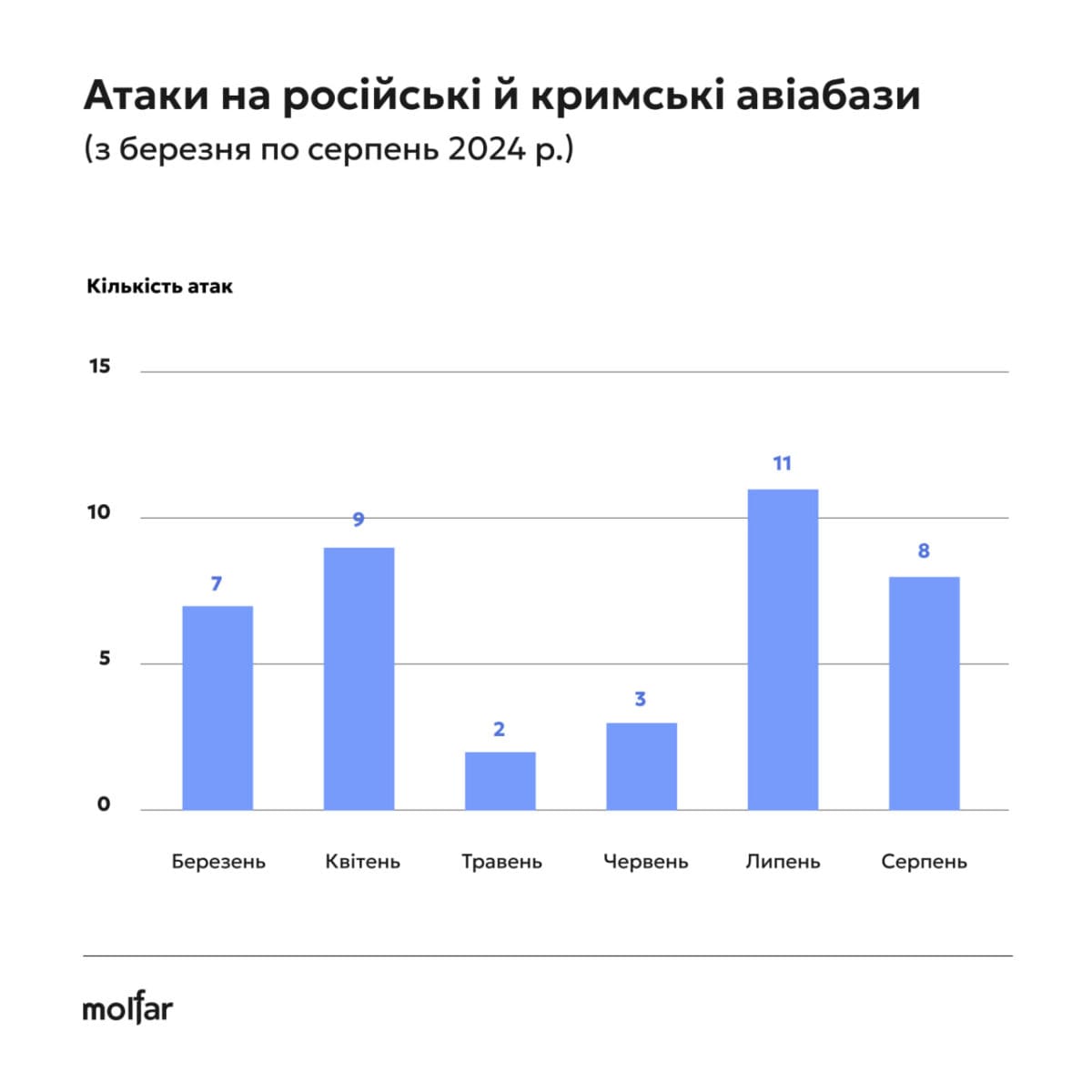
Analysts at the OSINT agency Molfar have released a study that shows significant activity of Ukrainian special services in striking Russian military targets. According to the agency, since the beginning of 2024, Russian air bases and airfields have been attacked by Ukraine at least 40 times.

According to the study, from March to August of this year, 35 attacks were carried out on the aggressor’s air bases in the territory of the Russian Federation, and another 5 on military airfields in the temporarily occupied Crimea.

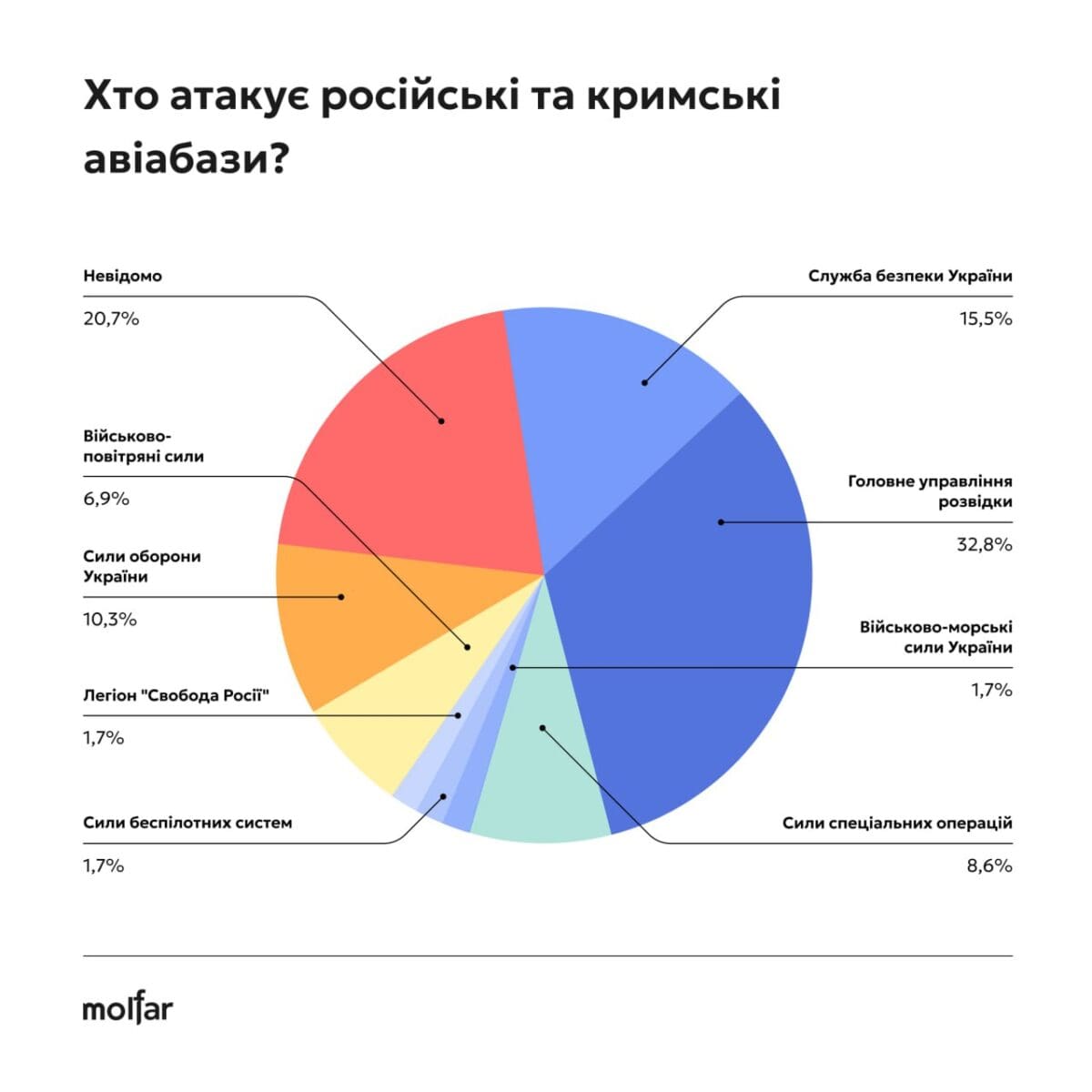
The Main Intelligence Directorate of Ukraine was the leader in terms of the number of operations conducted, accounting for 32% of all attacks carried out by kamikaze drones. The rest of the attacks were distributed as follows:

  • 15% – SBU
  • 10% – Defense Forces
  • 9% – STS
  • 7% – Air Force
  • about 20% of attacks were carried out by unknown units

It is worth noting that Molfar is a community of 35 analysts and more than 200 volunteers who are engaged in identifying war criminals, refuting Russian propaganda, and investigating war crimes.

As a reminder, on August 16, the GUR launched a powerful attack on the Russian airfield Savasleyka. The attack by kamikaze drones destroyed three military aircraft, including one MiG-31K/I, and severely damaged five other aircraft.

Source: https://x.com/molfar_agency/status/1826624553663270954

August 26, 2024
FacebookTwitterLinkedinWhatsappTelegramViberEmail
Position.

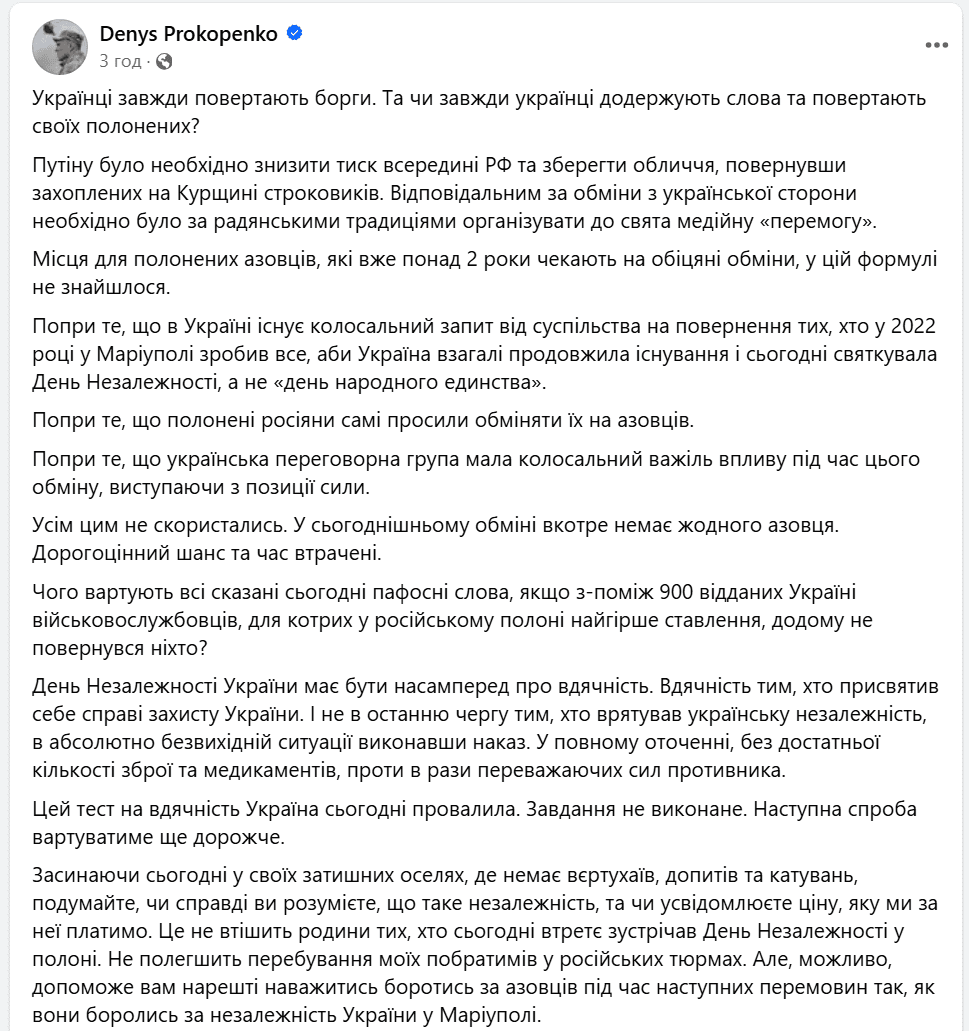
Azov commander on the exchange: why Prokopenko’s statement sparked a discussion

від Юрій Гончаренко August 24, 2024

The new details raise questions about the position of Denys “Redis” Prokopenko, the Azov command and the prospects for further exchanges

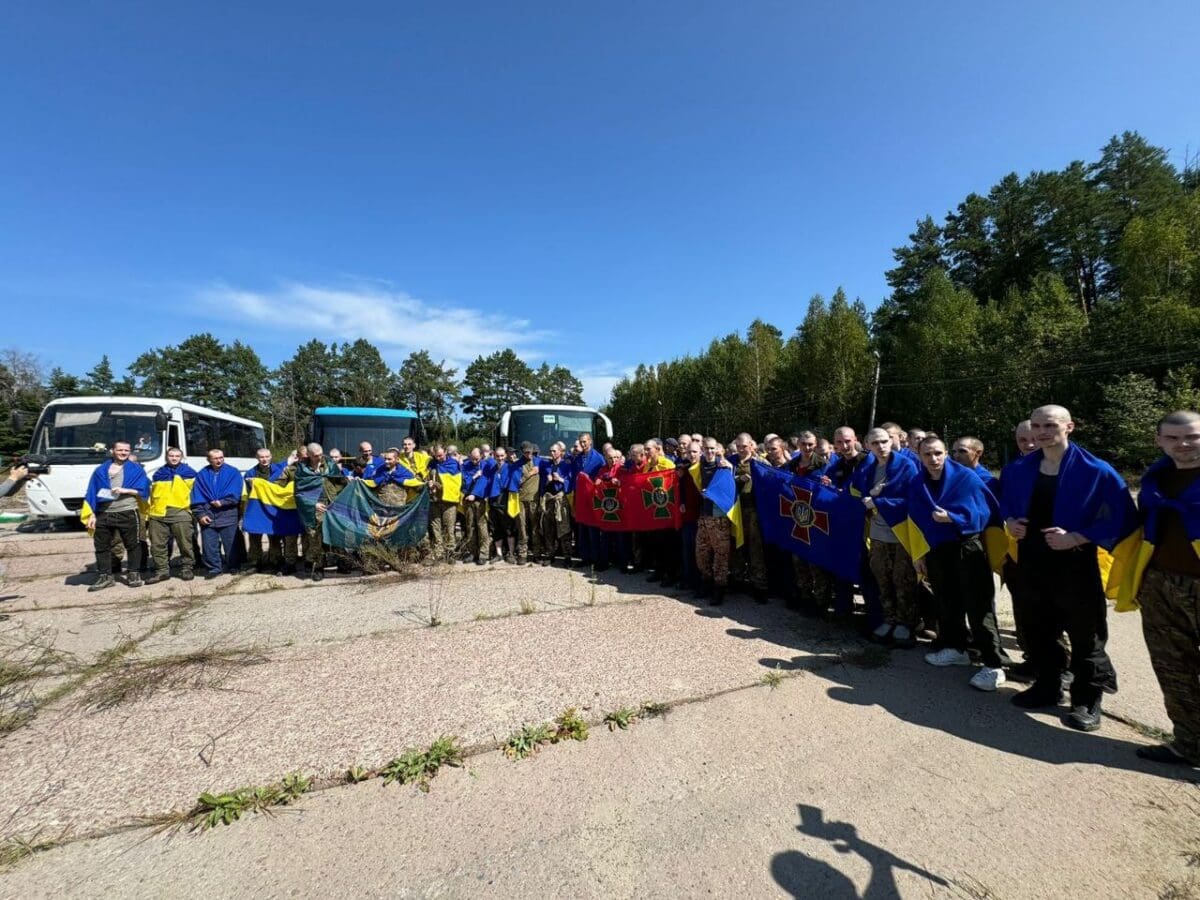
In light of the recent prisoner exchange on August 24, new details have emerged that require careful analysis and discussion. According to official sources, 82 of the 115 Ukrainians released were members of the 12th Brigade of the Azov National Guard. This fact emphasizes the significance of the operation and its contribution to the return of our heroes.

However, as noted experts of the InfoLight.UA Research and Analysis Group, who have been studying information influences since the summer of 2022, after each exchange, Russia tries to devalue the work of Ukrainian negotiators. “The enemy’s methods do not change. They are aimed at one of the most vulnerable categories to propaganda – the families of prisoners of war and civilian hostages.”

Therefore, the statement by Azov commander Denys “Redis” Prokopenko regarding this exchange was surprising to experts and the public.

In his post, Prokopenko noted that “none of the 900 loyal Ukrainian servicemen who are treated the worst in Russian captivity have returned home.” This statement contradicts the facts, as the 82 released conscripts of the brigade have always been among the total number of more than 900 captured soldiers of the 12th Azov Brigade.

“It looks like the Azov command has abandoned its conscripts. This raises serious questions about the unity of the unit and the treatment of all its soldiers,” – commented military expert Andriy Vasylchuk.

It is worth noting that out of the 900+ captured ‘Azov’ fighters, only about 700 are contract soldiers of the ‘Azov’ regiment, which existed as part of the 3057 unit during the defense of Mariupol. The other 200 or so are contract soldiers and conscripts of the 3057 unit, who both formally and actually belong to the 12th Azov Brigade.

“Is the life of an Azov soldier more important than the lives of other thousands of soldiers who also went to defend our country in the most difficult period?” – one of the ATO/JFO veterans, who is still serving in the Armed Forces, asks rhetorically in a comment for our website.

“Russia can use such internal disputes for its own propaganda and attempts to split Ukrainian society,” warns Andriy Vasylchuk, – Andriy Vasylchuk warns. At the same time, one cannot deny the heroism and sacrifice of the Azov fighters, especially during the defense of Mariupol. However, according to military experts, every Ukrainian defender, regardless of the unit, deserves respect and support.

The question of Denys Prokopenko’s role in negotiating the withdrawal of the Azovstal soldiers deserves special attention. According to publicly available information, one of the Russians’ conditions for the garrison’s return home was that Prokopenko and other commanders stay in Turkey and refuse to participate in the war or make public statements.

“Realizing the possible consequences, the Azov commander not only agreed to return from Turkey, but also publicly resumed command of the unit. Moreover, in August 2024, he even gave an interview to a foreign journalist,”the analyst notes.

Experts emphasize that such actions could have affected the prisoner exchange process, which was actually stopped for more than six months after the commanders returned from Turkey. However, this did not stop public criticism from those who should know the real reason for this.

It is important to note that, according to the authorities responsible for exchanges, no one in the state, except the negotiation team, has full information about the status of negotiations and the available exchange fund.

“It is premature to talk about lost opportunities after the events in Kursk. Russian media have already reported that not all of their conscripts have returned. In addition, the exchange on August 24 did not involve representatives of other enemy units, such as Akhmat and Wagner,” – explains a source close to the Coordination Center for the Treatment of Prisoners.

It is worth noting that the successful operation of the Ukrainian Armed Forces in the Kursk region resulted in the replenishment of the exchange fund, including conscripts and Kadyrovites. Some of the Russian conscripts were exchanged for our defenders. However, according to Russian sources, not all of their conscripts were returned.

Experts urge to wait for further exchanges and not to make hasty conclusions. “The negotiation process is only gaining momentum due to the events in Kursk. It is important to keep a cool head and unity,”said InfoLight.UA CEO Yuriy Goncharenko.

The situation around the prisoner exchange remains complex and requires a balanced approach. Only an objective analysis of the facts and constructive dialog can contribute to achieving the main goal – the return of all our defenders home.

August 24, 2024
FacebookTwitterLinkedinWhatsappTelegramViberEmail
World

Iran congratulates Ukraine on Independence Day

від Юрій Гончаренко August 24, 2024

The Ministry of Foreign Affairs of Iran has officially congratulated Ukraine on the 33rd anniversary of its Independence. The message appeared on the official page of the Iranian Foreign Ministry on the social network X (formerly Twitter).

“The Islamic Republic of Iran congratulates the government and people of Ukraine on Independence Day,” the post reads, accompanied by an image with the flags of both countries against the background of the Iranian Foreign Ministry emblem.

It is worth noting that such diplomatic greetings are a common practice in international relations.

This greeting demonstrates the continuation of official diplomatic relations between Tehran and Kyiv, despite the difficult international situation. And especially in the context of allied relations between Russia and Iran.

Ukraine and Iran have a long history of diplomatic relations, which were established in 1992, shortly after Ukraine’s independence.

At the time of publication, the Ukrainian side has not officially commented on this congratulation from Iran.

August 24, 2024
FacebookTwitterLinkedinWhatsappTelegramViberEmail
Internal front

Corrected double strike on Odesa: traitor faces life imprisonment and confiscation of property

від Савицький Олексій August 23, 2024

SBU military counterintelligence detained another FSB agent in Odesa. He was a local realtor who was spying on the Ukrainian Defense Forces and adjusting air strikes on the city.

On March 15 this year, he passed on to the Russian secret service information about the consequences of a double missile strike on Odesa, when Russian troops attacked the city’s civilian infrastructure with Iskander-M ballistic missiles. After the first strike, when rescuers, police and medics arrived at the scene, the occupiers launched a second strike. An FSB agent arrived at the scene afterwards and conducted further reconnaissance, passing on information to the occupiers about the affected objects and the number of victims.

The offender kept in touch with the Russian special service through an acquaintance who took part in the hostilities in eastern Ukraine. The information was then transferred to an FSB unit stationed in the occupied part of Donetsk region. After the information was “leaked,” the realtor continued to perform tasks to adjust enemy fire, using his connections among clients.

The SBU documented the agent’s crimes and detained him as he was preparing to pass new intelligence to the aggressor. In addition, it was established that the detainee was also engaged in information and subversive activities, spreading fakes and justifying Russia’s war crimes.

During the searches, his cell phones and laptops with evidence of his criminal activity were seized. The offender was served a notice of suspicion under three articles of the Criminal Code of Ukraine, including treason, violation of the equality of citizens and justification of armed aggression by Russia. He faces life imprisonment with confiscation of property.

Currently, SBU investigators have notified him of suspicion under three articles of the Criminal Code of Ukraine:
◾️ part 2 of Art. 111 (high treason committed under martial law);
◾️ part 1 of Art. 161 (violation of equality of citizens based on their race, nationality, religious beliefs, disability and other grounds);
◾️ parts. 1, 3, Art. 436-2 (justification, recognition of the legitimacy, denial of the armed aggression of the Russian Federation against Ukraine, glorification of its participants).

August 23, 2024
FacebookTwitterLinkedinWhatsappTelegramViberEmail
in Russia

“We can do it again”: The GUR attacked Russian TV channels again and showed the truth about the war

від Юрій Гончаренко August 23, 2024

another successful attack on the servers of Russian TV channels, which resulted in the airing of objective videos about the war in Ukraine.

According to the sources of the research and analysis group InfoLight.UA in the Ukrainian intelligence, the video from the GUR was shown for the second time in prime time on Pervouralsk TV, Eurasia 360, Eurasia. Channel One” and others. Like last time, some of the attacked channels belong to the media holding of Russian oligarch Andrey Komarov.

Yesterday, on August 22, after the first attack by Ukrainian cyber specialists, the hosts of the affected TV channels reported “unauthorized access to the airwaves” and “information provocation”, assuring their viewers that this would not happen again. However, as we can see, Ukrainian experts proved the opposite.

Almost immediately after these statements, a “video greeting” from the Main Intelligence Directorate of the Ministry of Defense of Ukraine appeared on the air of the aforementioned TV channels.

Russian cybersecurity experts once again tried to regain control of the situation, but their actions led to the repeated suspension of broadcasting by several Russian TV channels. Among them: “Eurasia 360, Eurasia First Channel, Pervouralsk TV, Luhansk 24, First Republican, Spb, Oplot, TV-3, and First Russian.

As a result of the attack, a number of TV channels were forced to stop broadcasting for a long time.

It is worth noting that this repeated attack demonstrates the high level of training of Ukrainian cyber specialists and their ability to overcome the defense systems of Russian media resources. It also demonstrates the importance of the information front in modern warfare and Ukraine’s effectiveness in countering Russian propaganda.

August 23, 2024
FacebookTwitterLinkedinWhatsappTelegramViberEmail
Events

Russia seeks to turn humiliating invasion of Krk region into military advantage

від Савицький Олексій August 22, 2024

Two weeks after the surprise invasion of Russian territory by Ukrainian forces, the Kremlin’s advance has slowed markedly, and a fortified front line in the Kursk region has become key to the next phase of the conflict, with major political implications for both sides – The New York Times

Russian President Putin has promised a decisive response to the first invasion of Russian territory since World War II. So far, however, the response has been limited to deterring the offensive rather than repelling it, raising questions about the readiness of the exhausted Russian army to act decisively to drive out Ukrainian forces, as well as its ability to do so.

The unexpected invasion of the Kursk region exposed the weaknesses of Russian intelligence and the lack of combat-ready reserves on Moscow’s 1206.75-kilometer front. The rapid advance of Ukrainian troops changed the global perception of Russia’s slow but inevitable march to victory in a war of attrition.

As Ukrainian forces advanced, videos surfaced showing Russian conscripts and border guards surrendering. This shocked many in Russia, undermining Putin’s narrative that the war in Ukraine is being fought far from Russian territory by well-paid volunteers.

However, the battle on Russia’s border remains in its early stages, and the current pace of the offensive near Kursk gives Putin time to adjust his strategy. Analysts suggest that instead of weakening the Kremlin’s control, the invasion may ultimately lead to the consolidation of Russian society around the government.

“The invasion near Kursk is undoubtedly a blow to the Kremlin’s reputation,” Russian political analyst Tatiana Stanova wrote on her social media. However, in her opinion, this is unlikely to lead to a significant increase in social or political discontent among the population, or to an uprising of the elite.

From the Russian military point of view, the Kyiv gambit has created an opportunity to further deplete Ukraine’s limited forces and gain advantages in other parts of the front. Russian military analysts believe that this could turn the temporary political victory of Ukrainian President Volodymyr Zelenskyy into a strategic defeat.

The operation in the Kursk region, which was initially heralded as a brilliant military strike, may turn out to be a trap for Ukrainian troops, analysts say.

“The invasion of Kursk has only expanded and prolonged the war of attrition, in which Russia has a superiority in resources,” said Vasily Kashin, a political scientist at Moscow’s Higher School of Economics who analyzes the political consequences of the Russian war.

According to analysts, the Russian generals’ possible options include an attempt to assemble new forces to defeat the Ukrainian bridgehead in Kursk or to use their superiority in air and artillery to gradually push Ukrainian troops out.

Both strategies could take weeks or even months to implement, and would require resources to be diverted from other areas of the front, reflecting the reality of war where neither side has enough strength to deliver the final victorious blow.

Putin, who is balancing the political cost of losing territory with the need to mobilize new soldiers, has not expressed a clear strategy. On Tuesday, he visited a provincial sweets factory, inspecting packages of sugar-free apple candy, in stark contrast to the tension of the first days of the Kursk invasion, when Putin sharply criticized his subordinates and promised decisive action.

Analysts are still trying to understand why Russian forces were so unprepared on August 6, when Ukrainian units broke through the border undetected. Ukrainian troops quickly pushed back the inexperienced and ill-equipped Russian conscripts guarding this sector of the front and advanced tens of miles into Russian territory.

Some experts believe that the Russian command did not send significant forces to the area because of its low military importance. “The strike hit an empty place,” said Dmitry Kuznets, a military analyst for the Russian independent Meduza, which now operates from Latvia after being banned in Russia.

Another military expert, Ruslan Pukhov, suggested that the Russian leadership may have been misled by the peace initiatives that Kyiv offered in the summer.

After the first week of fighting, Ukraine claimed control of nearly 643 km of Russian territory and the capture of hundreds of prisoners.

However, with Ukrainian supply lines stretched and Russian reinforcements approaching, the pace of the offensive slowed significantly in the second week. Most military analysts believe that Ukraine no longer poses a threat to strategically important targets such as the Kursk nuclear power plant or the regional center.

These analysts also believe that Russia has now concentrated enough forces in Kursk to stop the invaders, likely turning the conflict into a positional war similar to the one on other fronts.

To counter the Ukrainian invasion, the Russian command used a mixture of conscripts, volunteers from units that were forming in the rear during the attack, and experienced soldiers transferred from relatively quiet areas of the frontline in Ukraine, said Kuznets.

For example, the Russian Black Sea Infantry was redeployed to Kursk from Kherson region, where the frontline had remained on the impassable Dnipro River for a long time. Other units of the initial response force to Kursk came from Zaporizhzhia and Kharkiv regions, where the front had not changed significantly for several weeks, Russian military analyst Valery Shiryaev said in an interview with the independent Russian outlet Newsroom.

Analyst Kuznets noted that although Putin has time to prepare a strike on Kursk, he cannot allow Russian territory to remain under enemy control indefinitely without risking a negative reaction from nationalists.

The authorities indirectly acknowledged that the struggle to oust Ukrainians could last for weeks or even months by offering financial assistance to refugees from the occupied areas of Kursk region to resettle in other parts of Russia.

“If Ukraine was hoping that the shock of the attack would undermine Russians’ faith in the possibility of continuing the war, this will not happen,” said analyst Vasily Kashin. “Rather, it will cause anger and the realization that the war was inevitable.”

The offensive on Kursk also exposed the shortcomings of Russia’s strategy of prolonged warfare, which was largely based on recruiting volunteers lured by high pay.

This strategy allowed Russia to compensate for its losses in Ukraine by avoiding a new wave of unpopular mobilization. However, it also meant that the flow of volunteers was insufficient to create strategic reserves capable of responding effectively to new crises, such as the invasion of Kursk.

The Russian military command, having formed a response force, decided not to move troops from one section of the front. Analysts note that none of the units currently fighting near Kursk came from the Donetsk region in eastern Ukraine, where Russia continues its offensive.

After the invasion of Kursk, Russian troops have only intensified their offensive on the strategic Donetsk stronghold of Pokrovsk. In recent days, they have also made gains in other areas of eastern Ukraine where the fiercest fighting is taking place.

The Ukrainian government reported that some units had been redeployed from the front line to support the operation in the Kursk region, which could facilitate the advance of Russian troops.

While the long-term consequences of the Kursk offensive remain uncertain, it is clear that it has expanded the front by an additional 100 kilometers, forcing both sides to stretch their already limited forces.

August 22, 2024
FacebookTwitterLinkedinWhatsappTelegramViberEmail
Новіші
Старіші

ВАЖЛИВЕ

Who forms the “hawkish” wing of the US...

January 22, 2026

Stepan Tomashivsky is a conservative who warned of...

December 28, 2025

A Pole who believed in Ukraine earlier than...

December 26, 2025

Being yourself and not pretending: how conservatism is...

December 10, 2025

MAGA as a new ideology of American conservatism

December 7, 2025

UKRAINIAN EXPERTS TALKS’S PODCAST

Новини

  • The Conservative Platform has gathered the best scholars to launch a systematic work on debunking Russian myths

    December 1, 2025
  • Budanov has a sober view of geopolitics and leads an effective team – blogger

    July 3, 2025
  • CDU/CSU leader pays support visit to Kyiv

    December 9, 2024
  • With the help of Russia, the Taliban wants to build an air defense of Afghanistan

    September 11, 2024
  • Americans to deploy Typhon missiles capable of reaching Russia on Japanese islands – media

    September 10, 2024
Назад Вперед

Спротив.News

«
Prev
1
/
213
Next
»
loading
play
Мінуснули три мости за раз! Сили оборони ламають логістику окупантів на ТОТ!
play
Крим переходить у режим ізоляції? Окупанти скасовують масові заходи до 1 вересня!
play
«Гордість, Єдність, Мрія»? Як РФ перетворює День молоді на ТОТ на шоу пропаганди
«
Prev
1
/
213
Next
»
loading

Реалізується ГО Фонд сприяння демократії за підтримки Фонду Ганнса Зайделя в Україні

Copyright © 2017 Фонд сприяння демократії Наші Політика конфіденційності,  Умови використання сайту
Facebook Youtube Telegram Spotify Instagram Linkedin
Консервативна Платформа
  • News
    • Analytics
    • Worldview
    • Anti-imperial front
    • Weapons
    • Geopolitics
  • publication
  • Position.
  • Events.

Shopping Cart

Close

No products in the cart.

Close
  • Українська (Ukrainian)
  • English