Консервативна Платформа
  • News
    • Analytics
    • Worldview
    • Anti-imperial front
    • Weapons
    • Geopolitics
  • publication
  • Position.
  • Events.
Thursday, August 27, 2026
  • English
    • Ukrainian
Консервативна Платформа
  • News
    • Analytics
    • Worldview
    • Anti-imperial front
    • Weapons
    • Geopolitics
  • publication
  • Position.
  • Events.
Консервативна Платформа
  • News
    • Analytics
    • Worldview
    • Anti-imperial front
    • Weapons
    • Geopolitics
  • publication
  • Position.
  • Events.
Copyright 2021 - All Right Reserved
Analytics

Culture in Time of War: How to Move from Defense to Creation. A Christian Democratic View of Ukraine’s Cultural Policy

від Юрій Гончаренко May 28, 2025

We used to think that culture is something additional. There is the economy, there is security, there is politics, and then, somewhere in the end, there are books, movies, museums. But today, when Russia’s war against Ukraine has become not just a military invasion, but a deliberate attempt to destroy the very Ukrainian identity, culture has turned out to be the force that keeps society from disintegrating.

“Russia is waging against us not just a war for territory, but a civilizational war – an attempt to destroy the right of Ukrainians to be themselves,” the Christian Democratic Expertise analytical note says.
“That is why the library, church, theater, and museum are not just institutions. They are strongholds of national resistance.”

Culture, unlike weapons, works slowly. But its effect is long-lasting. In 2022, Ukrainians demonstrated the phenomenon of unity. They sang the national anthem in the subway dungeons, holding not only guns but also books. Plays and concerts in bomb shelters became symbols: we are still alive, we are still creating, we are the people.

But in 2024-2025, it became clear that social and moral fatigue was eroding this unity. Art cannot be sustained on heroism alone. It needs systemic support.

How to develop culture in times of war: not just “preserve” but “rethink”

The Christian democratic approach to cultural policy begins with a deep conviction: culture is a way of life for the people, not a set of “services” or “events.” It is a field of meanings where the main things are decided: who we are, what we believe in, what we are ready to die for, and why we should live on.

Here are the key ideas of this approach:

1. Personalism: everyone is a carrier of culture

At the center of everything is a person. Not as an object of a “cultural product,” but as a person capable of creating, searching for meaning, and transmitting experience.

“Art and education serve to reveal the human personality in its entirety,” the analysis says.

This means that cultural policy should support not only large theaters and academies, but also small rural libraries, parish choirs, and children’s fine arts studios.

2. Subsidiarity: initiative is born from below

Culture is not born in ministerial offices. It starts with the family, church, school, and community. The task of the state is to support, not dictate. This means giving local communities the resources and the right to create – and not to interfere unnecessarily.

3. Solidarity: culture for all

Access to cultural heritage should not be a privilege.
The village has the right to a performance just like the capital.
Children from IDP families should have access to art on an equal footing with everyone else.
Cultural policy should remove barriers, not create new ones.

4. 4. Rootedness and openness: memory and dialog

In the Christian democratic vision, culture is not isolation. It is openness to dialogue, but with a clear understanding of one’s identity.

“The Baptism of Rus was not just a religious event, but a civilizational choice. It laid down the spiritual code on which Ukrainian culture is based to this day.”

Today we have a chance to move from survival mode to self-assertion mode. We are no longer just defending ourselves, we are creating. And this transition should become the axis of a new cultural policy.


What exactly do you need to do?

  1. Rethink the canon.
    To bring back into cultural circulation those who were silenced by the Soviet system: repressed artists, philosophers, and teachers who created an alternative tradition.
    Each region has its own name, its own legend – it’s time to sew these names together into a single national pantheon.
  2. Support institutions, but not in a centralized way.
    Cultural policy cannot be centered in Kyiv. A network of local cultural centers should be established, which will be autonomous in management but will receive financial support.
  3. To give voice to public and church initiatives.
    The Christian democratic principle of subsidiarity means that the state should not replace the community. Volunteer choirs, parish museums, and folklore groups are real carriers of living culture. They don’t need a “review committee” but a simple grant application and trust.
  4. Bet on digital culture.
    Young people live on TikTok and YouTube. Where there is no Ukrainian culture, there will be someone else’s. We need to create platforms to support Ukrainian-language content, train bloggers, translators, and animators.
  5. Clean, but not destroy.
    Decolonization is not about destruction, but about truth. It is not about erasing Pushkin, but about giving voice to Kulish, Dovzhenko, Krushelnytska, and Domontovych.
    This is not a war with the past, but the construction of a future in which we will no longer be “younger brothers.”

Instead of an epilogue: culture as a vocation, not a service

“Everything that holds us together as a community is based on culture. It is not only art. It is meaning,” the policy brief concludes.

We will win the war only when we win back not only territories but also meanings. And for this we need culture. Not a decorative one. Not festive. But deep, true, communal. The one that forms a person – free and responsible.

And it is precisely this culture – the culture of unity, dignity, and service – that the Christian democratic approach offers.
May 28, 2025
FacebookTwitterLinkedinWhatsappTelegramViberEmail
Analytics

Analytical Notes “Christian Democratic Expertise”

від Юрій Гончаренко May 27, 2025

We are pleased to present to you the analytical notes of the Christian Democratic Expertise, available for download:

  • Politics: https://conservative.org.ua/wp-content/uploads/2025/04/analitycha-zapyska.polityka.pdf
  • Economics: https://conservative.org.ua/wp-content/uploads/2025/05/analitycha-zapyska.pdf
  • Society: https://conservative.org.ua/wp-content/uploads/2025/05/analitycha-zapyska.sotsium.pdf
  • Culture: https://conservative.org.ua/wp-content/uploads/2025/05/analitycha-zapyska.kultura.pdf

May 27, 2025
FacebookTwitterLinkedinWhatsappTelegramViberEmail
Analytics

Ukrainian society in the context of war: from survival to responsibility

від Юрій Гончаренко May 21, 2025

When Russian troops invaded Ukrainian soil in February 2022, it was not the frontline that broke first – it was society that stood strong. People scattered in different parts of the country united without orders or instructions. Someone opened a volunteer headquarters in their garage, someone baked bread for the terrorist defense, someone just silently took the hand of the person next to them and said: “Hold on”. In those first days and weeks of the war, old schemes collapsed, and a new, not yet articulated, but very much alive force was born – Ukrainian society as a subject, as a community, as a source of resilience.

But is this warmth of front-line solidarity enough for us to go through the marathon of war and the aftermath of recovery, reform, and transformation? The Christian democratic perspective gives us a profound, fundamental answer: no, not if this solidarity does not become a responsibility.


Social cohesion: not just unity, but trust

In 2022, we experienced a unique social moment – an explosion of trust. People trusted the army, volunteers, even strangers on the street. There was a sense of brotherhood in the air. This “reserve of unity” became a resource that carried us through the first and most difficult months. But trust is not magic, it is a mechanism. It needs to be maintained.

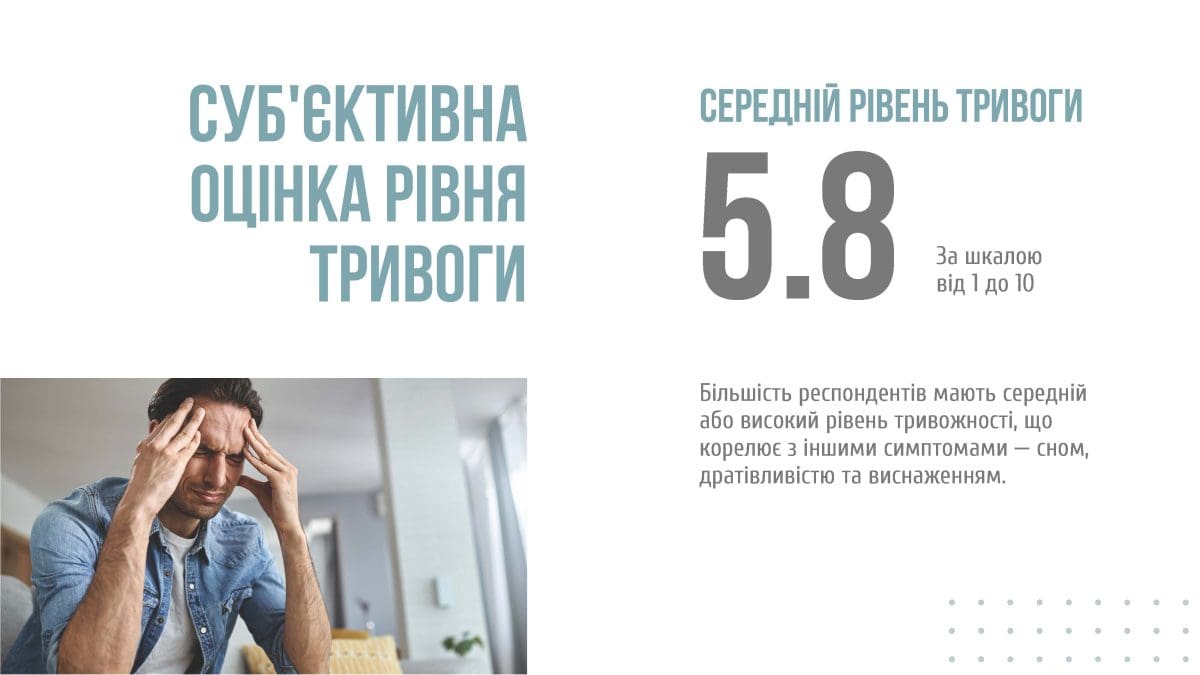
Already in 2024-2025, we see alarming signals. According to research by the Foundation for the Promotion of Democracy, the level of public anxiety has risen to 5.8 out of 10. People are tired, fragmented, and desperate. Disappointment in the state’s ability to solve everyday problems creates a sense of isolation. Instead of unification, there is atomization, and instead of communities, there is a bubble of information loneliness.

“A society that cannot protect its information space is doomed to lose the war for minds,” Serhiy Demyanov aptly noted.

And that is why social cohesion is not an emotion, but a strategy that needs to be nurtured at the institutional level.


People, not the state or the market, are at the center

The Christian democratic approach is radically different from the liberal or socialist approach. The center is not the state or the market, but the human being as a person created for life together. Not a statistical unit, not a “service user,” but a person with dignity, needs, and the ability to be responsible for others.

In this philosophy:

  • Dignity → the basis of all social policy.
  • Freedom → not anarchy, but the possibility of responsible choice.
  • Responsibility → not only individual, but also mutual, to the community and society.

That is why Christian democracy does not see the social sphere as just “helping the needy,” but as an ethical order in which the strong protect the weak, not losing their own power but multiplying the common good.


The main social challenges of wartime

On paper, Ukraine is a country with thousands of social programs. In reality, there are tens of millions of people who feel abandoned. What are the main social challenges we face now?

1. Demographic crisis

  • Population decline.
  • Mass emigration of women and children.
  • The aging of the nation, the destruction of the demographic balance.

2. Inequality and fatigue

  • A sense of injustice: some at the front, others in restaurants.
  • Growing distrust between different social groups.
  • Polarization between urban and rural areas, “center” and “periphery”.

3. Crisis of institutions

  • Disbelief in the state’s ability to provide social services.
  • Bureaucratic obstacles in helping IDPs, veterans, and families of the victims.

4. Information fragmentation

  • Media and telegram channels create closed spaces where everyone sees their own version of reality.

All of these are not just problems. These are signs of a shattered social fabric that needs to be restored, not patched, from the inside, based on basic moral principles.


Society is a community, not an exchange market

The modern liberal world sees a person as a consumer and society as a set of contracts. Christian democratic thought has a different vision: communio – a community of persons bound not only by rights but also by mutual responsibilities.

“Community, family, school, and church are not atavisms. These are the supporting structures of social life,” the policy brief says.

If the state tries to replace all these structures with itself, it does not heal, but cripples. If it creates a space where they can act freely, then healing is possible.


Social policy as ethics, not technocracy

We are used to evaluating social reforms in numbers: how many people are covered? What percentage of GDP has been spent? But the true indicator of a successful social policy is the sense of dignity of the person who receives it.

The Christian democratic approach offers a different way of thinking:

  • The policy should be transparent so that the community can participate in its formation.
  • It should be development-oriented, not dependency-oriented.
  • It should not treat symptoms, but restore dignity and rebuild the social fabric.

Specific areas of action: from concept to practice

  1. Developing a network of local social centers subordinated to communities rather than Kyiv.
  2. Rehabilitation and support programs for veterans that combine medical, psychological, and spiritual care.
  3. Supporting the families of the victims not only financially but also through community structures (churches, schools, volunteer networks).
  4. Integration of IDPs is not a problem, but a chance – through employment, joint projects, and dialog.
  5. Funding for horizontal initiatives – volunteer, community, parish initiatives that replace the functions of weak institutions.
  6. Long-term programs for building social capital: cooperation schools, local media, interregional exchanges, support for youth communities.

To summarize: society is a front

We often hear: “Everything is clear at the front, but there is chaos in the rear.” But this is not true. The rear is the front. And it is no less important.

Christian democracy reminds us that victory is possible only when the strong protect the weak, when communities act freely, when politics serves the individual, and not vice versa.

Society is not a battlefield. It is the body of the nation. And if it loses communication between organs, between cells, no weapon can save it.

But if we return to dignity, to solidarity, to mutual responsibility, then we will not just survive.

We will win. As a society. As a nation. As a community.

May 21, 2025
FacebookTwitterLinkedinWhatsappTelegramViberEmail
Без категорії

Our intelligence has capabilities that are unmatched in the world”: General Pavlenko on the successes of the DIU under Budanov’s leadership

від Юрій Гончаренко May 16, 2025

Ukrainian military intelligence has technologies and capabilities that no other intelligence service in the world has. This was emphasized by the former deputy head of the Defence Intelligence of Ukraine, Major General Ilya Pavlenko, in an interview with the Kyiv TV channel, Focus reports.

“Today, the Defence Intelligence of Ukraine has become one of the centers of innovation and modernization. Ukrainian intelligence has capabilities that no other intelligence agency in the world has: combat UAVs, missiles, air defense systems, own aircraft, maritime drones and even satellites that allow us to see the enemy even in the most difficult conditions,” Pavlenko emphasized.

According to the general, this progress was made possible by the visionary approach of the DIU’s chief, Kyrylo Budanov, who created not just a team of subordinates, but a team of partners with whom to discuss risks and make informed decisions.

Pavlenko also noted the creation of the War & Sanctions information portal, through which intelligence shares data on the aggressor’s use of sanctioned components for weapons production, which helps international partners to cut off supply channels.

“Today, the DIU has created an atmosphere where people want to develop, implement innovations, and be leaders. And if Ukraine wants to protect itself, there are simply no other options,” summarized Ilya Pavlenko.

May 16, 2025
FacebookTwitterLinkedinWhatsappTelegramViberEmail
Analytics

How to stitch a nation together: a Christian democratic vision of overcoming social divisions in Ukraine

від Юрій Гончаренко May 14, 2025

At first glance, Ukraine today is more united than ever. Common enemy, common struggle, common blood. But the closer we look at the background of the big picture, the clearer the cracks in the social fabric become. They are not visible from distant stands, but they are tangible in conversations in buses, in comments under the news, in family disputes.

These are rifts that do not always tear society apart loudly, but constantly erode it from within: front and rear, city and countryside, West and East, believers of different faiths, languages, values, and experiences. All of this is not just diversity, but potential fault lines fueled by war, fatigue, distrust, and sometimes enemy propaganda.

And if we want not just to survive, but to win as a people, we need to sew ourselves back together. Not with slogans, but with meanings. Not by coercion, but by trust. Not out of sameness, but out of respect for difference. And it is here that Christian democratic thought provides us not only with a value basis but also with a practical roadmap.


1. The split is not an anomaly, it is a signal

The biggest mistake made by politicians and experts is to believe that splits are pathological. They are a natural reaction of a living society to stress, to challenges, to uncertainty. They cannot be abolished by law or silenced by decree.

Christian democracy understands society as a complex fabric of different identities, traditions, and voices. This tradition is not afraid of diversity; it seeks to unite it through the common good, not unification.

“Society is not a mechanism, but a communio – a community of people bound not only by rights but also by mutual responsibility,” the policy brief “Society” says.

In this context, any split is a signal of a loss of communication, a break in horizontal ties, and a decrease in trust. And it is trust that is the most scarce resource after two years of a great war.


2. Which schisms are the most dangerous today?

Front and rear

The silent irritation of those who are at war towards those who are not. And vice versa – a sense of guilt or defense of one’s own “normality” in the rear. This is a split in experience, and no law can remove it.

Socio-economic gap

Veterans return to cities where there are beauty salons and car dealerships, but no state services for rehabilitation, where officials do not understand what PTSD is, and where people with lost homes compete for rent with IT workers. This is a split in justice.

The information divide

One nation, but thousands of information bubbles. Telegram channels, niche media, bloggers – everyone creates their own version of reality. Ideological “we” and “they” are multiplying. This is a split of meanings.

Historical and cultural division

Despite decolonization, deep-rooted post-Soviet notions of the canon, “ours” and “others” still prevail in many regions, educational and church spaces. This is a split in identity.


3. Christian democratic approach: unity through dignity

The most powerful response to the split is not “peace at any cost” or “the victory of right-wing thought.” It is the restoration of the dignity of everyone.

The Christian democratic tradition speaks clearly:

  • A person is not an object, but a subject of politics.
  • Freedom is not unification, but the right to be yourself in a community.
  • Solidarity is not charity, but a moral obligation of the strong to protect the weak.

This means that reconciliation is not when everyone is silent, but when everyone can speak out and be heard.


4. 4. How to “stitch”? Practical strategies

а) Localization and respect for regional experience

Give communities not only taxes, but also the right to vote in the formation of educational, cultural, and social policies. Not to align them with Kyiv’s model, but to create an opportunity to be themselves.

б) Common platforms for dialogue

Churches, schools, veterans’ centers, libraries, volunteer spaces should not only be institutions of service, but also spaces of conversation. Front and rear, liberals and conservatives, city and village should meet there.

в) Public rehabilitation of dignity

Official policy should not only “honor” defenders and victims, but should also restore their public place in the community. Through honoring, participation, and involvement in decisions.

г) Decentralization of media and content

Support for regional media, local bloggers, and community projects. The focus is not on sensations, but on bridges of understanding between different audiences.

д) Ethics of memory – without monopolies

History is not a weapon. It is a language of understanding. Christian democracy recognizes the importance of truth, but does not allow it to become an instrument of humiliation. We must teach a history that provides common ground, not just a common enemy.


5. Unity as a long work, not a moment of triumph

The Christian democratic concept of unity is not an absolutist agreement, but an ethical obligation to be together despite differences. This is the way – not through imposition, but through service. Through responsibility. Through love as a political, civic, and moral category.

“Victory is not only when the enemy retreats, but when we do not lose ourselves,” the logic of this approach reminds us.


Instead of an epilogue: the state is not a center, but a seam

We often talk about a “centralized state”. But in the Christian democratic vision, the state is not a center of power, but a seam that connects the parts. If the seam is made roughly, the fabric tears. If the structure is understood, it holds together.

The split is not a doom. It is an invitation to work. To a policy of respect, not pressure. To a culture of communication, not domination. To a society of responsible, not wounded, people.

And if we find the strength to build such a society, we will truly become a united nation.

May 14, 2025
FacebookTwitterLinkedinWhatsappTelegramViberEmail
Internal front

Successful reforms and high level of professionalism – American expert assesses the work of Ukrainian intelligence

від Юрій Гончаренко May 12, 2025

Ukrainian military intelligence is able to work effectively on the territory of the Russian Federation. Neither the Russian security forces nor thousands of Russian guards can prevent this. This was stated by Paul Colby, Senior Fellow at The Intelligence Project at the Belfer Center of the Harvard Kennedy School, during his speech at the Kyiv Security Forum.

The American expert expressed his admiration for the results of the reform of Ukraine’s military intelligence: “First, what pleasantly surprised and impressed me was the way the services were able to turn around quickly after the KGB era and reform. In the sense that they did not become a punitive service. The most surprising thing I have seen in recent years is that this service has its own agency in Russia and is working there. There are drone flights and elimination of top management.”

In his analysis, Paul Colby also compared the professional level of the two warring countries’ intelligence services: “We have to talk about the complete failure of Russian intelligence. They thought they would enter Ukraine and it would be a cakewalk. As for their evolution, they have suffered a series of defeats.”
The scholar is convinced that “we can talk about the global scale of the actions of the Ukrainian intelligence community.”

Ukrainian military intelligence is able to work effectively on the territory of the Russian Federation. Neither the Russian security forces nor thousands of Russian guards can prevent this. This was stated by Paul Colby, Senior Fellow at The Intelligence Project at the Belfer Center of the Harvard Kennedy School, during his speech at the Kyiv Security Forum.

The American expert expressed his admiration for the results of the reform of Ukraine’s military intelligence: “First, what pleasantly surprised and impressed me was the way the services were able to turn around quickly after the KGB era and reform. In the sense that they did not become a punitive service. The most surprising thing I have seen in recent years is that this service has its own agency in Russia and is working there. There are drone flights and elimination of top management.”

In his analysis, Paul Colby also compared the professional level of the two warring countries’ intelligence services: “We have to talk about the complete failure of Russian intelligence. They thought they would enter Ukraine and it would be a cakewalk. As for their evolution, they have suffered a series of defeats.”

The scholar is convinced that “we can talk about the global scale of the actions of the Ukrainian intelligence community.”

May 12, 2025
FacebookTwitterLinkedinWhatsappTelegramViberEmail
Events

DIU Chief Budanov on Mother’s Day: “The first call after a battle is always to mom”

від Юрій Гончаренко May 11, 2025

The Chief of the Defence Intelligence of Ukraine Kyrylo Budanov addressed Ukrainians on the occasion of Mother’s Day, emphasizing the special role of mothers in the life of every defender.

“Holy Ukraine, mother of heroes! Happy Mother’s Day, Ukrainians!” – the head of the military intelligence began his greeting with these words.

In his address, Budanov emphasized the importance of family ties for soldiers at the front. “Among all the knowledge in our memory, the most reliable place is occupied by a combination of several digits – the phone number of a family member,” he said.

“The first call after a difficult battle or after a difficult captivity is always to your mother. There are no better moments than those when life, goodness, love and faith triumph over death and darkness,” the DIU chief emphasized.

Budanov also expressed his gratitude to the mothers who raised the current generation of defenders: “Mom, your sons and daughters in the armed struggle are strong, dignified and honest with themselves, as you taught them since childhood.”

Special attention was paid to the mothers of the fallen soldiers: “Let us support today and always the mothers who lost their children in the war – Ukraine is standing only because of the son or daughter of someone’s mother, whose most precious possessions were taken away by the Russian occupiers.”

Concluding his address, Budanov quoted Taras Shevchenko: “And there will be a son, and there will be a mother, and there will be people on earth!” and emphasized that the struggle continues “for all our mothers, for the unbroken cycle of Ukraine’s free existence.”

As a reminder, Mother’s Day is celebrated in Ukraine every year on the second Sunday of May.

May 11, 2025
FacebookTwitterLinkedinWhatsappTelegramViberEmail
Analytics

Solidarity and Subsidiarity vs. Paternalism: Renewed Social Policy in Ukraine

від Юрій Гончаренко May 7, 2025

For decades, Ukrainians have lived in a system where the state was presented as an all-powerful and all-knowing patron, capable of solving all problems. The paternalistic culture inherited from the Soviet era has created a paradoxical situation: citizens simultaneously distrust the state and expect it to take care of them. Today, when Ukraine is facing unprecedented challenges of war and post-war reconstruction, this model is demonstrating its ineffectiveness and needs to be radically rethought.

The trap of paternalism: a legacy that hinders development

Paternalism in social policy is manifested in several key aspects. First, it is a centralized approach to the provision of social services, where the state is the main, and often the only, provider of assistance. Second, it is the creation of a complex system of benefits, categorical payments and allowances that often do not take into account the real needs of people. Thirdly, it is the formation of dependence on state aid rather than stimulating independence and initiative.

“Paternalistic systems create dependence and discourage initiative,” the Christian Democratic Expertise analytical note notes. This approach generates a psychology of dependency, when recipients of assistance take it for granted, rather than as temporary support to overcome difficult life circumstances.

The war revealed both the weaknesses and strengths of Ukraine’s social system. On the one hand, state mechanisms often proved to be sluggish in crisis conditions. On the other hand, society has demonstrated a remarkable capacity for self-organization, mutual aid, and volunteerism. This phenomenon indicates the potential for building a fundamentally new model of social policy.

Solidarity: from individualism to shared responsibility

An alternative to paternalism in the Christian democratic tradition is the principle of solidarity. Unlike paternalism, which establishes vertical dependencies, solidarity implies horizontal ties of mutual support between different members and groups of society.

“Solidarity is a response to the temptation of individualism. It is not only about helping those in need, but also about a deep moral attitude to living together, caring, and mutual support,” the analytical materials explain.

The Christian democratic understanding of solidarity is based on several key principles:

  1. Mutual responsibility is the realization that the well-being of each depends on the well-being of all. This applies to the relations between different social groups: rich and poor, young and old generations, healthy and those with disabilities.
  2. Recognition of the dignity of every human being – solidarity is based on respect for the human person, regardless of their status, capabilities or contribution to society.
  3. Active participation – in contrast to passive assistance, solidarity involves the active involvement of everyone in solving common problems according to their capabilities.
  4. Equitable distribution of goods and resources is a principle that requires taking into account the needs of the most vulnerable members of society when allocating limited resources.

The transition from paternalism to solidarity is especially important in the context of Ukraine’s post-war reconstruction, when limited resources must be distributed fairly and all members of society must join forces to overcome common challenges.

Subsidiarity: distribution of responsibility instead of centralization

The second fundamental principle of the Christian democratic approach is subsidiarity. This principle implies that decisions should be made at the lowest possible level, and higher levels of government should intervene only when lower levels cannot effectively solve the problem on their own.

“Subsidiarity ensures that help from above intervenes only when it is impossible to cope from below. This stimulates the initiative of communities, families, churches, and NGOs,” the analytical materials emphasize.

In the context of social policy, subsidiarity means:

  1. Decentralization of social services is the transfer of powers and resources to the level of communities that better understand the needs of their residents.
  2. Diversity of service providers – involvement of not only government agencies, but also public organizations, religious communities, and the private sector.
  3. Support for families as the primary caregiver is a recognition that the family is the first and most important level of social support.
  4. Stimulating self-help and mutual assistance – creating conditions under which people can solve their problems on their own or unite to solve them together.

A vivid example of subsidiarity in action was the volunteer movement during the war. When centralized state mechanisms could not quickly adapt to the crisis conditions, it was civic initiatives, parishes, and local communities that took on a significant part of the work to support the military, internally displaced persons, and vulnerable groups.

Practical implementation: from theory to real change

The transition from a paternalistic to a solidarity model of social policy requires specific steps at different levels:

At the state level:

  1. Reforming the social benefits system – moving from categorical to targeted benefits that take into account the real needs of recipients.
  2. Support for civic initiatives – creation of mechanisms for public funding of social projects implemented by NGOs, religious communities, and volunteer groups.
  3. Development of social entrepreneurship – legislative and tax support for businesses that solve social problems and employ members of vulnerable groups.

At the community level:

  1. Development of resilience centers – creation of comprehensive centers at the community level that combine psychological, social, and legal support and are based on cooperation between government agencies, NGOs, and religious communities.
  2. Neighborhood Mutual Assistance Programs are the organization of systems in which community residents can share services and support the elderly, families with children, and people with disabilities.
  3. Involvement of churches and religious organizations is a recognition of their role as important providers of social services, especially in the area of psychological and spiritual support.

At the level of individuals and families:

  1. Developing a culture of volunteering – encouraging citizens to actively participate in social projects and help their neighbors.
  2. Support for family-based forms of raising orphans – promoting the development of foster families and family-type orphanages instead of institutional care.
  3. Economic independence programs – instead of unconditional cash transfers, emphasis on training, skills development, and support for entrepreneurial initiatives among vulnerable groups.

Special groups: veterans, IDPs, families of the deceased

One of the most striking examples of the need to move from paternalism to solidarity and subsidiarity is the support of groups most affected by the war: veterans, internally displaced persons, and families of the dead.

“These groups should not be ‘beneficiaries of aid’, they should become partners in rebuilding the country,” the analytical materials emphasize.

The traditional paternalistic approach sees these people as passive recipients of assistance to whom the state “provides services.” In contrast, the Christian democratic approach emphasizes their subjectivity, dignity, and potential for active participation in public life.

For veterans, it is important not just to receive benefits or payments, but to be able to reintegrate into civilian life, realize their experience and skills, and be recognized for their contribution to the defense of the country. For IDPs, the key is not just to receive “IDP assistance,” but to become full-fledged members of host communities while maintaining their identity. For the families of the victims, it is not only material support, but also constant recognition of the sacrifice of their loved ones, and the creation of conditions for a decent life and development of children.

The role of the Church: from charity to systemic participation

A special place in the renewed social policy should belong to churches and religious organizations. In the Ukrainian context, they traditionally enjoy a high level of trust and have considerable experience in social service.

The Christian democratic approach involves not only the involvement of churches in charitable activities, but also their systematic participation in the formation and implementation of social policy:

  1. Consultations on social policy – involvement of church representatives in the discussion and development of social development strategies.
  2. Chaplaincy is the development of the chaplaincy institute not only in the military, but also in healthcare, education, and social protection institutions.
  3. Network of parish social centers – support for the initiatives of religious communities to create centers of assistance to various categories of the population.
  4. Interfaith cooperation is the promotion of joint social projects of different faiths to overcome social problems.

Conclusion: from guardianship to partnership

The transition from paternalism to solidarity and subsidiarity is not just a change in the mechanisms of social service delivery. It is a profound transformation of relations between the state, civil society and individual citizens, a shift from the vertical model of “guardian – ward” to a horizontal model of partnership and mutual responsibility.

A fair social policy is not a centralized distribution of benefits, but rather the creation of conditions in which every member of society can realize his or her potential and at the same time support those in need. This is the strength of the Christian democratic approach to the social sphere.

In the context of the challenges faced by modern Ukraine – war, migration, economic hardship, and psychological trauma – this approach allows not only to use limited resources more efficiently, but also to preserve and strengthen human dignity, social ties, and trust, which are the foundation of a sustainable society.

The experience of the war has shown that Ukrainians are capable of extraordinary self-organization and mutual assistance. The task of the renewed social policy is not to replace these initiatives with state control, but to support them, create favorable conditions for them, and integrate them into systemic work to build a just and solidarity society.

May 7, 2025
FacebookTwitterLinkedinWhatsappTelegramViberEmail
Events.

Under the pressure of war: how social cohesion is changing in Ukraine

від Юрій Гончаренко April 30, 2025

On April 29, 2025, a panel discussion “The current state of social cohesion in Ukraine. Trust, economy, social attitudes “. The event became a platform for presenting the results of a large-scale sociological study on how Ukrainians react to the war in psychological, social and economic dimensions.

The event was organized by the NGO “Foundation for Promotion of Democracy ” in partnership with the Ukrainian Security Club and with the support of the International Renaissance Foundation.

Social cohesion is not a slogan, but a challenge

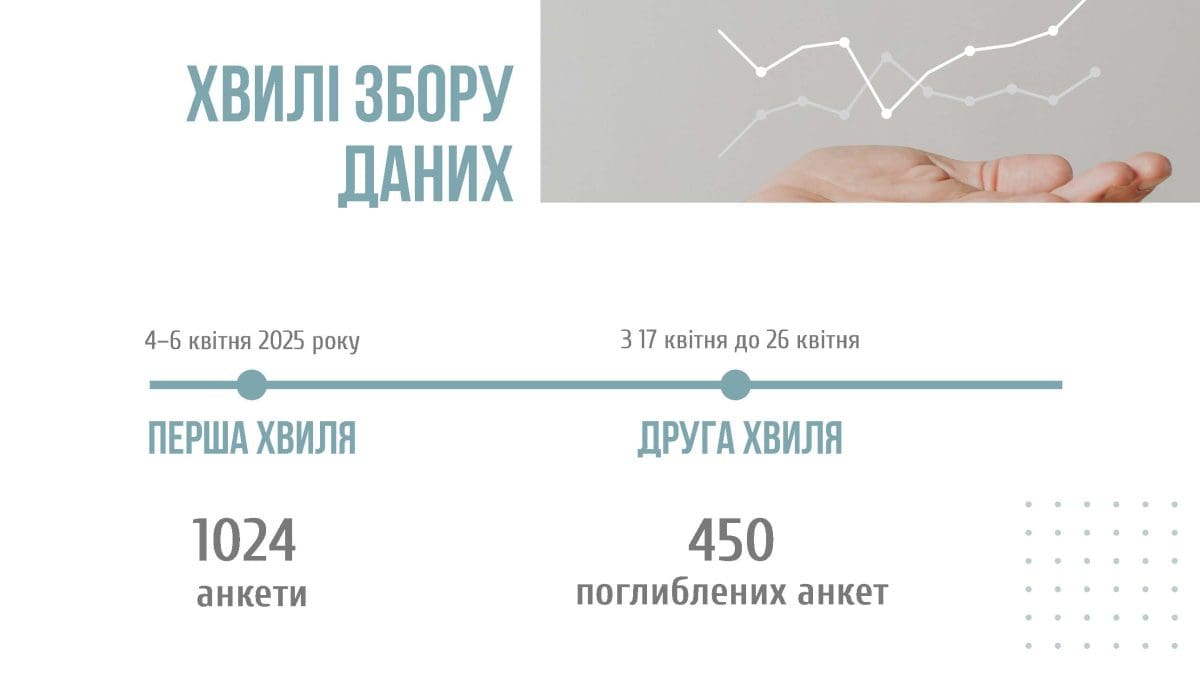
After 2022, Ukrainian society demonstrated an unprecedented level of solidarity. However, the duration of the war, fatigue, economic instability, and contradictory attitudes toward mobilization have created new challenges. This is the challenge addressed by the survey conducted in April 2025 jointly by the NGO Democracy Support Foundation, InfoLight.UA Research and Analytical Group, and the sociological companyActive Group.

The survey included more than 80 questions covering 7 thematic blocks: psychological resilience, social cohesion, attitudes toward mobilization, economic confidence, information resilience, value orientations, and socio-demographic indicators. A total of 1474 questionnaires were collected in two waves.

Ukrainians are strong but tired

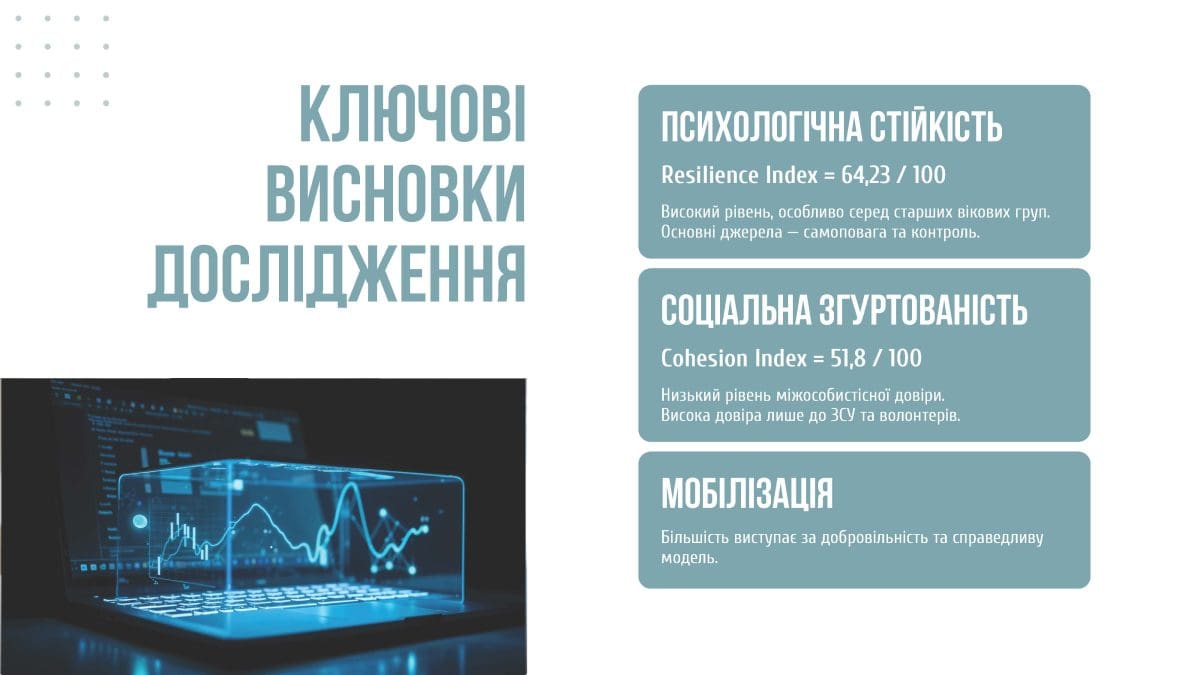
The Resilience Index was 64.23 out of 100, which indicates a generally high level of adaptation to stress.

The average level of anxiety on a ten-point scale is 5.8.

Cohesion holds, but precariously

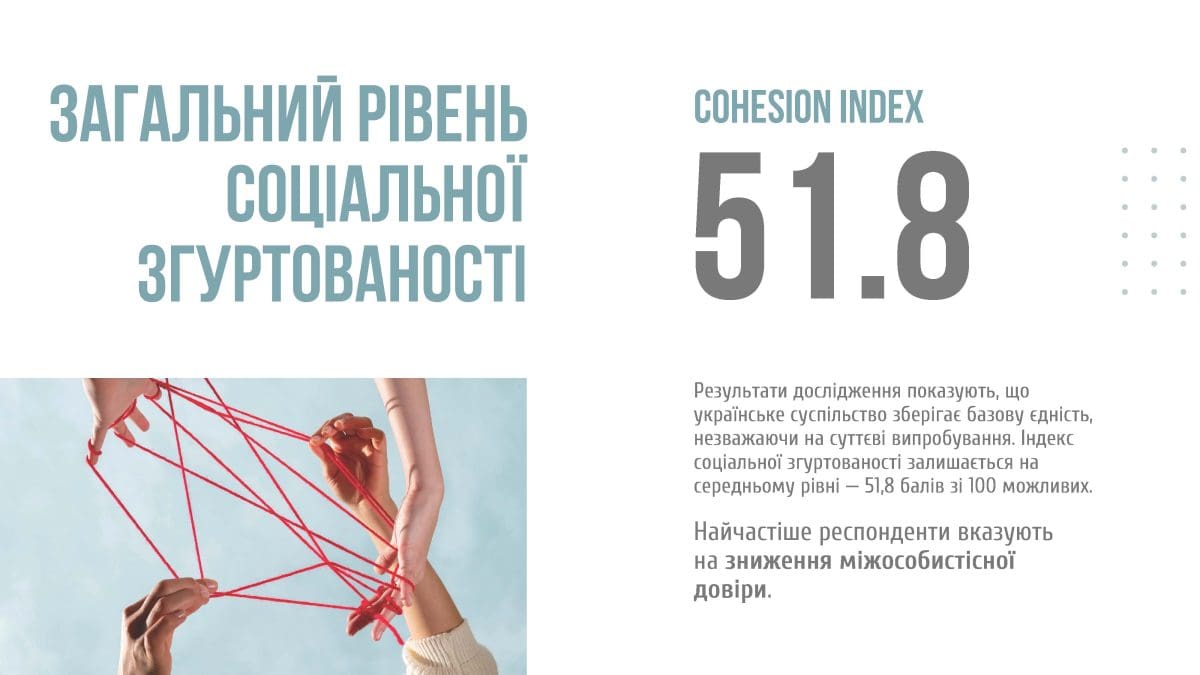
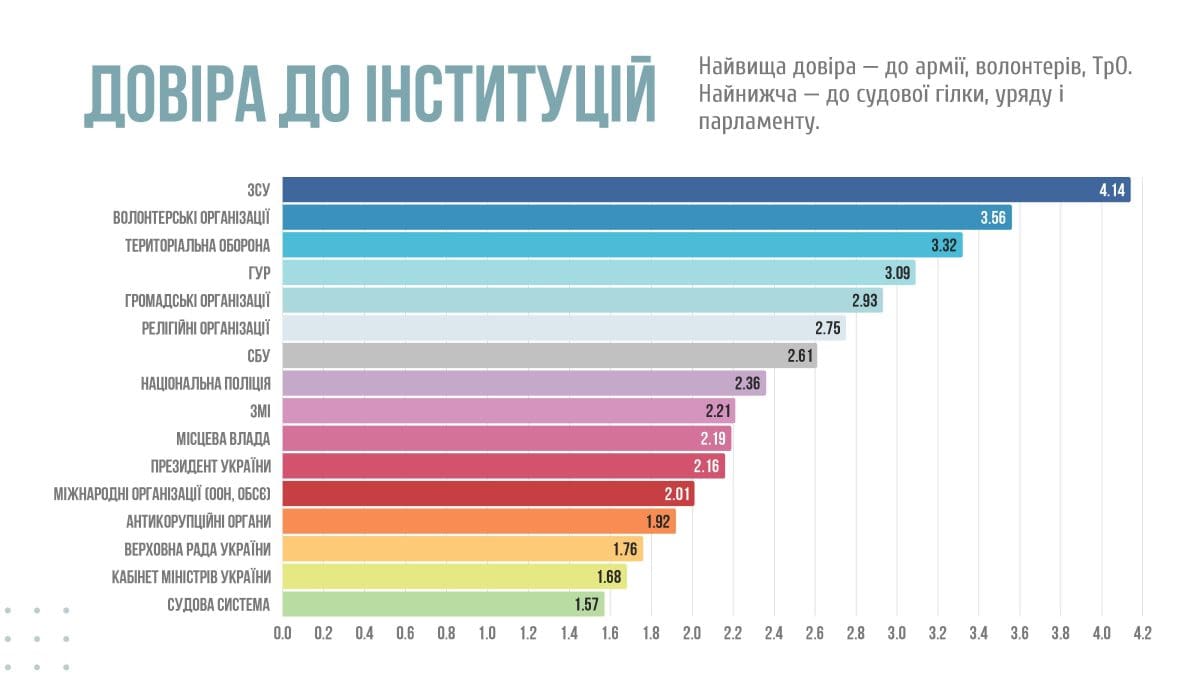
The Cohesion Index is 51.8 out of 100. This means that Ukrainians are still able to act together, but on the verge of losing unity. People have the most trust in their own countrymen, the Armed Forces, and volunteers. The lowest is in the judiciary, parliament and the Cabinet of Ministers.

What unites and what divides?

The respondents noted that Ukrainians are united most of all today:

  • common enemy (67.9%)
  • common goal – victory in the war (59.4%)
  • collective difficulties (40.5%)

Instead, the sources of the greatest tension have become:

  • political disagreements – 61.6%.
  • mobilization – 60.1%.
  • the issue of possible compromises on the war – 55.9%

According to Oleksiy Ivashyn, a veteran and head of the Defense Veterans NGO Oleksiy Ivashyn, the society needs a new agreement on mobilization – fair, rotational, with transparent rules. “Now the sense of injustice is tearing apart even those environments that should be united,” he emphasized.

Trust in Institutions: Army, Volunteers, and… GUR

One of the most interesting parts of the presentation was the assessment of trust in public institutions. The leaders are:

  • Armed Forces of Ukraine (AFU) – average score 4.1 out of 5
  • Volunteer organizations – 3.6
  • Terrorist defense – 3.3
  • The Defence Intelligence of Ukraine ( DIU) – 3.1, which is significantly higher than other state bodies

In particular, trust in the DIU exceeds the level of trust in the SBU (2.6), the National Police (2.4), the Cabinet of Ministers (1.7) and the Verkhovna Rada (1.8). This demonstrates the high credibility of military intelligence in society as an effective and relatively independent player.

Commenting on the highest level of trust in the DIU, experts noted that in a previous study conducted in January 2025 by the InfoLight.UA Research and Analysis Group, DIU special units enjoyed the highest level of trust among those who were ready to voluntarily mobilize into a combat unit.

“Probably, this trust is the result of systematic work, which consists of the best training, support, care for the life of each soldier and, among other things, the desire to be involved in the coolest operations,” said Yuriy Goncharenko, founder of InfoLight.UA Research and Analysis Group.

The lowest scores were given to the judiciary (1.6) and the government, which underscores the deep crisis of legitimacy of some state institutions.

Not illusions, but sobriety

“We should not idealize the situation,” said Yuriy Goncharenko. “Our goal is not to say that everything is fine, but rather to recognize the fractures and find answers to them.”

He emphasized that the results of the study should become the basis for state solidarity policy, as well as for decisions at the level of local communities, volunteer organizations and churches, which are often closer to people than government officials.


The presentation in Truskavets was not just a formal panel, but an attempt to speak honestly about the weaknesses of our cohesion. Ukraine has survived – but maintaining social unity in 2025 is a separate front. And this front requires not heroism, but systemic solutions, fair rules and attention to everyone who is on the verge of emotional exhaustion or social disappointment.

April 30, 2025
FacebookTwitterLinkedinWhatsappTelegramViberEmail
Events.

Roundtable “Network of Responsible Politicians” concludes panel discussion on cohesion at the Carpathian Sea Democracy Week

від Юрій Гончаренко April 29, 2025

Truskavets, April 29, 2025. The resort town, where people usually talk about mineral water and prevention, this time became a platform for a conversation about the social health of Ukraine. Immediately after the in-depth panel discussion “The Current State of Social Cohesion in Ukraine” organized by the NGO “Foundation for Promotion of Democracy”, 14 people gathered in the cozy hotel lobby – without cameras, pathos and protocols – for a roundtable discussion “Network of Responsible Politicians”.

The format was intimate, but the content was strategic. The discussion centered on psychological fatigue, the fragmentation of society, trust in institutions, and the most painful topic of mobilization.

“We should not idealize the situation,” said Yuriy Goncharenko, founder of the InfoLight.UA analytical group, “Society is divided more than we want to admit. But that is why we have to look for honest answers.”

Goncharenko reminded that the Resilience Index, according to the survey, is 64.2 out of 100, which is a lot, but not the same impetus as in 2022.
The Cohesion Index is even lower – 51.8 points, on the verge of “shaken unity.”

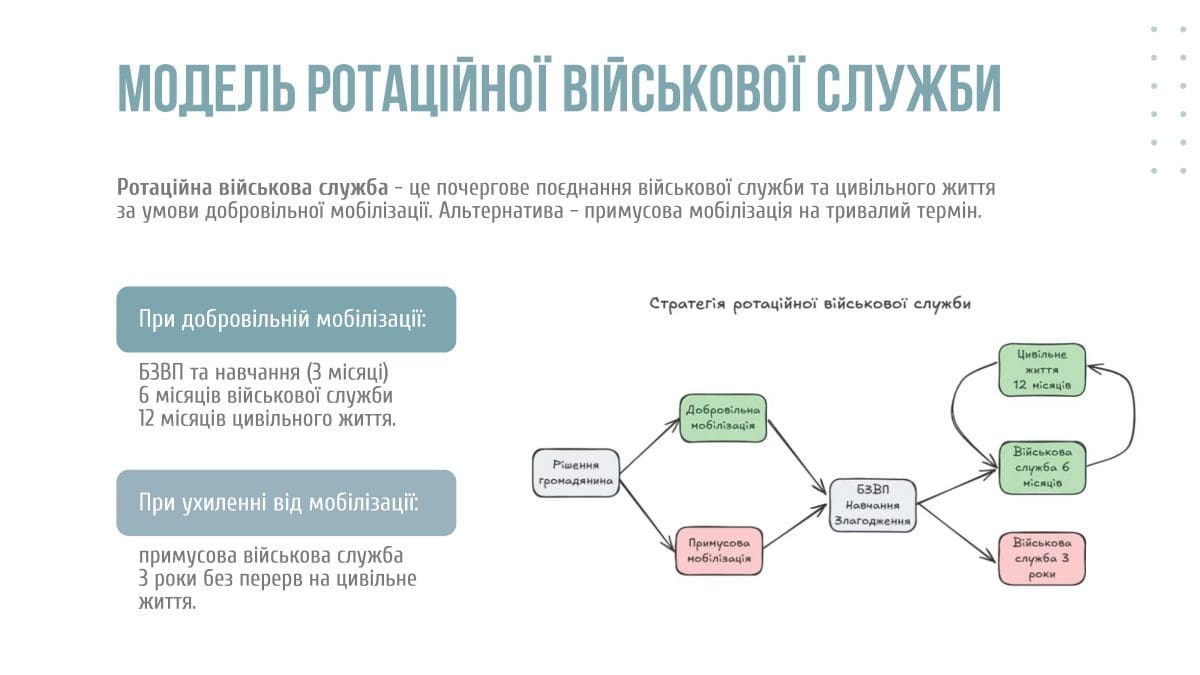
The participants discussed a new “deal of justice”: how to form a modern policy of mobilization that will not cause protest, will not look like coercion, but will become part of a sense of shared responsibility.

Oleksiy Ivashyn, a veteran and head of the Defense Veterans NGO, spoke briefly but clearly:
“The biggest thing that is destroying now is injustice. People are not afraid to serve. People are afraid to be “extreme” while others are sitting on the sidelines. This tears communities apart from the inside.”

In parallel, there was a conversation about trust. Ukrainians trust the Armed Forces, volunteers, and military intelligence the most. The least trusted are the government, parliament, and courts. This is not just sociology, it is a map of legitimacy.

Svitlana Kushnir, a political scientist and media expert, noted that “today, communities, churches and volunteers are what keep trust. But this is a resource that also has limits. And if politicians do not get involved, this resource will simply burn out.”

In conclusion, the moderator noted that the “network of responsible politicians” is not a club of the elite, but an attempt to launch a horizontal platform for those who want not only to win elections, but to be responsible for the unity and sobriety of society.


The conclusion of the day was simple: Ukraine has held out. But holding on is harder than protecting it. And if we do not stitch the country together politically, psychologically and economically now, the gaps will only deepen.

April 29, 2025
FacebookTwitterLinkedinWhatsappTelegramViberEmail
Новіші
Старіші

ВАЖЛИВЕ

Who forms the “hawkish” wing of the US...

January 22, 2026

Stepan Tomashivsky is a conservative who warned of...

December 28, 2025

A Pole who believed in Ukraine earlier than...

December 26, 2025

Being yourself and not pretending: how conservatism is...

December 10, 2025

MAGA as a new ideology of American conservatism

December 7, 2025

UKRAINIAN EXPERTS TALKS’S PODCAST

Новини

  • The Conservative Platform has gathered the best scholars to launch a systematic work on debunking Russian myths

    December 1, 2025
  • Budanov has a sober view of geopolitics and leads an effective team – blogger

    July 3, 2025
  • CDU/CSU leader pays support visit to Kyiv

    December 9, 2024
  • With the help of Russia, the Taliban wants to build an air defense of Afghanistan

    September 11, 2024
  • Americans to deploy Typhon missiles capable of reaching Russia on Japanese islands – media

    September 10, 2024
Назад Вперед

Спротив.News

«
Prev
1
/
213
Next
»
loading
play
Мінуснули три мости за раз! Сили оборони ламають логістику окупантів на ТОТ!
play
Крим переходить у режим ізоляції? Окупанти скасовують масові заходи до 1 вересня!
play
«Гордість, Єдність, Мрія»? Як РФ перетворює День молоді на ТОТ на шоу пропаганди
«
Prev
1
/
213
Next
»
loading

Реалізується ГО Фонд сприяння демократії за підтримки Фонду Ганнса Зайделя в Україні

Copyright © 2017 Фонд сприяння демократії Наші Політика конфіденційності,  Умови використання сайту
Facebook Youtube Telegram Spotify Instagram Linkedin
Консервативна Платформа
  • News
    • Analytics
    • Worldview
    • Anti-imperial front
    • Weapons
    • Geopolitics
  • publication
  • Position.
  • Events.

Shopping Cart

Close

No products in the cart.

Close
  • Українська (Ukrainian)
  • English