Консервативна Платформа
  • News
    • Analytics
    • Worldview
    • Anti-imperial front
    • Weapons
    • Geopolitics
  • publication
  • Position.
  • Events.
Thursday, August 27, 2026
  • English
    • Ukrainian
Консервативна Платформа
  • News
    • Analytics
    • Worldview
    • Anti-imperial front
    • Weapons
    • Geopolitics
  • publication
  • Position.
  • Events.
Консервативна Платформа
  • News
    • Analytics
    • Worldview
    • Anti-imperial front
    • Weapons
    • Geopolitics
  • publication
  • Position.
  • Events.
Copyright 2021 - All Right Reserved
Analytics

Solidarity and Subsidiarity vs. Paternalism: Ukraine’s Renewed Social Policy

від Юрій Гончаренко April 24, 2025

For decades, Ukrainians have lived in a system where the state was presented as an all-powerful and all-knowing patron, capable of solving all problems. The paternalistic culture inherited from the Soviet era has created a paradoxical situation: citizens simultaneously distrust the state and expect it to take care of them. Today, when Ukraine is facing unprecedented challenges of war and post-war reconstruction, this model is demonstrating its ineffectiveness and needs to be radically rethought.

The trap of paternalism: a legacy that hinders development

Paternalism in social policy is manifested in several key aspects. First, it is a centralized approach to the provision of social services, where the state is the main, and often the only, provider of assistance. Second, it is the creation of a complex system of benefits, categorical payments and allowances that often do not take into account the real needs of people. Thirdly, it is the formation of dependence on state aid rather than stimulating independence and initiative.

“Paternalistic systems create dependence and discourage initiative,” the Christian Democratic Expertise analytical note notes. This approach generates a psychology of dependency, when recipients of assistance take it for granted, rather than as temporary support to overcome difficult life circumstances.

The war revealed both the weaknesses and strengths of Ukraine’s social system. On the one hand, state mechanisms often proved to be sluggish in crisis conditions. On the other hand, society has demonstrated a remarkable capacity for self-organization, mutual aid, and volunteerism. This phenomenon indicates the potential for building a fundamentally new model of social policy.

Solidarity: from individualism to shared responsibility

An alternative to paternalism in the Christian democratic tradition is the principle of solidarity. Unlike paternalism, which establishes vertical dependencies, solidarity implies horizontal ties of mutual support between different members and groups of society.

“Solidarity is a response to the temptation of individualism. It is not only about helping those in need, but also about a deep moral attitude to living together, caring, and mutual support,” the analytical materials explain.

The Christian democratic understanding of solidarity is based on several key principles:

  1. Mutual responsibility is the realization that the well-being of each depends on the well-being of all. This applies to the relations between different social groups: rich and poor, young and old generations, healthy and those with disabilities.
  2. Recognition of the dignity of every human being – solidarity is based on respect for the human person, regardless of their status, capabilities or contribution to society.
  3. Active participation – in contrast to passive assistance, solidarity involves the active involvement of everyone in solving common problems according to their capabilities.
  4. Equitable distribution of goods and resources is a principle that requires taking into account the needs of the most vulnerable members of society when allocating limited resources.

The transition from paternalism to solidarity is especially important in the context of Ukraine’s post-war reconstruction, when limited resources must be distributed fairly and all members of society must join forces to overcome common challenges.

Subsidiarity: distribution of responsibility instead of centralization

The second fundamental principle of the Christian democratic approach is subsidiarity. This principle implies that decisions should be made at the lowest possible level, and higher levels of government should intervene only when lower levels cannot effectively solve the problem on their own.

“Subsidiarity ensures that help from above intervenes only when it is impossible to cope from below. This stimulates the initiative of communities, families, churches, and NGOs,” the analytical materials emphasize.

In the context of social policy, subsidiarity means:

  1. Decentralization of social services is the transfer of powers and resources to the level of communities that better understand the needs of their residents.
  2. Diversity of service providers – involvement of not only government agencies, but also public organizations, religious communities, and the private sector.
  3. Support for families as the primary caregiver is a recognition that the family is the first and most important level of social support.
  4. Stimulating self-help and mutual assistance – creating conditions under which people can solve their problems on their own or unite to solve them together.

A vivid example of subsidiarity in action was the volunteer movement during the war. When centralized state mechanisms could not quickly adapt to the crisis conditions, it was civic initiatives, parishes, and local communities that took on a significant part of the work to support the military, internally displaced persons, and vulnerable groups.

Practical implementation: from theory to real change

The transition from a paternalistic to a solidarity model of social policy requires specific steps at different levels:

At the state level:

  1. Reforming the social benefits system – moving from categorical to targeted benefits that take into account the real needs of recipients.
  2. Support for civic initiatives – creation of mechanisms for public funding of social projects implemented by NGOs, religious communities, and volunteer groups.
  3. Development of social entrepreneurship – legislative and tax support for businesses that solve social problems and employ members of vulnerable groups.

At the community level:

  1. Development of resilience centers – creation of comprehensive centers at the community level that combine psychological, social, and legal support and are based on cooperation between government agencies, NGOs, and religious communities.
  2. Neighborhood Mutual Assistance Programs are the organization of systems in which community residents can share services and support the elderly, families with children, and people with disabilities.
  3. Involvement of churches and religious organizations is a recognition of their role as important providers of social services, especially in the area of psychological and spiritual support.

At the level of individuals and families:

  1. Developing a culture of volunteering – encouraging citizens to actively participate in social projects and help their neighbors.
  2. Support for family-based forms of raising orphans – promoting the development of foster families and family-type orphanages instead of institutional care.
  3. Economic independence programs – instead of unconditional cash transfers, emphasis on training, skills development, and support for entrepreneurial initiatives among vulnerable groups.

Special groups: veterans, IDPs, families of the deceased

One of the most striking examples of the need to move from paternalism to solidarity and subsidiarity is the support of groups most affected by the war: veterans, internally displaced persons, and families of the dead.

“These groups should not be ‘beneficiaries of aid’, they should become partners in rebuilding the country,” the analytical materials emphasize.

The traditional paternalistic approach sees these people as passive recipients of assistance to whom the state “provides services.” In contrast, the Christian democratic approach emphasizes their subjectivity, dignity, and potential for active participation in public life.

For veterans, it is important not just to receive benefits or payments, but to be able to reintegrate into civilian life, realize their experience and skills, and be recognized for their contribution to the defense of the country. For IDPs, the key is not just to receive “IDP assistance,” but to become full-fledged members of host communities while maintaining their identity. For the families of the victims, it is not only material support, but also constant recognition of the sacrifice of their loved ones, and the creation of conditions for a decent life and development of children.

The role of the Church: from charity to systemic participation

A special place in the renewed social policy should belong to churches and religious organizations. In the Ukrainian context, they traditionally enjoy a high level of trust and have considerable experience in social service.

The Christian democratic approach involves not only the involvement of churches in charitable activities, but also their systematic participation in the formation and implementation of social policy:

  1. Consultations on social policy – involvement of church representatives in the discussion and development of social development strategies.
  2. Chaplaincy is the development of the chaplaincy institute not only in the military, but also in healthcare, education, and social protection institutions.
  3. Network of parish social centers – support for the initiatives of religious communities to create centers of assistance to various categories of the population.
  4. Interfaith cooperation is the promotion of joint social projects of different faiths to overcome social problems.

Conclusion: from guardianship to partnership

The transition from paternalism to solidarity and subsidiarity is not just a change in the mechanisms of social service delivery. It is a profound transformation of relations between the state, civil society and individual citizens, a shift from the vertical model of “guardian – ward” to a horizontal model of partnership and mutual responsibility.

A fair social policy is not a centralized distribution of benefits, but rather the creation of conditions in which every member of society can realize his or her potential and at the same time support those in need. This is the strength of the Christian democratic approach to the social sphere.

In the context of the challenges faced by modern Ukraine – war, migration, economic hardship, and psychological trauma – this approach allows not only to use limited resources more efficiently, but also to preserve and strengthen human dignity, social ties, and trust, which are the foundation of a sustainable society.

The experience of the war has shown that Ukrainians are capable of extraordinary self-organization and mutual assistance. The task of the renewed social policy is not to replace these initiatives with state control, but to support them, create favorable conditions for them, and integrate them into systemic work to build a just and solidarity society.
April 24, 2025
FacebookTwitterLinkedinWhatsappTelegramViberEmail
Без категорії

Mobilization as a social divide: how to restore moral legitimacy?

від Юрій Гончаренко April 23, 2025

In the third year of the full-scale war, Ukrainian society is facing a paradoxical situation: a phenomenon that should unite the nation against a common enemy is becoming a source of internal tension. Mobilization, which is critically necessary for the defense of the state, is at the same time creating fault lines that weaken the social fabric and undermine moral and psychological resilience.

New reality: from the spirit of 2022 to the fatigue of 2025

At the beginning of the invasion, Ukraine witnessed an unprecedented phenomenon: the voluntary mobilization of tens of thousands of people who came to military recruitment offices to defend their homeland. This spirit of unity created the impression that society had reached a consensus on defense.

But the reality of 2025 is very different. According to a study by the Democracy Action Fund, mobilization has become one of the most polarizing topics. Several key factors explain this change in attitudes:

The duration of the war. The protracted nature of the conflict has led to physical and psychological exhaustion of those at the front.

Unfair distribution of the burden. Some men have been at the front without rotation for more than a year, while others have never been mobilized or are deliberately evading.

Blurred understanding of the “justice of war”. Over time, the public consensus on how responsibility for the defense of the country should be distributed is weakening.

Justice as a basis for legitimacy

The Christian democratic perspective emphasizes a fundamental principle: the moral legitimacy of the state suffers if its policies are perceived as unfair or selective. This is particularly acute in matters related to life and death.

“A deep sense of social injustice is the main emotional root of the divisions,” the analytical materials emphasize. When some citizens see others finding ways to avoid mobilization through corruption, connections, or traveling abroad, it destroys the very essence of the social contract of common defense.

The current situation is complicated by the fact that there is no transparent and understandable system that would guarantee a fair distribution of military responsibilities. This creates a feeling that “some are fighting the war” while others are “evading or living like they are living until 2022.”

Psychological consequences of unfair mobilization

The problem takes on not only an ethical but also a practical dimension when it comes to the psychological state of society. According to research, the level of anxiety in Ukrainian society reaches 5.8 points out of 10.

Among the key factors of this anxiety:

  • Fear for the fate of loved ones at the front
  • Feeling helpless before the mobilization system
  • Disbelief in the fairness of state institutions
  • Disappointment with the impunity of corruption in the mobilization sector

“In times of war, emotional resilience is not a private matter for a psychologist, but a strategic factor of national security,” experts say.

It is important to understand that psychological fatigue from war is exacerbated by a sense of injustice. When a person sees that the duty to defend the country is unevenly distributed, it undermines their motivation and willingness to endure the restrictions of wartime.

Social consent as the basis of mobilization policy

The Christian democratic vision emphasizes that mobilization should reflect public agreement on how the country is defended. This means the need for a constant dialogue between the state and citizens, transparency in decision-making, and the involvement of different segments of society in discussing mobilization policy.

Key elements of this approach:

Transparency of mobilization criteria. Society must clearly understand the rules of conscription, who gets a deferment and why, and how long the service lasts.

Public reporting. Regular information on the status of mobilization, the number of recruits, rotations, and service conditions.

Public control. Involve representatives of civil society, including veterans’ organizations, in monitoring mobilization processes.

Social dialog. Continuous discussion with different groups of society on issues related to mobilization, taking into account their needs and concerns.

The role of communities in supporting the mobilized

Another important aspect emphasized by the Christian democratic approach is the role of local communities in supporting those mobilized and their families. Mobilization is not only a relationship between the state and an individual citizen, but also a matter of solidarity at the community level.

“In the Christian democratic approach, the community is not only a territorial subject of self-government, but also a moral and social unit of solidarity,” the analytical materials note.

An effective model of such support includes:

  • Establishment of community-based support centers for military families
  • Adaptation programs for veterans returning from the frontline
  • Systematic psychological assistance for both the military and their families
  • Mechanisms for rapid response to the urgent needs of mobilized families

It is through this multi-level support that mobilization can become not only a legislative compulsion but also a manifestation of public solidarity.

Restoring moral legitimacy: concrete steps

Summarizing the Christian democratic approach to solving the problem of the split around mobilization, several key recommendations can be identified:

  1. Implementation of a rotational model. A clear system in which every man of military age performs military service on a rotational basis, with guaranteed terms of both service and civilian life.
  2. Strengthening the fight against corruption in military enlistment offices. The inevitability of punishment for selling “white tickets” or illegal evasion of service.
  3. Differentiated approach to different categories of citizens. Consideration of professional skills, marital status, and health status when determining the nature of service.
  4. Transparent communication. Constantly informing the public about the status of mobilization, dispelling myths and fears.
  5. Decent conditions for military personnel. Ensuring the proper level of equipment, training, medical care and rehabilitation.
  6. Involvement of religious communities. Use of the moral authority of churches to form an ethic of shared responsibility for the defense of the country.
  7. Psychological support. Create a system of psychological support for both military personnel and civilians.

Conclusion: from split to solidarity

The moral legitimacy of mobilization is not an abstract concept, but a concrete factor that determines the ability of a society to withstand external aggression. When citizens perceive the mobilization policy as fair, they are ready to endure the restrictions and trials associated with war.

The Christian democratic approach suggests rethinking mobilization not as an instrument of pressure or coercion, but as a manifestation of mutual responsibility to the community. This means moving from a system where some “chosen ones” bear the burden and others avoid it to a model where everyone contributes according to their capabilities.

In this model, mobilization ceases to be a source of social division and becomes a manifestation of national solidarity. This is not only an ethically correct approach, but also a practically effective one, because an army formed on the basis of justice and voluntary consent is always stronger than an army gathered through coercion.

Restoring the moral legitimacy of mobilization is not just a task for the military leadership, but a national priority that requires the efforts of the entire society: from political leaders to religious communities, from civil society to every citizen. Only such a comprehensive approach will allow turning a potential fault line into a source of unity and strength.

April 23, 2025
FacebookTwitterLinkedinWhatsappTelegramViberEmail
Analytics

Social cohesion in time of war: moral strategy and national resource

від Юрій Гончаренко April 17, 2025

After two years of full-scale war, Ukraine is facing not only military but also social challenges. The unique phenomenon of national cohesion, which became one of the decisive factors of resistance in the first months of the invasion, is undergoing natural erosion. How to preserve this invisible but critical resource of national resilience?

Explosion of unity: a phenomenon of 2022

February 2022 revealed to the world not only the horrors of Russian aggression, but also the unprecedented ability of Ukrainians to organize and solidarize. Tens of thousands of volunteers, the activation of parishes, and the instant mobilization of civil society all created a rear that became a support for the front.

“This phenomenon can be seen as a manifestation of the deep social solidarity that is part of Ukrainian identity, but often remained hidden in peacetime,” the analysts note. The invasion activated a collective defense mechanism, which manifested itself in unprecedented mutual assistance and the revival of traditions of mutual support.

According to sociologists, 2022 was the year when trust in institutions, the army, volunteers, and communities peaked. Against the backdrop of an existential threat, society spontaneously developed the mechanisms of unity that would otherwise have required years of conscious effort.

Challenges for 2024-2025: fatigue, fragmentation, distrust

Today, the situation is changing. According to the analysis of the Democracy Assistance Foundation (2025), since the beginning of 2024, there has been a noticeable decline in the level of social cohesion. The social cohesion index is only 51.8 out of 100 points, and it is trending downward.

What are the main factors behind this decline?

Social fatigue. People are morally exhausted, and anxiety levels are rising (anxiety index is 5.8 out of 10). Constant anxiety, uncertainty about the future, and economic problems all undermine psychological resilience.

Problems of mobilization. There is a sense of unfair distribution of responsibilities: some have been at the front for more than a year without rotation, while others have never been mobilized or are evading. This situation gives rise to moral dilemmas and social splits.

Political tension. Elections, discussions about the terms of peace, and the lack of a unified strategy all exacerbate the difference in vision of the future.

Decreased interpersonal trust. One of the most disturbing symptoms is that people trust each other less, which undermines the very foundation of the social fabric.

Christian democratic response: solidarity as a moral imperative

In such circumstances, the Christian democratic approach offers a response that goes beyond technocratic crisis management. It sees cohesion not as a unity imposed from above, but as the result of a conscious choice by citizens who recognize a common destiny and responsibility.

“In the Christian tradition, cohesion is not only a political task, but an ethical requirement: to build bridges, not walls; to listen to other groups, not to muffle their pain; to support the weak not out of pity, but out of respect for their dignity,” explains the social policy expert.

This perspective allows us to see divisions not just as sociological facts, but as moral challenges that require not only technocratic solutions, but also an ethical response based on the principles of solidarity, subsidiarity, and the common good.

Inequality as a threat to national unity

One of the main threats to cohesion is inequality, especially in times of war. Although social mobilization smoothed out inequalities in 2022-2023, they are now resurfacing:

  • Economic inequality: some have lost everything, while others have become demonstrably rich.
  • Inequality of access to resources: treatment, psychological support, evacuation are not equally available to everyone.
  • A gap in the sense of justice: there is a massive feeling that “some are fighting the war” and others are evading it.

A deep sense of social injustice becomes the emotional root of divisions. This is especially dangerous in times of war, when fair burden-sharing becomes not just an economic issue, but an existential one.

A strategy for preserving unity: from emotions to institutions

The Christian democratic approach offers concrete steps to preserve social cohesion:

Recognize cohesion as a strategic goal of state policy. Social cohesion should be prioritized alongside defense and the economy. It is proposed to include the social cohesion index in regular monitoring, to introduce a national cohesion program, and to create a social cohesion group at the NSDC as an analytical and strategic center.

Create a network of community-based resilience centers. These centers should combine the work of psychologists, chaplains, and social workers to provide comprehensive support to people. It is especially important that they function on the basis of cooperation between the state, community, church, and NGOs.

Fair mobilization through a rotational model. The system, under which most men serve in rotation, with limited periods of continuous service at the front, is perceived as fair and humane. “Mobilization should stop being a lottery and become a duty that does not degrade dignity,” the experts emphasize.

Rethink the support for veterans, IDPs, and families of the victims. These groups should not just be “beneficiaries of aid” – they should become partners in rebuilding the country. It is proposed to reform the system of veterans’ services, introduce lifetime status for the family of the deceased, and develop integration programs for IDPs with a focus on employment and participation in community life.

Define the role of the church as a partner in strengthening the social fabric. Churches and religious communities have the trust, infrastructure, credibility and experience to serve. They can be included in consultations on cohesion policy, veterans’ reintegration programs, and work with families of the deceased.

Community as an environment of solidarity

Particular emphasis is placed on the role of the community – not just as an administrative unit, but as a moral and social environment of mutual assistance.

“In the Christian democratic approach, the community is not only a territorial subject of self-government, but also a moral and social unit of solidarity,” explains the local government expert.

It is the community that first meets internally displaced persons, becomes a source of support for the families of the victims, restores social ties and builds an infrastructure of psychological resilience. The principle of subsidiarity implies that problems are best solved at the lowest possible level, and only when they exceed the capabilities of this level should higher authorities be involved.

The ethics of trust: restoring meaning to institutions

Sociological studies show that today only the Armed Forces enjoy a high level of trust, while most state institutions are at the bottom of the trust scale. The Christian democratic approach emphasizes that institutions should serve people, not dominate them.

To restore trust, it is necessary:

  • Ethical leadership – examples of morally motivated actions in government
  • Transparency and participation – public control, budget openness
  • “Human face of the state” – social workers, judges, educators should not be “officials” but people who care

“Only institutions that care can support the nation in a crisis,” the analysts conclude.

From fragmentation to a common path

Rifts in society cannot be hidden – they must be openly recognized, diagnosed and treated. This can be done through fair and transparent mobilization, decent treatment of veterans and families of the fallen, systematic work with anxiety and emotional exhaustion, restoring trust in institutions, and supporting local communities as the basis of unity.

Ukrainian society has retained in its depths a moral resource that dictatorships do not have: faith in man, trust in one’s neighbor, and willingness to serve. It is these virtues that should be elevated to the level of politics-not cynicism, but responsibility; not control, but trust; not fear, but hope.

In times of trial, the fundamental Christian values of faith in human dignity, hope for revival, and love for one’s neighbor can become not only personal guidelines but also a national strategy that inspires and guides society in its most difficult times.

April 17, 2025
FacebookTwitterLinkedinWhatsappTelegramViberEmail
Internal front

To distort Budanov is to play against Ukraine – Reiterovich (VIDEO)

від Юрій Гончаренко April 15, 2025

Political analyst Ihor Reiterovych criticized journalists and bloggers who distort the statements of the Chief of the Main Intelligence Directorate Kirill Budanov. According to him, this plays into the hands of the enemy.

During the program “Zrada & Peremoha” with political analyst Svitlana Kushnir on the socio-political platform “Intervisor”, political scientist, PhD in Political Science Ihor Reiterovych said that some media outlets deliberately take Budanov’s words out of context and distort them in a way that is harmful to Ukraine.

“It’s time to realize, perhaps in the fourth year of the war, that many of the things he says have a component related to his direct activities,” the expert said.

Reiterovich explained that Budanov is neither a politician nor a typical military officer, but a figure fulfilling a complex mission in the information war against Russia. That is why his public statements should be treated strategically, and not just picked out for hype or manipulation.

“He is fulfilling his task, including the ISDS against Russia… So you can comment, but you can’t openly distort it and then use it against Ukraine…” Reiterovich added.

April 15, 2025
FacebookTwitterLinkedinWhatsappTelegramViberEmail
Ukraine

Expert: Zaluzhnyi and Budanov are perceived as opposition, not part of the ruling team

від Юрій Гончаренко April 14, 2025

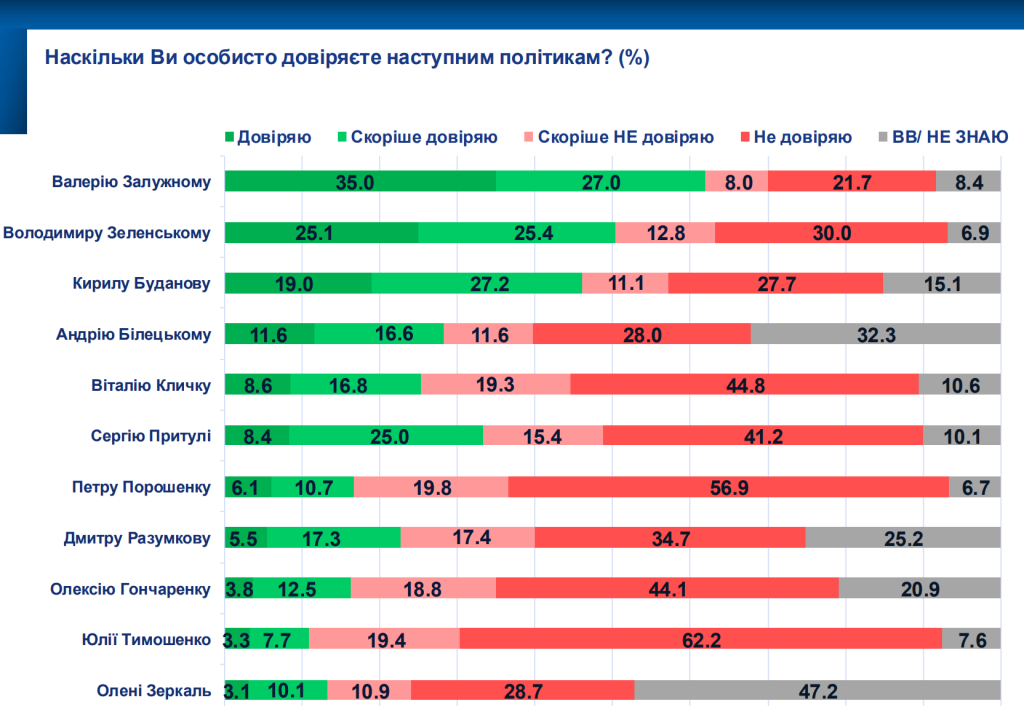
The military officers with the highest public trust ratings – former Armed Forces Commander-in-Chief Valeriy Zaluzhnyi (now Ambassador to the UK) and Chief of the Defence Intelligence Service Kyrylo Budanov – are not currently seen as part of the ruling team. On the contrary, according to recent opinion polls, they are perceived as opposition figures.

This was stated by Roman Romaniuk, a political commentator at Ukrayinska Pravda, in a new episode of the UP-2 podcast.

“Kirill Budanov and Valery Zaluzhny could potentially be certain pillars of a conventional new ruling party. But if you look at the polls now, both are perceived as opposition figures rather than pro-government,” Romaniuk said.

The analyst emphasized that there is currently no evidence that Zaluzhnyi or Budanov are or plan to become members of the political team of current President Volodymyr Zelenskyi.

According to Romanyuk, the overall picture of the upcoming elections in Ukraine will depend on who emerges as “national heroes.”

“Bankova does not currently have any military officers who could be included in the top ten of Zelensky’s party and who would bring electoral support. Those who appear in the ratings today are not part of the ruling team,” the expert stated.

April 14, 2025
FacebookTwitterLinkedinWhatsappTelegramViberEmail
World

“If anyone can destroy the Crimean Bridge, it is Ukraine”: US Lieutenant General supports Budanov’s actions

від Юрій Гончаренко April 11, 2025

The Crimean bridge is the line that, according to retired U.S. Lieutenant General Ben Hodges, Ukraine is fully capable of crossing. It is not about crossing, it is about destruction. And not just partial destruction, but one after which no one will use the bridge again. The former commander of the U.S. Army in Europe believes that it is a matter of time – and Kirill Budanov’s decision.

Speaking to Radio Liberty, Hodges did not hide his conviction that Ukraine’s GUR chief knows what he is doing. “I would say that General Budanov will do so when he is ready,” he said, commenting on the possibility of a new strike on the Crimean bridge.

Hodges’ position has been unchanged for years: Crimea is the key to ending the war. Russia has been holding on to the peninsula since 2014, since its illegal annexation. The general believes that Crimea is the most important foothold for the Kremlin, and losing it would mean defeat.

“The key to Crimea is isolation first. And this, of course, means that we need to disable the bridge and cut off land access,” the former commander said. According to him, this is the only way to deprive Russia of control over the peninsula.

But this is not an easy task. The Crimean bridge is a monster that cannot be taken by a missile or a drone. “This is a huge bridge. It is huge. You can’t destroy it in one blow,” Hodges emphasized. Complete destruction requires not only powerful explosives, but also a competent strategy.

He also noted that the Russians understand this. There is a whole defense system around the bridge. And yet, history knows many cases where protected objects have fallen. With determination and skill.

“And I think that if anyone in the world can do it, it will be Ukraine. They will do it when the time is right. And they have everything ready,” Hodges summarized.

In early April, Oleksiy Neizhpapa, commander of the Ukrainian Navy, also confirmed that despite the complexity, the Crimean bridge remains one of the priority goals of Ukrainian forces.

Well, given the words of the American general and the confidence of the Ukrainian command, the only question is when this reinforced concrete artery of the Russian army will become history.

April 11, 2025
FacebookTwitterLinkedinWhatsappTelegramViberEmail
Ukraine

What is the alternative to populism? Analysts gave an answer based on European experience

від Юрій Гончаренко April 9, 2025

Ukraine presented a set of solutions to counter populism in a conservative environment. Analysts have developed practical recommendations for the economy, security, information policy, and local government. The documents analyze the advantages of an ideology based on European traditions as an alternative to radical populist approaches.

With the support of the Hanns Seidel Foundation, the NGO Democracy Now has developed a series of policy briefs that offer a balanced view of the current challenges posed by the rise of populist forces. The documents were created as part of the Conservative Platform project.

“Our goal is to offer an alternative to radical populism, which is often disguised under conservative slogans. Christian democracy has a strong intellectual and practical tradition in Europe and can become an important reference point for Ukraine on its path to European integration,”said project manager Yuriy Honcharenko.

It is noted that the documents can be used by any political forces, public organizations and expert groups that share basic democratic values. They have been have been published on the official website of the “of the Conservative Platform..

On April 9, the content of the policy briefs was discussed during an online meeting of the Ukrainian Security Club. Based on the results of the discussion, the documents were submitted to the UBC expert groups for further processing.

April 9, 2025
FacebookTwitterLinkedinWhatsappTelegramViberEmail
Ukraine

Policy briefs on Christian democracy as an alternative to populism presented in Ukraine

від Юрій Гончаренко April 9, 2025

Kyiv, April 9, 2025 – A comprehensive set of ready-to-implement solutions and practical recommendations for countering populism in a conservative environment has been presented in Ukraine. The policy briefs, based on the principles of Christian democracy, offer concrete mechanisms for addressing pressing issues in the areas of economy, security, information policy, and local government in the face of growing populist sentiment.

The NGO “Foundation for the Promotion of Democracy ” with the support of the Hanns Seidel Foundation in Ukraine has developed a series of policy briefs within the framework of the Conservative Platform project, which offer a balanced view of the current challenges associated with the rise of populist forces in the conservative environment.

The presented documents analyze in detail the advantages of Christian democracy as a modern ideology and provide practical recommendations for the implementation of its key principles in the Ukrainian reality. The policy briefs cover a wide range of issues from economic policy and local government development to information security and national identity.

“Our goal is to offer an alternative to radical populism, which is often disguised under conservative slogans. Christian democracy has a strong intellectual and practical tradition in Europe and can become an important reference point for Ukraine on the path to European integration,” – said Yuriy Honcharenko, project manager, during the presentation of the materials.

The project’s peculiarity is its non-partisan nature. The developed policy briefs can be used by any political forces, NGOs, and expert communities that share basic democratic values. That is why all documents are published for public discussion on the official website of the Conservative Platform project.

Today, on April 9, the content of the policy briefs was discussed during an online meeting of the Ukrainian Security Club, where participants highly appreciated the depth and practical value of the materials presented. Following the discussion, the documents were submitted to the club’s expert groups for further elaboration.

“These materials lay the foundation for the formation of a balanced conservative policy that takes into account both European experience and Ukrainian specifics. The emphasis on the practical aspects of implementing the principles of subsidiarity, solidarity and responsibility in various spheres of public life is particularly valuable.” – commented one of the participants of the discussion.

A public presentation of the finalized documents is scheduled for the end of April 2025. The organizers plan to involve a wide range of experts, representatives of civil society organizations and political forces in the discussion to build consensus on ways to reform key areas of public life based on democratic values.

April 9, 2025
FacebookTwitterLinkedinWhatsappTelegramViberEmail
Important

Dignity versus formalism: what is wrong with the reform of the ICEC in Ukraine

від Юрій Гончаренко April 7, 2025

April 7 is World Health Day. This should be a day when society speaks about the right of every person to life, support and respect. However, in Ukraine, this day is marked by deep anxiety: the reform of the medical and social expertise (MSEC) system, which was supposed to be a step towards modernization and transparency, has actually exacerbated the crisis of access to fair care for people with disabilities.

This is not just an administrative problem, but a violation of basic rights and humanitarian principles. When people in need of assistance find themselves in a situation where formal procedures and bureaucratic confusion displace a person as a living being, this is evidence of a deep systemic error.

The reform introduced the so-called “everyday assessment,” but in practice it has resulted in an even more impersonal process. Submission of documents has become a labyrinth without a way out: patients are “shuffled” between family doctors and narrow specialists, creating a vicious circle that can often only be overcome by corrupt “arrangements.” The assessment itself takes place in a matter of minutes, formally, often with decisions that appear to have been made in advance.

One of the main abuses is the lack of unified criteria for assessing many diseases, which opens the door to manipulation. Formally, there may be a diagnosis, but no disability is established. In cases of serious illnesses such as oncology, the assessment does not take into account the general condition of the body after treatment: the effects of chemotherapy, surgery, lack of rehabilitation – all this is ignored.

The reform has also failed to ensure effective digitalization: submission of documents in electronic form is often impossible, and an extract from a commission’s decision in electronic format is not recognized as valid in most cases. This creates additional barriers to receiving benefits, such as free transportation or access to social programs.

Among the most worrisome signs is the widespread belief that the reform is being used to covertly reduce the number of people with a documented disability. This may be due to both economic factors (increased costs due to the war) and an attempt to reduce the burden on the support system. However, an approach that prioritizes cost savings over support for those who have experienced trauma, illness, or are in a state of need of care is an alarming signal for the entire state.

The main problem is formalism. The main thing is lost: the consideration of a person as a holistic person who has the right to support not according to abstract codes, but according to the real functional state. Instead of promoting recovery and rehabilitation, the system pushes people to despair, leaving them alone with illness, trauma, and injustice.

Society has the right to demand:

  • Suspend Resolution No. 1338 until the identified problems are resolved.
  • Automatic prolongation of disability for those who were to be reassessed in 2025.
  • Introduce a clear, understandable and impartial procedure for submitting documents.
  • Obligation of primary care physicians to issue referrals, even if specialists refuse.
  • Prohibitions on access to documents without the presence of the person being evaluated.
  • Video recording of all decisions with mandatory justification and the right to receive a copy of the recording.
  • Public declaration of income and property of all members of the commissions.
  • Unification of evaluation criteria with public discussion and participation of specialized communities.

And most importantly, it is necessary to restore the principle of considering each person in their full context: as a person who has lost the ability to live a normal life. Only then can the system be not only effective but also fair. Only then will we be able to talk about a society that truly respects its citizens.

Protecting the rights of people with disabilities

April 7, 2025
FacebookTwitterLinkedinWhatsappTelegramViberEmail
Ukraine

Budanov can decide the fate of the upcoming elections – poll results

від Юрій Гончаренко April 3, 2025

According to the results of the March survey “General Situation in Ukraine. Barometer, March 2025”, Ukrainians trust three people the most: Valeriy Zaluzhnyi (62%), Volodymyr Zelenskyi (50.5%), and Kyrylo Budanov (46.2%).

The Poshtary analytical team analyzed this situation and found that the head of the Defence Intelligence of Ukraine could play a decisive role in the upcoming presidential race.

Political scientists note that in times of war, public trust is concentrated around the military leadership. At the same time, Budanov’s unique position makes him a potentially influential player.

“Kyrylo Budanov remains somewhat in the shadows, with indicators close to the other two leaders of trust. He is also quite public, and has even better electoral positions, if only because it will be difficult to blame him for miscalculations and defeats at the front, unlike Zaluzhnyi,” political analyst Oleksandr Kochetkov writes on his page.

According to experts, amid the fierce competition between Zelenskyy and Zaluzhnyy, Budanov’s position could be decisive. “Budanov has much greater opportunities to enter top politics on his own and to block with some political figures and political forces,” – Kochetkov said.

It is worth noting that the politicians of the “old formation” demonstrate record low levels of trust: the overall level of distrust in Yulia Tymoshenko is 81.6%, and in Petro Poroshenko – 76.7%.

Source: Business Capital

April 3, 2025
FacebookTwitterLinkedinWhatsappTelegramViberEmail
Новіші
Старіші

ВАЖЛИВЕ

Who forms the “hawkish” wing of the US...

January 22, 2026

Stepan Tomashivsky is a conservative who warned of...

December 28, 2025

A Pole who believed in Ukraine earlier than...

December 26, 2025

Being yourself and not pretending: how conservatism is...

December 10, 2025

MAGA as a new ideology of American conservatism

December 7, 2025

UKRAINIAN EXPERTS TALKS’S PODCAST

Новини

  • The Conservative Platform has gathered the best scholars to launch a systematic work on debunking Russian myths

    December 1, 2025
  • Budanov has a sober view of geopolitics and leads an effective team – blogger

    July 3, 2025
  • CDU/CSU leader pays support visit to Kyiv

    December 9, 2024
  • With the help of Russia, the Taliban wants to build an air defense of Afghanistan

    September 11, 2024
  • Americans to deploy Typhon missiles capable of reaching Russia on Japanese islands – media

    September 10, 2024
Назад Вперед

Спротив.News

«
Prev
1
/
213
Next
»
loading
play
Мінуснули три мости за раз! Сили оборони ламають логістику окупантів на ТОТ!
play
Крим переходить у режим ізоляції? Окупанти скасовують масові заходи до 1 вересня!
play
«Гордість, Єдність, Мрія»? Як РФ перетворює День молоді на ТОТ на шоу пропаганди
«
Prev
1
/
213
Next
»
loading

Реалізується ГО Фонд сприяння демократії за підтримки Фонду Ганнса Зайделя в Україні

Copyright © 2017 Фонд сприяння демократії Наші Політика конфіденційності,  Умови використання сайту
Facebook Youtube Telegram Spotify Instagram Linkedin
Консервативна Платформа
  • News
    • Analytics
    • Worldview
    • Anti-imperial front
    • Weapons
    • Geopolitics
  • publication
  • Position.
  • Events.

Shopping Cart

Close

No products in the cart.

Close
  • Українська (Ukrainian)
  • English